
Roundabouts in America: Rules, Yield Logic, and Why Many Drivers Get Them Wrong

Key Takeaways
How Roundabout Right-of-Way Actually Works
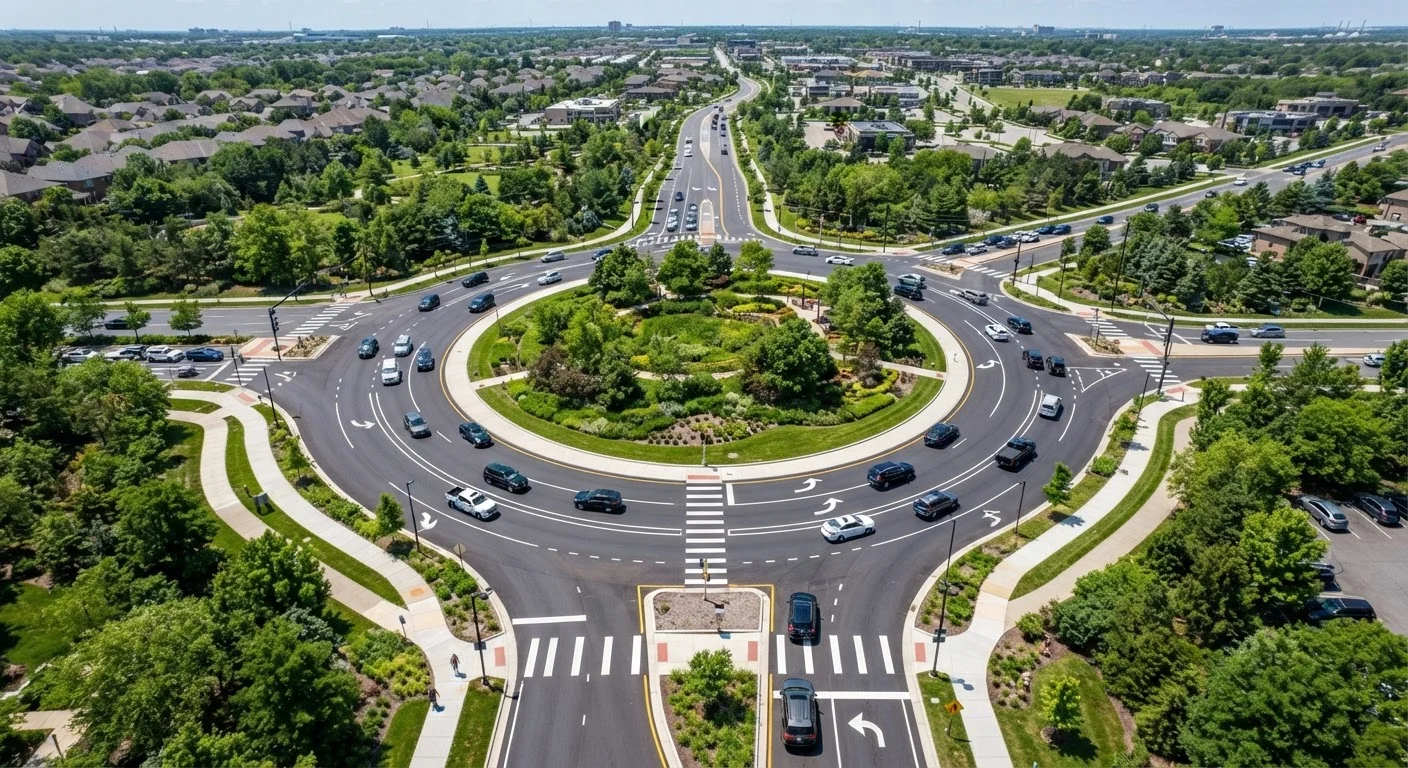
A roundabout is a one-way circular intersection where traffic flows counterclockwise around a central island. Unlike a traditional signalized intersection, no traffic light arbitrates who goes when - the yield sign does. Every driver entering the roundabout must give way to vehicles already circulating inside. This single rule governs nearly every interaction that takes place at a roundabout, and misunderstanding it is the root cause of most roundabout incidents.
The design's safety advantage is structural: because all vehicles travel in the same direction at low speed, head-on and high-speed T-bone collisions - the deadliest crash types at conventional intersections - are essentially eliminated. Conflict points are reduced significantly compared to a standard four-way intersection. But the design only delivers those benefits when drivers respect the yield logic consistently.
82%
Reduction in serious injury crashes
The Federal Highway Administration reports that roundabouts reduce serious injury crashes by approximately 82% compared to conventional signalized intersections.
~7,000
Roundabouts operating in the U.S.
The U.S. has seen steady roundabout growth over the past two decades, though adoption remains far lower than in the United Kingdom or Australia.
For drivers more comfortable with stop signs and traffic lights, roundabouts feel counterintuitive. There's no red light to tell you when to stop, no green light to tell you when it's safe. You must judge the gap yourself. That active judgment is exactly where most errors enter the picture. See our complete guide to safe driving in America for a broader look at how right-of-way principles apply across different road types.
The Most Common Roundabout Mistakes - and How to Correct Them
The errors below account for the majority of roundabout conflicts reported by traffic engineers and law enforcement. They are not random - they follow predictable patterns tied to unfamiliarity and habit carried over from conventional intersections.
Failing to yield to circulating traffic at the entry point.
Why it happens: Many drivers treat the roundabout entry like a four-way stop, assuming they have equal right of way or that it's their 'turn' to go.
Choosing the wrong lane before entering a multi-lane roundabout.
Why it happens: Drivers focus on navigating the circle itself rather than planning their exit in advance, leading to last-second lane changes.
Changing lanes while inside the roundabout.
Why it happens: Realizing mid-circle that the wrong lane was chosen, drivers attempt to correct by drifting or cutting across.
Stopping unnecessarily at the entry yield line when traffic is clear.
Why it happens: Unfamiliarity with roundabouts breeds hesitation. Drivers default to a full stop out of caution, even when no vehicles are present in the circle.
Failing to signal before exiting the roundabout.
Why it happens: Drivers concentrate on steering through the circle and forget that exiting requires a right-turn signal, just like any other turn.
Ignoring pedestrian crosswalks on the approach and exit legs.
Why it happens: Attention is directed inward toward circulating traffic, causing drivers to overlook the marked crosswalks just outside the circle.
Yield Does Not Mean Stop
The yield sign at a roundabout entry means slow down and merge when safe - not come to a complete stop unless traffic prevents entry. Stopping unnecessarily disrupts flow and can trigger rear-end collisions from drivers behind who expect you to merge. Treat the yield the same way you would a freeway on-ramp: match the gap, not a full stop.
Multi-lane roundabouts introduce additional complexity. Lane discipline before entry is critical: your lane choice at the yield line locks in your available exit options. Drivers who delay this decision and attempt mid-circle corrections are responsible for a disproportionate share of sideswipe incidents. Navigating dense intersections of any kind demands the same advance planning - a concept explored further in our article on highway vs. city driving skills.
Never Stop or Reverse Inside the Circle
If you miss your exit, do not stop, reverse, or cut across lanes. Continue around the roundabout and exit on your next pass. Stopping mid-circle or attempting to back up creates an immediate collision hazard for circulating vehicles that cannot anticipate your movement.
Pedestrians and cyclists deserve specific attention. Roundabout crosswalks are intentionally set back from the circle's edge, but the exit leg still requires active scanning. A driver focused on re-entering traffic after exiting may fail to check the crosswalk before accelerating - a mistake that puts vulnerable road users at direct risk. Just as reduced-speed zones carry legal obligations, roundabout crosswalk rules are enforceable; yielding to pedestrians there is required by law in most states.
Building Confidence at Roundabouts
Confidence at a roundabout comes from repetition and a clear mental model, not from speed. Approach every roundabout with the same sequence: slow and scan as you reach the splitter island, identify your intended exit, select the correct lane, yield to circulating traffic, merge smoothly, signal your exit, and yield to pedestrians as you leave. That sequence, practiced consistently, eliminates the hesitation that produces most errors.
If you're a newer driver who encounters roundabouts infrequently, it helps to practice the approach in lower-traffic conditions - early morning or quieter suburban locations - before navigating a busy multi-lane version. Our guidance on what new drivers should know before highway driving applies a similar principle: build the skill incrementally in lower-stakes environments first.
Roundabouts are not inherently difficult. They are simply different from what most American drivers learned on. Understanding the yield logic clearly, selecting your lane early, and committing to a smooth, consistent path through the circle puts you well ahead of the drivers who make roundabouts more hazardous than they need to be.