

Key Takeaways
Our Verdict
For most consumers outside dense urban centers, 4G LTE plans continue to deliver reliable, practical performance for everyday tasks. 5G offers meaningful advantages in specific locations and use cases - particularly heavy streaming, mobile gaming, and fixed wireless home internet - but the upgrade's value depends entirely on your device, carrier's spectrum holdings, and where you spend your time. Neither network generation is universally superior; the right choice depends on your actual usage patterns and coverage reality.
| Best for | Recommended |
|---|---|
| Urban residents who frequently stream HD video or game on mobile | 5G Plan (mid-band or mmWave coverage areas) |
| Rural or suburban users with limited 5G coverage | 4G LTE Plan |
| Budget-conscious users with moderate data needs | 4G LTE Plan |
| Future-proofing with a new 5G-compatible device | 5G Plan (if coverage maps confirm mid-band access) |
The Marketing vs. the Reality
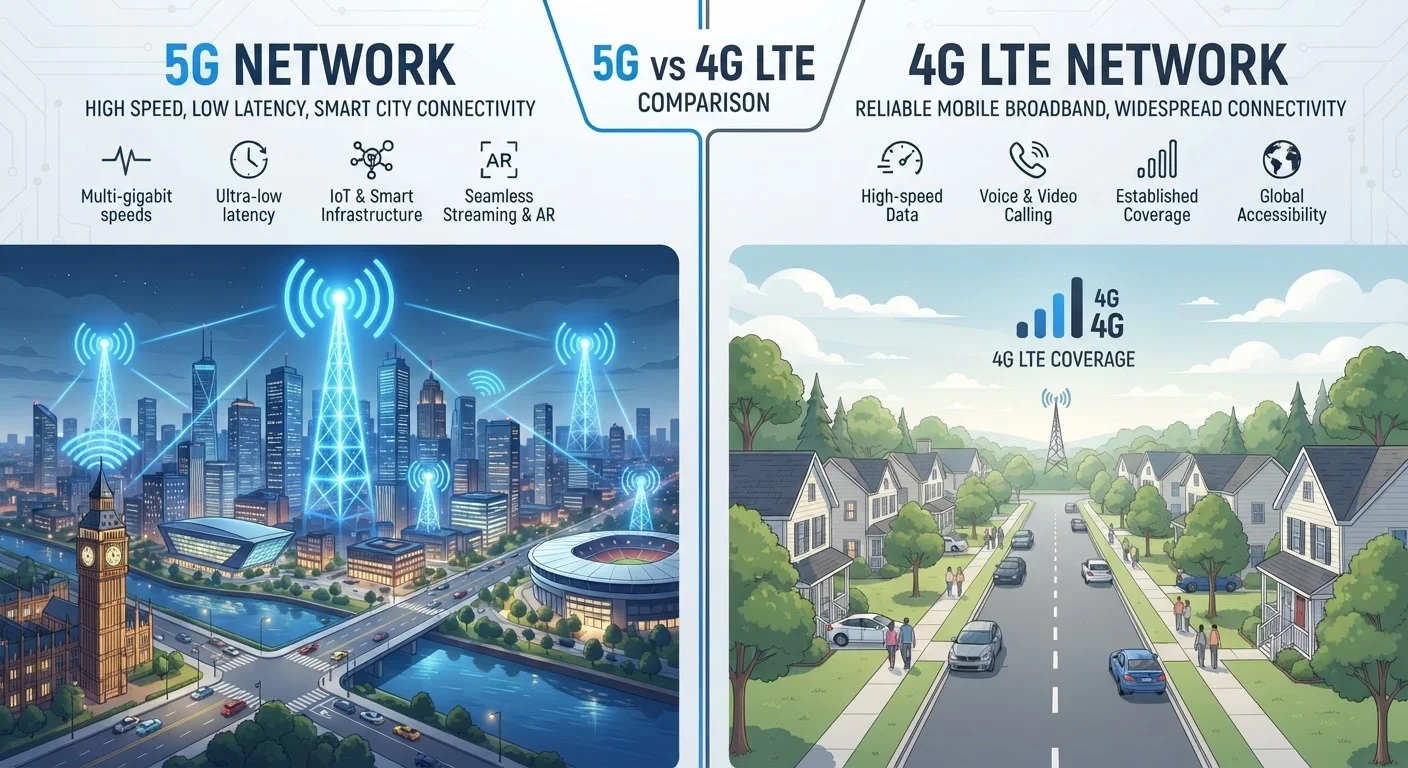
Carriers market 5G as a generational leap, and in certain conditions, it is. But the experience a real user has depends on three factors that rarely appear in advertisements: the type of 5G spectrum their carrier uses, local network density, and whether their device supports the relevant bands. Without understanding these, paying for a 5G plan can mean paying a premium for coverage that behaves almost identically to 4G LTE.
If you're still building a foundation for evaluating any wireless plan, this first-timer's guide to phone plans covers the core concepts before you compare generations.
| 4G LTE | Low-Band 5G | Mid-Band 5G | mmWave 5G | |
|---|---|---|---|---|
| Typical real-world download speed | 20-100 Mbps | 30-100 Mbps | 200-600 Mbps | 1 Gbps+ |
| Typical latency | 30-60 ms | 25-50 ms | 10-30 ms | Under 10 ms |
| Coverage reach | Nationwide, mature | Broad, widely deployed | Urban/suburban, expanding | Very limited, dense areas only |
| Building penetration | Good | Good | Moderate | Poor |
| Plan cost premium | Baseline | Often minimal | Moderate increase | Often highest tier |
| Device requirement | Any LTE phone | 5G phone required | 5G phone + band support | 5G mmWave phone required |
What Each Network Generation Actually Delivers
4G LTE, when functioning on a well-maintained network, typically delivers download speeds between 20 and 100 Mbps in real-world use - more than sufficient for video calls, HD streaming, social media, and navigation. Peak theoretical speeds are higher, but congestion during busy hours can reduce practical performance significantly.
5G's story is more complicated. It operates across three spectrum bands:
- Low-band 5G (sub-1 GHz): Wide coverage, but speeds only modestly above 4G LTE - often 30-100 Mbps. This is the 5G most rural and suburban users actually connect to.
- Mid-band 5G (2.5-6 GHz): The sweet spot - strong range combined with meaningfully higher speeds, typically 200-600 Mbps. Increasingly common in larger cities and suburbs.
- mmWave 5G (24 GHz+): Blazing speeds (1 Gbps+) but extremely limited range and building penetration. Mostly found in dense urban nodes, arenas, and airports.
Understanding plan tiers matters here too - carriers often reserve priority 5G access for higher-tier plans. How carriers structure plan tiers explains what you're actually getting at each price point.
Check Your Carrier's Spectrum Map, Not Just Coverage
Most carriers publish general coverage maps, but not all 5G coverage is equal. Look for tools that distinguish between low-band, mid-band, and mmWave deployments in your area. Some carriers offer band-specific maps or allow you to check which signal type your address receives. This single step can clarify whether a 5G plan upgrade would actually change your experience.
Coverage, Cost, and the Device Requirement
A 5G plan without a 5G-capable device delivers nothing beyond standard 4G LTE performance. And even with the right device, your phone must support the specific bands your carrier deploys - this varies by manufacturer and model. Always confirm band compatibility before committing to a plan upgrade.
On cost: 5G plans often carry a $5-$15 monthly premium over equivalent 4G LTE options, though pricing structures differ by carrier and promotional period. For users who stream, browse, and message at a moderate pace, that gap may not correspond to any perceptible speed difference - particularly if they're in a low-band 5G area.
Coverage maps are a starting point, not a guarantee. Carriers self-report coverage, and real-world signal can vary by street, building material, and network load. Before upgrading, it's worth checking independent coverage tools and crowd-sourced signal data for your specific commute and home address.
Also consider: if your primary data concern is keeping costs low rather than maximizing speed, plans designed for light data users may serve you better regardless of network generation.
When the Upgrade Makes Sense - and When It Doesn't
The 5G upgrade is most justifiable when mid-band or mmWave coverage is confirmed at the places you use your phone most. Heavy mobile video consumers, remote workers relying on mobile hotspot connectivity, and mobile gamers in covered areas will notice real differences. 5G's lower latency - typically under 10 milliseconds on mid-band - also benefits real-time applications like video calls and cloud gaming.
For the majority of users in suburban or rural settings, or those primarily using Wi-Fi at home and work, the upgrade delivers less tangible value. 4G LTE remains highly capable, and its network infrastructure is mature and broadly optimized. Unlimited plan fine print - deprioritization thresholds, hotspot caps, video resolution limits - often matters more to everyday experience than which generation label appears in your status bar.
The practical question isn't whether 5G is faster in a lab - it is. The question is whether it's meaningfully faster where you are, on the plan you'd actually pay for, with the device you own or plan to buy.