

Key Takeaways
What 'Unlimited' Actually Means
The word unlimited on a wireless plan sounds straightforward: use as much data as you want, whenever you want. In practice, carriers use it to mean something considerably more nuanced. Federal Trade Commission guidance has long flagged the term as potentially misleading when plans include material restrictions, yet it remains the dominant marketing language in the U.S. wireless industry.
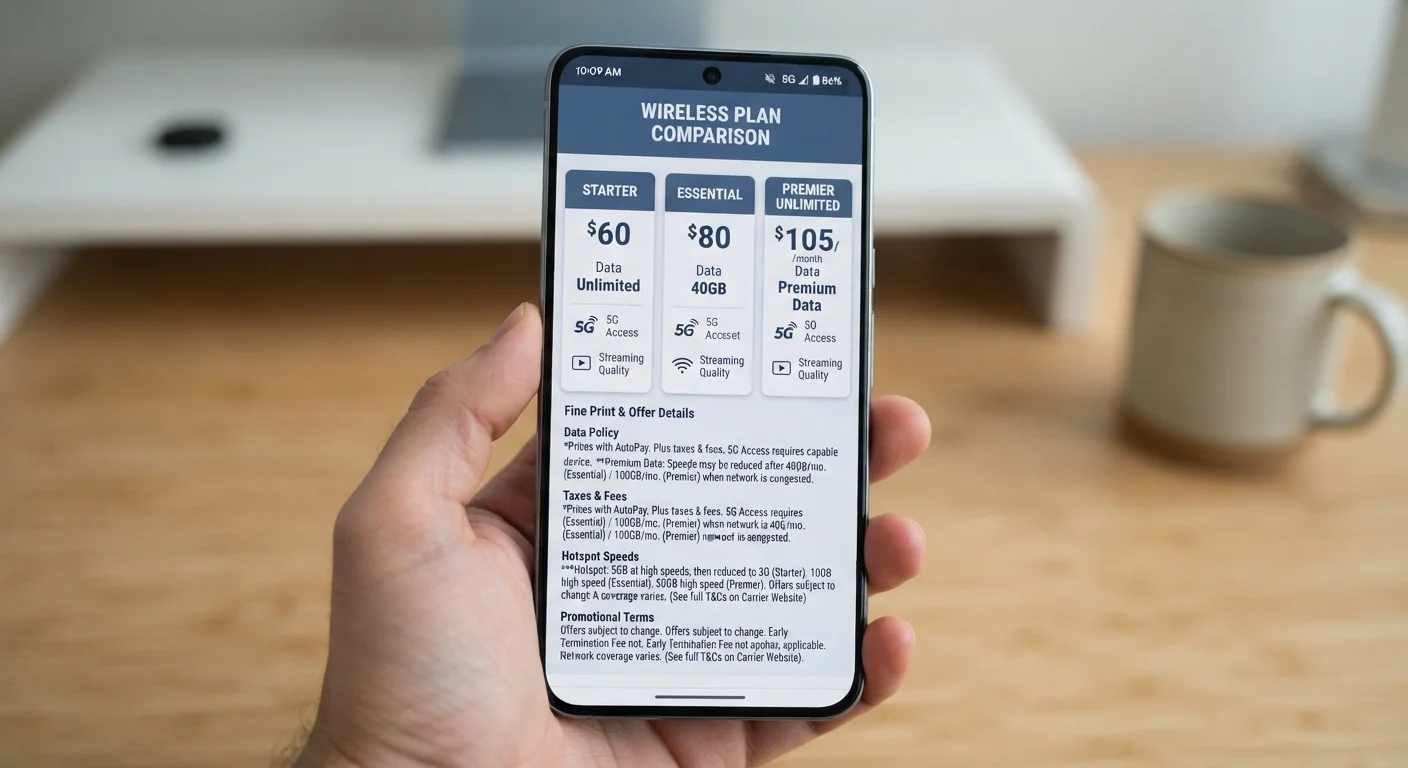
Understanding what you're actually buying requires looking past the plan name to three specific policy areas: deprioritization thresholds, mobile hotspot allowances, and video streaming quality caps. Each of these can affect your day-to-day experience far more than the total data figure on the marketing page.
If you're trying to decide whether unlimited even makes sense for your usage habits, our article on phone plans for light data users is worth reading first. Many people pay for unlimited data they'll never come close to needing.
Myth
Unlimited data means I can use as much data as I want at full speed, always.
Fact
All unlimited plans include network management policies that can slow your speeds once you exceed a usage threshold or during congestion.
Carriers are permitted to engage in deprioritization - temporarily reducing your data speeds when a cell tower is handling heavy traffic. This applies after you exceed a defined monthly threshold on most plans, and it can happen regardless of that threshold during peak hours. The speeds you see in a carrier's marketing materials typically reflect ideal, uncongested conditions.
Myth
My unlimited plan includes unlimited mobile hotspot data.
Fact
Mobile hotspot data is almost universally capped at a high-speed allotment, after which speeds drop sharply - often to 600 Kbps or below.
Carriers typically treat hotspot usage as a separate data bucket from smartphone browsing and streaming. Once you exhaust the high-speed hotspot allocation - which varies widely by plan tier - the remaining data is throttled to speeds that can make even basic web browsing sluggish. This distinction is especially important for anyone who regularly tethers a laptop or tablet to their phone.
Myth
Paying more for an unlimited plan guarantees better network speeds.
Fact
Higher-tier plans generally offer better network priority and higher deprioritization thresholds, but actual speeds still depend on local network conditions and congestion.
Premium unlimited tiers often include higher priority access to network bandwidth and are deprioritized only after a larger data threshold - or in some cases not at all. But priority and speed are not the same thing. If a tower in your area is overloaded, even a top-tier plan may deliver slower-than-expected speeds. Real-world performance varies by carrier, location, and time of day. Checking independent network performance data for your specific region provides a more reliable picture than carrier-published claims.
Myth
All unlimited plans handle video streaming the same way.
Fact
Many lower-tier unlimited plans cap video quality at standard definition (480p) by default, regardless of your device's capability.
Carriers frequently use video throttling as a way to manage network traffic and differentiate plan tiers. On entry-level unlimited plans, streaming is often capped at 480p - noticeably lower quality on modern smartphone screens. Some plans allow you to enable higher-resolution streaming by changing an account setting, while others reserve HD or 4K streaming exclusively for their highest-priced tiers. Verifying the video policy before signing up prevents disappointment for heavy streamers.
Myth
Switching to an unlimited plan means I no longer need to think about data.
Fact
Unlimited plans still require attention to hotspot limits, roaming policies, and deprioritization rules that affect real-world usability.
The appeal of an unlimited plan is removing the anxiety of monitoring data usage - and for smartphone browsing and app use, that largely holds true. But adjacent data uses like mobile hotspot, international roaming, and video streaming quality all operate under separate rules that can catch users off guard. Reviewing the full network management policy, not just the plan summary, is the only way to know exactly what you're getting.
The Hidden Limits That Shape Your Experience
Once you understand the core myths, three practical areas deserve close attention before you commit to any plan.
Deprioritization Thresholds
Most carriers publish a specific gigabyte threshold - commonly between 22 GB and 100 GB depending on the tier - after which your data is eligible for deprioritization. This doesn't mean you lose service; it means your data requests go to the back of the queue when a cell tower is congested. In dense urban areas or at crowded venues, the slowdown can be significant. Premium-tier plans typically carry higher thresholds and stronger network priority guarantees.
Mobile Hotspot Policies
Using your phone as a Wi-Fi hotspot for a laptop or tablet almost always draws from a separate, smaller pool of high-speed data - even on plans marketed as fully unlimited. Once that pool is exhausted, hotspot speeds typically drop to 600 Kbps or less, which makes video calls and large file transfers impractical. If you rely on hotspot connectivity for work or travel, the hotspot data allowance may matter more than any other plan feature. See our questions to ask before committing to a wireless plan for a checklist that covers exactly these details.
Video Streaming Resolution Caps
Many entry-level unlimited plans cap video streaming at 480p (standard definition) by default. Some carriers allow you to opt into higher resolution, but only on mid- or premium-tier plans. If you stream video regularly on your phone, this distinction is worth confirming before you sign up.
22-100 GB
Typical deprioritization threshold range across major U.S. carriers
Thresholds vary significantly by plan tier; lower-cost unlimited plans generally carry lower thresholds before deprioritization can apply.
480p
Default video cap on many entry-level unlimited plans
Standard definition streaming is commonly the default on base-tier unlimited plans, with HD reserved for mid- or premium-tier subscriptions.
600 Kbps
Typical hotspot speed after high-speed allotment is exhausted
Most major U.S. carriers throttle mobile hotspot to approximately 600 Kbps once the plan's high-speed hotspot data is used up.
How to Evaluate a Plan Before You Sign
Reading the plan's terms and conditions - specifically the network management policy document - is the most reliable way to find the actual rules. Carrier websites sometimes bury these in a separate legal disclosures section rather than the plan comparison page.
Key questions to answer before committing:
- At what data threshold does deprioritization begin?
- How much high-speed hotspot data is included, and what speed applies after the cap?
- Is video streaming capped at a specific resolution, and can it be changed?
- Does international roaming work, and at what speeds or data limits?
Coverage quality is equally important and often underrepresented in carrier marketing materials. Our guide on interpreting coverage maps explains why a carrier's map can look complete even in areas with unreliable signal. If you're also evaluating home internet options alongside a mobile plan, our home internet hub covers the key considerations there.
Auto-Pay and Paperless Billing Discounts
Many carriers advertise plan prices that are only available when you enroll in auto-pay and paperless billing. If you opt out of either, the monthly cost may be several dollars higher per line. Always confirm the price you'll actually pay based on your preferred billing method before committing.
Taking time to compare the actual policy documents - not the headline features - is what separates a plan that works for your life from one that frustrates you for 24 months.