

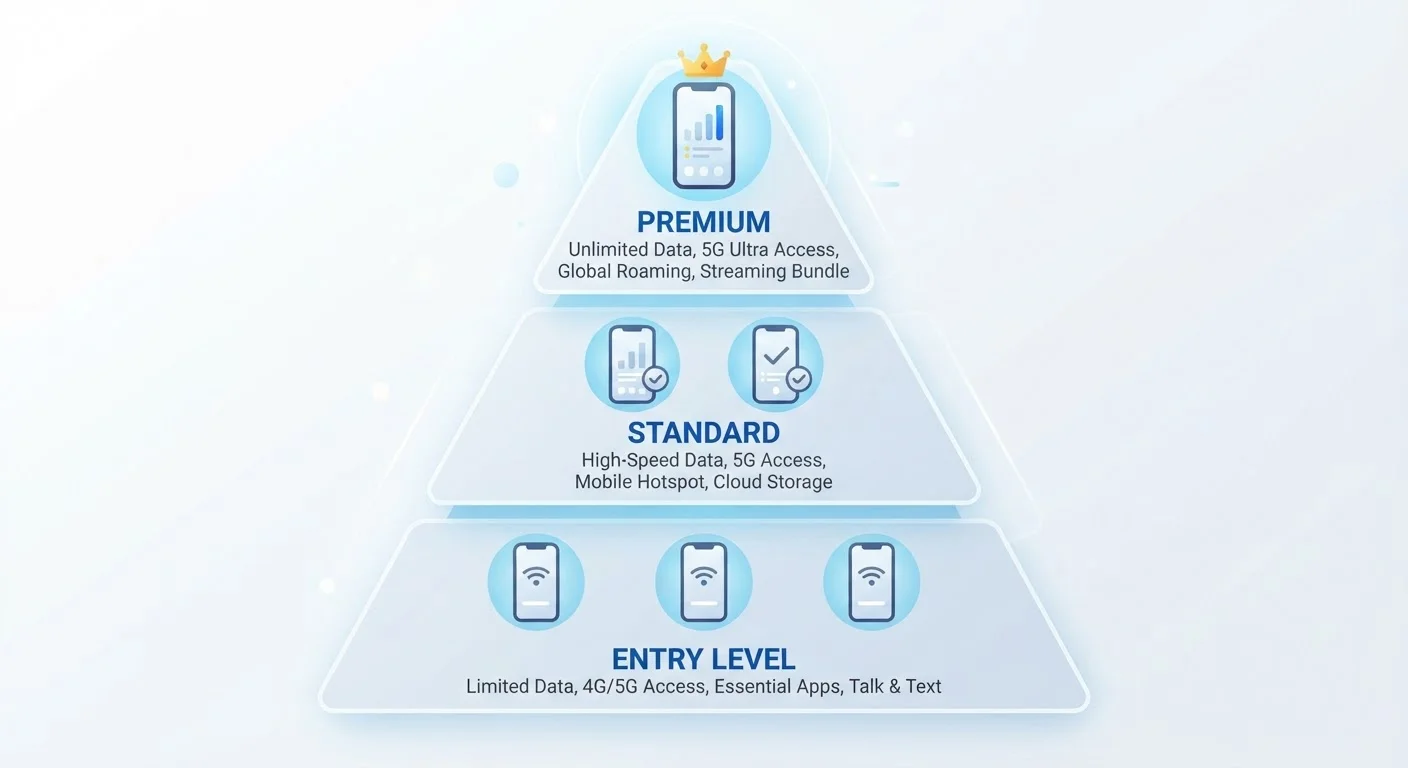
How Carriers Structure Plan Tiers
Every major U.S. wireless carrier organizes its plans into a tiered lineup - typically three levels ranging from a no-frills entry option to a feature-loaded premium tier. This structure isn't accidental: it's designed to give consumers an obvious upgrade path and to anchor higher-value perceptions at the top end. Understanding what actually changes between tiers helps you evaluate whether stepping up is worth the extra monthly cost.
At a high level, the differences between tiers come down to four variables: data priority and speed caps, hotspot allotments, international access, and bundled extras like streaming subscriptions or device protections. Price gaps between tiers on major carriers typically range from $10 to $20 per line per month, so the math matters.
For a broader look at how carriers construct their bills - including autopay discounts and per-line fees - see our breakdown of wireless plan pricing.
Entry-Level Plans: What You Get (and Give Up)
Entry-tier plans are designed for cost-conscious users who want reliable connectivity without extras. They typically offer a fixed or capped data allowance - often between 5 GB and 15 GB - before speeds are throttled to 2G-equivalent rates. Some carriers offer unlimited data at this tier but enforce strict deprioritization, meaning your connection slows significantly during network congestion.
Hotspot access is either absent or limited to a small bucket (commonly 5 GB or less). International options are minimal - roaming is often unavailable or charged at per-day or per-MB rates. Bundled streaming services, device upgrade programs, and cloud storage perks are generally not included.
Entry plans make the most sense for users who primarily connect over Wi-Fi and use mobile data sparingly. If that describes you, phone plans for light data users covers smarter options in more detail.
Data deprioritization
A carrier practice where users who have exceeded a threshold of high-speed data usage are temporarily slowed during periods of network congestion. It differs from a hard cutoff - speeds may recover when congestion eases.
Mobile hotspot
A feature that lets your phone share its cellular data connection with other devices, like a laptop or tablet, via Wi-Fi. Carriers typically cap how much hotspot data runs at full speed.
Priority data
A defined amount of data that a carrier delivers at full network speed before any deprioritization rules apply. Higher plan tiers generally include larger priority data thresholds.
Roaming
Using cellular service on a network outside your carrier's own coverage area, including internationally. Roaming access and costs vary significantly across plan tiers.
Bundled perks
Third-party services - such as streaming subscriptions, cloud storage, or device protection plans - included with a phone plan at no separate charge. Their value depends on whether you would pay for them independently.
Mid-Tier Plans: The Most Common Sweet Spot
Mid-tier - sometimes marketed as "Plus" or "Extra" - is where most carriers concentrate the bulk of their subscriber base. These plans typically include unlimited data with a defined high-speed data priority threshold (often 25 GB to 50 GB), after which speeds may be slowed during congestion. Hotspot allotments increase meaningfully, commonly to 15 GB-30 GB of high-speed mobile hotspot data.
International options expand at this tier. Many mid-tier plans include texting and low-speed data in Mexico and Canada, plus reduced-rate calling. One or two streaming add-ons - a music service, a basic video tier - are often bundled.
The mid-tier is worth evaluating carefully against what you actually use. Paying for 30 GB of hotspot data each month isn't valuable if you rarely tether a laptop. Multi-line households can shift this calculus - see how bundling affects per-line costs for the underlying math.
Premium Plans: When the Top Tier Is Worth It
Premium plans - often labeled "Ultimate," "Infinite," or similar - stack on every feature the carrier offers. Priority data thresholds jump to 50 GB-100 GB or more before deprioritization applies. Hotspot allotments typically reach 50 GB+ of high-speed data. International access widens to include calling in select countries, higher-speed roaming, and sometimes short-term international day passes.
Premium tiers also bundle the most streaming and device perks: top-tier video subscriptions, cloud storage upgrades, device protection plans, and in some cases Apple TV+, Netflix, or similar services at no added cost. These bundles can represent real value - but only if you'd pay for them independently.
One factor worth scrutinizing at the premium tier: network speed. Carriers increasingly tie 5G access to plan tier. Our comparison of 5G and 4G LTE plans explains what that distinction actually means in everyday use.
Before committing to a premium tier, tally up which bundled services you'll realistically use. If streaming perks overlap with services you already subscribe to, the effective upgrade cost is lower than the sticker price difference. If they don't, you may be paying for features that sit unused.
If you're new to navigating all of this, our first-timer's guide to choosing a phone plan walks through every key concept from the ground up.