

Key Takeaways
Option A
Highway Driving
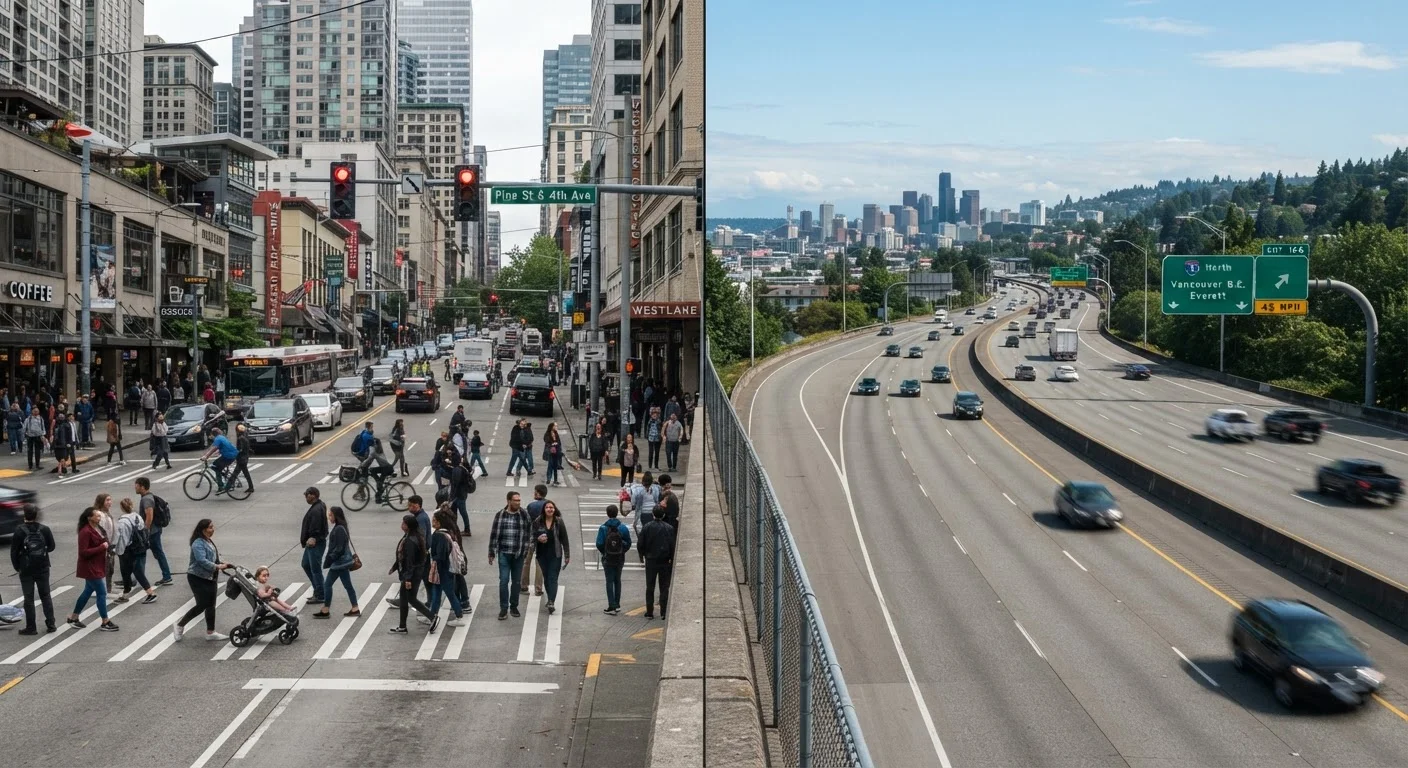
The high-speed, long-haul environment demanding sustained focus.
Best for: Covering distance efficiently on interstates and expressways where sustained speed, lane discipline, and merge judgment are critical.
Option B
City Driving
The complex, unpredictable urban environment requiring constant adaptation.
Best for: Navigating dense intersections, pedestrian crossings, cyclists, and frequent stops where quick reaction and situational awareness take priority.
If you primarily drive long interstate routes or commute on expressways
Highway Driving
Focus your skill-building on merge judgment, following distance at speed, and managing fatigue on longer runs - these are the factors that matter most on open roads.
If most of your driving happens in dense urban or suburban areas
City Driving
Prioritise intersection awareness, pedestrian scanning habits, and managing distractions from signals and street activity - urban environments reward reactive, patient drivers.
If you regularly switch between city and highway in a single commute
Highway Driving
The most dangerous transition is city-to-highway entry; practice your merge and speed-matching technique deliberately until it becomes second nature.
The Core Difference: Speed Versus Complexity
At its simplest, highway driving trades complexity for speed, and city driving trades speed for complexity. On a highway, most variables - lane count, direction of traffic, access points - are controlled and predictable. The challenge is that everything happens faster. At 70 mph, you cover roughly 103 feet every second, meaning a two-second lapse in attention can put you 200 feet down the road before you've registered a problem.
City driving flips this dynamic. Speeds are lower, but the number of active variables at any given moment is dramatically higher: pedestrians stepping off curbs, cyclists filtering between lanes, vehicles turning without signaling, double-parked delivery trucks forcing lane changes. Urban environments are episodic - each block can present a completely new hazard profile. The cognitive load is front-loaded and relentless rather than sustained and linear.
Understanding this distinction helps drivers diagnose their own weak points. If you're tense on interstates but relaxed in traffic, you likely need to build confidence with speed management and merge technique. If city driving exhausts you but highways feel easy, sharpening your intersection scanning and pedestrian awareness is where to invest your attention.
Highway-Specific Skills Every Driver Should Develop
Merging at speed is one of the most misjudged skills on the road. A safe merge requires matching the speed of moving traffic - not stopping at the end of an on-ramp and waiting. Drivers who enter the highway at 40 mph into 70 mph traffic create a rolling hazard behind them. The technique: use the entire length of the acceleration lane to reach highway speed, identify your gap early, check mirrors and blind spots, and signal before committing.
Following distance on a highway should be measured in seconds, not car lengths. The commonly cited three-second rule - pick a fixed point, let the car ahead pass it, and count until you reach the same point - is a minimum in good conditions. At highway speeds, reaction time and braking distance demand more buffer than most drivers maintain. Wet or icy conditions extend this margin significantly.
Sustained attention management is unique to longer highway runs. Unlike city driving, which forces engagement through constant stimulus, highways can lull drivers into a semi-autopilot state. Building habits like periodic mirror checks every five to eight seconds and deliberate lane-position awareness counteracts this. If you're planning a long highway trip, nighttime fatigue risks compound the challenge further.
| Criterion | Highway Driving | City Driving |
|---|---|---|
| Typical speed range | 55-80 mph | 15-45 mph |
| Primary hazard type | Speed differentials, tailgating, fatigue | Pedestrians, cyclists, intersection conflicts |
| Key skill demand | Merging, following distance, sustained focus | Scanning, patience, rapid hazard response |
| Decision frequency | Lower - fewer but higher-consequence decisions | Higher - constant micro-decisions required |
| Navigation complexity | Lower - controlled access, fewer intersections | Higher - signals, turns, one-ways, parking |
| Fatigue pattern | Monotony-driven inattention over time | Cognitive overload from constant stimulation |
| Braking demands | Gradual, planned stops from speed | Frequent, sometimes sudden stops |
City-Specific Skills That Demand a Different Mindset
Intersection management is the defining skill of urban driving. U.S. traffic fatality data consistently shows intersections as high-concentration crash sites, partly because drivers enter them assuming others will comply with signals and right-of-way rules. The safer approach: treat every green light as a conditional clearance, scan cross-traffic before committing, and give way to anyone who appears to be running a red before braking. This is the essence of defensive driving - anticipating failures in others' behavior rather than assuming compliance.
Pedestrian and cyclist scanning requires building a habitual visual routine. This means checking not just the crosswalk directly ahead but the sidewalks and bike lanes flanking it, identifying anyone who might step or roll into your path. Children, people on phones, and riders emerging from between parked vehicles are all common urban hazards that appear with very little warning.
Patience under pressure is genuinely a driving skill in city conditions. Aggressive behavior - honking, tailgating, forcing turns - escalates risk at precisely the moments when precision matters most. Understanding how frustration escalates into hazardous decisions is why road rage and aggressive driving carry real legal and safety consequences, not just social ones.
~40%
U.S. fatal crashes occurring at intersections
According to Federal Highway Administration data, intersections account for a substantial share of traffic fatalities, underscoring the risk profile of urban driving.
103 ft/sec
Distance covered per second at 70 mph
At typical interstate speed, a driver covers roughly 103 feet every second, illustrating why sustained attention and following distance are non-negotiable on highways.
3 seconds
Minimum recommended following distance (dry conditions)
The three-second rule is a widely taught baseline for highway following distance under normal conditions; adverse weather warrants a longer gap.
Switching Environments: The Reset Most Drivers Skip
One of the most underappreciated driving risks is the transition between environments - particularly city-to-highway. Drivers accustomed to 25-30 mph stop-and-go traffic often underestimate how quickly they need to reach merge speed, or they bring urban caution (excessive hesitation, slow lane changes) onto roads where moving decisively is safer. The reverse is also true: drivers coming off a long highway run may carry speed-perception distortion into residential streets, perceiving 35 mph as slower than it is.
The practical fix is a deliberate mental reset at each transition. When entering a highway, focus explicitly on acceleration and gap selection. When exiting into an urban area, check your speedometer actively for the first few blocks rather than relying on feel. New drivers making this transition for the first time will find additional guidance in what to know before your first highway drive.
Both environments sit within a broader framework of road safety practices covered in safe driving in America - from traffic law basics to emergency responses that apply regardless of where you are on the map.