
Driving in Rain, Snow, and Fog: Adjusting for Conditions Most Drivers Underestimate

Key Takeaways
Why Adverse Weather Catches Drivers Off Guard
Most drivers know, in theory, that rain and snow are dangerous. What they underestimate is how dramatically road physics change the moment conditions deteriorate. A car traveling 60 mph on dry pavement might stop in roughly 200 feet. On wet pavement, that distance can stretch to 300 feet or more - and on ice, it can reach over 800 feet. These aren't edge cases; they're the conditions millions of Americans drive through every year.
The problem is familiarity. Because most drivers have navigated bad weather without incident, it creates a false confidence that their normal driving habits are adequate. They aren't. Adjusting for conditions means rethinking your speed, your following distance, and how you use your vehicle's controls - not just being more cautious in a general sense. For a deeper look at how the fundamental demands of driving shift across environments, see our guide to highway vs. city driving.
Reduce speed well before - not during - deteriorating conditions
Slowing down proactively gives you more time to react and prevents the abrupt braking that causes skids. Waiting until conditions feel dangerous means you're already operating at reduced margin.
Double or triple your following distance in rain, snow, or fog
Stopping distances increase dramatically on wet or icy surfaces. The standard three-second following rule assumes dry-pavement stopping distances - in adverse conditions, it is dangerously insufficient.
Disable cruise control the moment road surfaces become compromised
Cruise control is designed for stable, dry conditions. On wet or slippery roads it can maintain or increase speed during a loss of traction, making a skid worse rather than allowing the driver to manage it.
Use low-beam headlights in fog and heavy rain
High beams reflect off water and ice particles, creating a wall of glare that reduces the driver's forward visibility. Low beams direct light at the road surface where it's needed.
Ensure tire tread and pressure meet minimum safe thresholds before winter or wet seasons
Tire tread channels evacuate water between the tire and road. Worn tread dramatically increases hydroplaning risk. Proper inflation maintains the contact patch geometry the tire was designed for.
Steer into a skid - don't overcorrect
When the rear of the vehicle slides, instinct pushes many drivers to steer sharply away from the slide. This often leads to a snap oversteer in the other direction. Steering gently in the direction of the skid brings the vehicle back to alignment.
Rain: Managing Hydroplaning and Loss of Traction
Rain is the most commonly underestimated hazard because it's the most routine. The danger isn't just slippery roads - it's hydroplaning, which occurs when a layer of water builds up between your tires and the road surface, eliminating contact and steering control. This can happen at speeds as low as 35 mph on standing water, especially with worn tires.
The single most important factor in rain safety is your tires. Tread channels are engineered to evacuate water - shallow tread means less evacuation, more hydroplaning risk. If your tires are borderline, wet weather is not a condition to gamble with. Check the Car Maintenance hub for guidance on evaluating tire condition before the rainy season.
Beyond tires, slow down progressively rather than maintaining highway speeds until you feel the vehicle slip. Turn off cruise control - it cannot detect surface changes and may attempt to maintain speed during a skid. If you feel the steering go light (a sign of hydroplaning), ease off the accelerator gently and steer straight until your tires regain contact.
Snow and Ice: Smooth Inputs Are Everything
Snow and ice demand a fundamentally different physical relationship with your vehicle. On ice, braking distances can be four to ten times longer than on dry pavement. The most dangerous thing most drivers do in snowy conditions is apply normal driving inputs - sharp braking, quick steering adjustments - that would be fine in dry weather but cause immediate loss of control on slick surfaces.
The guiding principle in snow and ice is smooth: smooth acceleration, smooth braking, smooth steering. If you need to slow down, begin braking far earlier than feels necessary. Modern anti-lock braking systems (ABS) help maintain steering control under hard braking on slippery surfaces, but they don't shorten stopping distances - they prevent lockup. Allow for significantly more space ahead than you think you need. For context on how following distance and reaction time interact, our article on safe following distance vs. reaction time explains why drivers routinely underestimate the gap they need.
~21%
Of all U.S. vehicle crashes are weather-related
According to the U.S. Department of Transportation Federal Highway Administration, approximately 21% of annual vehicle crashes are weather-related, with wet pavement involved in the largest share.
4-10x
Longer stopping distances on ice vs. dry pavement
Stopping distance data from road safety research consistently shows ice can multiply stopping distances by four to ten times compared to dry asphalt at equivalent speeds.
35 mph
Speed at which hydroplaning can begin
Tire engineers and safety researchers note that hydroplaning can initiate at speeds as low as 35 mph on standing water, particularly with worn tread or underinflated tires.
Fog: Visibility Illusions and Lighting Mistakes
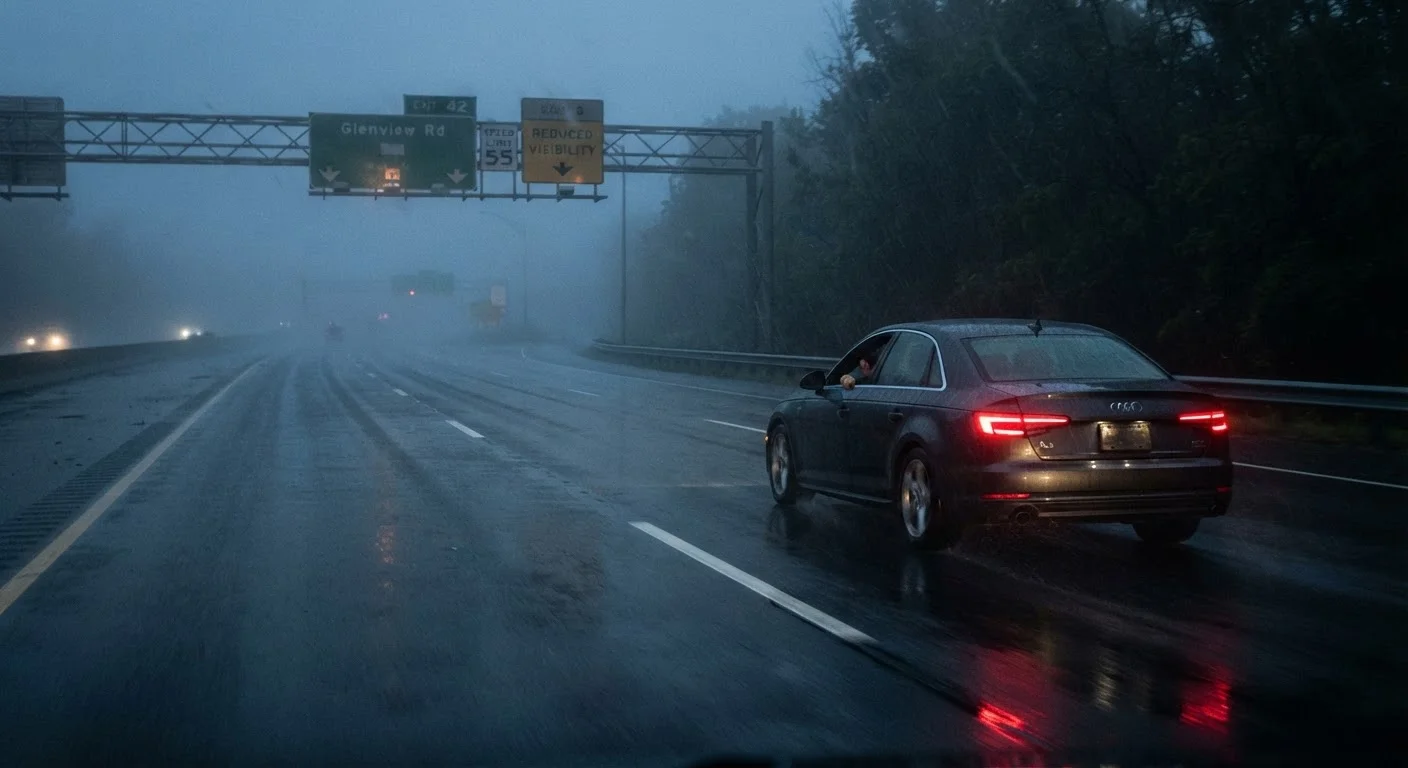
Fog is uniquely dangerous because it distorts perception of speed and distance. Objects appear farther away than they are, and drivers often unconsciously speed up to compensate for discomfort. The result is closing distance on hazards with far less reaction time than they realize.
The most common lighting mistake in fog is using high beams. High beams scatter off water droplets and bounce light directly back at the driver, reducing visibility further. Low beams - or fog lights if your vehicle has them - keep illumination angled downward and are far more effective. Slow to a speed where you can stop within the distance you can see, and increase following distance substantially. If fog becomes extremely dense, consider pulling off the road safely and waiting it out rather than driving blind.
Adverse weather driving connects directly to broader road safety skills. Whether you're a newer driver or someone revisiting fundamentals, the Safe Driving in America complete guide provides an end-to-end reference for handling conditions across every type of American road.