

Key Takeaways
Enhanced Penalty Zones
School zones and construction (work) zones are designated stretches of roadway where standard traffic laws are intensified. Speed limits are lowered, fines for violations are typically doubled or more, and additional rules - such as stopping for crossing guards or yielding to flaggers - apply. These zones exist specifically to protect children and roadway workers who are exposed to moving traffic.
In most states, enhanced zone laws are established by state statute, meaning the elevated penalties apply regardless of posted signage at the specific site - though visible signage is the primary way drivers are notified of zone boundaries.
Why These Zones Exist - and Why Penalties Are Steeper
School zones and construction zones share a common rationale: they place vulnerable people - children and roadway workers - in close proximity to moving vehicles. Because the consequences of a collision in these environments are especially severe, lawmakers in every U.S. state have layered on legal requirements that go beyond normal road rules.
According to the Federal Highway Administration, work zone crashes account for hundreds of fatalities each year in the United States. School-age pedestrian injuries are similarly concentrated around arrival and dismissal times. The legal framework around these zones is a direct response to that risk profile.
For a broader foundation on traffic law and safe habits, see the complete safe driving guide covering rules and road habits across every type of American road.
700+
Annual work zone fatalities in the U.S.
The Federal Highway Administration reports that work zone crashes kill hundreds of people each year, including both workers and drivers.
2×-3×
Typical fine multiplier in school/work zones
Most U.S. states double or triple standard traffic fines for violations occurring within designated school or construction zones.
15-25 mph
Typical school zone speed limit range
While limits vary by state and locality, most school zones reduce the standard urban speed limit to between 15 and 25 mph during active hours.
School Zones: Speed, Timing, and Stopping Rules
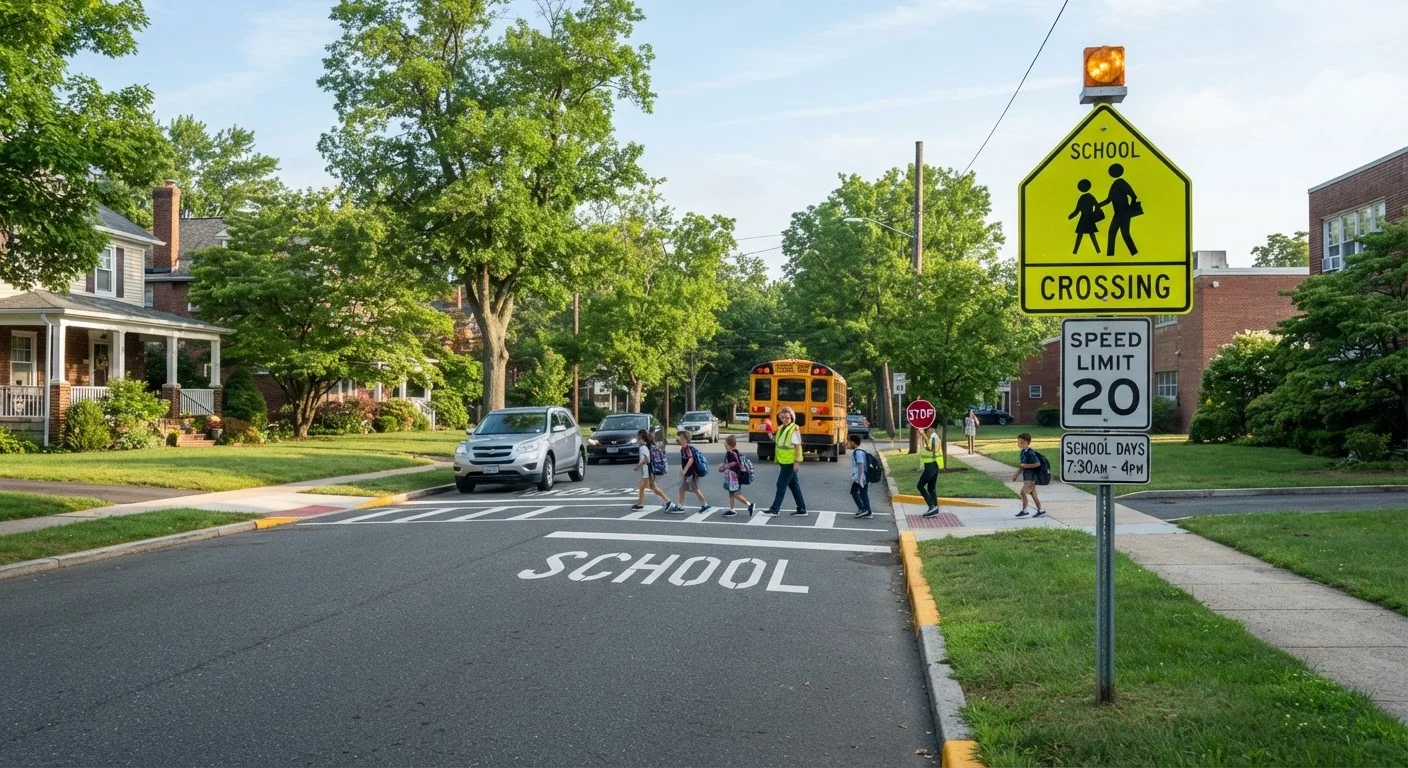
School zone speed limits in the U.S. typically range from 15 to 25 mph, compared to the standard 25-35 mph urban limit. The reduced speed is usually time-restricted - applying on school days during specific morning and afternoon windows - and is often communicated via:
- Fixed signs with posted hours
- Flashing amber beacons that activate when the reduced limit is in force
- Electronic variable message signs near high-traffic school entrances
Beyond speed, school zone law requires drivers to:
- Yield to crossing guards, who have statutory authority to direct traffic. Their instruction overrides the signal cycle.
- Stop for school buses displaying flashing red lights and an extended stop arm. On undivided roads, this applies to traffic traveling in both directions. On divided highways with a physical barrier, oncoming traffic may be exempt - but confirm your state's specific rule.
- Avoid blocking crosswalks when stopping at intersections near schools.
Penalties for speeding in a school zone are substantially higher than standard fines in virtually every state. Many states also impose additional license demerit points for school zone violations.
When the Flashing Light Is On, Slow Down Immediately
Many school zones use amber flashing beacons to indicate when the reduced speed limit is active. If you see a flashing beacon - even if you don't see children - the lower limit is legally in force. Build the habit of scanning for beacons well before reaching the zone so you're already at the correct speed when you enter.
Construction Zones: Flaggers, Reduced Limits, and Worker Protection Laws
Work zones are governed by a combination of state motor vehicle codes and federal standards - specifically the MUTCD, which sets guidelines for work zone signage that states are required to substantially adopt. The result is a relatively consistent national framework, though penalty amounts vary by state.
Key requirements in construction zones include:
- Reduced speed limits - typically 10-15 mph below the standard posted limit, displayed on orange signs marking the zone's start.
- Following flagger instructions - flaggers (the workers directing traffic through active work areas) have the same legal authority as traffic control signals. Disobeying a flagger is a chargeable offense in all states.
- Maintaining safe following distance - lane narrowing and abrupt stops by lead vehicles are common in work zones. Extra space is both a safety measure and a legal expectation in many states.
- No passing restrictions - many work zones explicitly prohibit lane changes or passing where marked.
Critically, most states enforce reduced speed limits and enhanced penalties even when workers are not present within the marked zone boundaries. The zone begins and ends at designated signs, not at the location of active workers.
Understanding work zone signage connects directly to broader sign literacy. The complete U.S. traffic signs reference covers the full range of regulatory and warning signs you'll encounter.
How Penalties Vary by State - and What's Consistent Everywhere
While the underlying logic is uniform - protect vulnerable road users through heightened legal deterrents - the specific fine amounts and penalty structures differ meaningfully from state to state. Some states double base fines; others triple them or add mandatory minimum fines regardless of the base rate. A handful of states include potential jail time for reckless driving in a work zone that results in injury or death.
What is consistent across all U.S. states:
- School zone and work zone speed limits are legally enforceable and carry real consequences.
- Distracted driving - particularly handheld cell phone use - is subject to elevated penalties in these zones in a growing number of states.
- Striking a worker in a construction zone typically triggers felony-level charges in most states, regardless of speed.
Drivers unfamiliar with a specific state's rules before traveling should check that state's Department of Motor Vehicles or Department of Transportation website for current penalty schedules. Road markings also carry legal weight in these zones - for a refresher on what painted lines mean and when they can be crossed, see what yellow road lines are really telling you.
A driver passes through a school zone at 35 mph during the posted restricted hours, matching the speed on the adjacent road just outside the zone.
A motorist approaches a construction zone on an interstate at night. Orange signs indicate a 55 mph limit, but no workers are visible and it's well after normal work hours.
A crossing guard steps into the road and holds up a stop paddle, but the traffic signal has just turned green.