

Key Takeaways
Why Some Parts Fail Before You Expect Them To
Most drivers know they need oil changes, tire rotations, and the occasional brake job. What catches people off guard are the components that wear down quietly - parts whose service intervals are shorter than intuition suggests, and whose failure often isn't dramatic until it becomes a real problem.
Driving conditions matter enormously here. Stop-and-go city traffic, extreme temperatures, dusty environments, and high annual mileage can all accelerate wear well beyond the averages printed in a service schedule. That's why understanding why these parts wear - not just when - gives you a meaningful advantage as an owner. For a broader look at the costs that tend to surprise new owners, see our breakdown of ownership costs most buyers overlook.
Cabin Air Filter
The cabin air filter cleans the air flowing through your heating and air conditioning system. Most manufacturers recommend replacing it every 12,000 to 15,000 miles, but drivers in areas with heavy pollen, dust, or wildfire smoke may need to change it closer to every 8,000 to 10,000 miles. A clogged filter reduces airflow noticeably, strains the blower motor over time, and allows more particulates into the cabin. Many owners don't know this filter exists until a technician pulls out a visibly blackened one during a service visit.
A clogged cabin filter strains your blower motor and lets more particulates into the air you breathe.
Wiper Blades
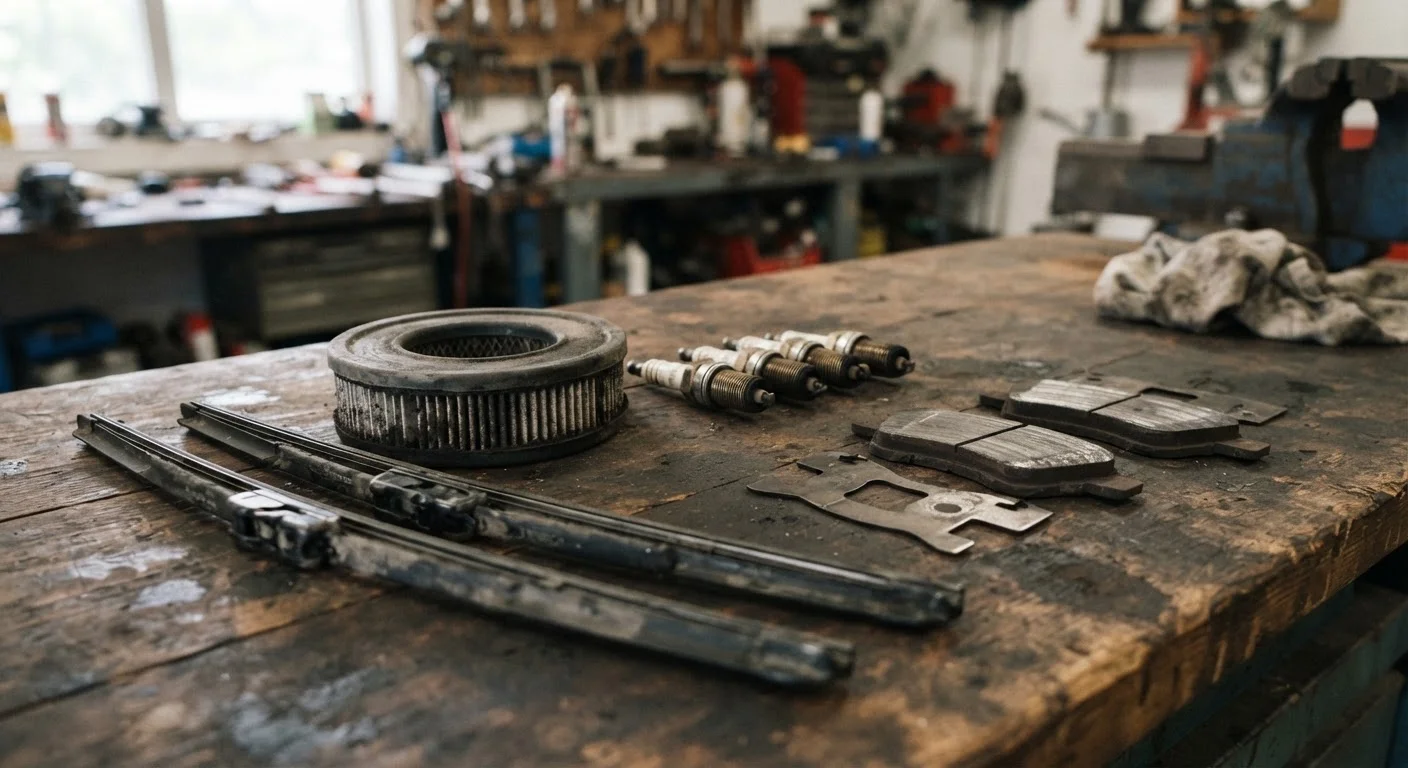
Rubber degrades from UV exposure, temperature swings, and repeated friction across glass - all of which happen continuously to wiper blades whether you use them or not. The standard recommendation is replacement every six to twelve months. Most drivers replace them reactively, after streaking or chattering becomes too annoying to ignore. By that point, the blades may have already left fine scratches on the windshield over time. Inspecting them at each seasonal change is a simple habit that keeps visibility - and glass - in good shape.
Wiper blades degrade from UV and heat even when parked, so age matters as much as use.
Spark Plugs
Conventional copper spark plugs typically require replacement every 30,000 miles - a figure many drivers underestimate. Extended-life iridium or platinum plugs can last 60,000 to 100,000 miles, but they still have a finite service life. Worn plugs produce weaker ignition, leading to reduced fuel economy, rough idling, and misfires. Since symptoms build gradually, it's easy to adapt to declining performance rather than recognize it as a maintenance signal. Checking your owner's manual for your specific plug type and interval is the most reliable guide.
Performance declines gradually with worn spark plugs - drivers often adapt to the change rather than noticing it.
Brake Fluid
Brake fluid is hygroscopic, meaning it absorbs moisture from the air over time. As water content increases, the fluid's boiling point drops - a serious concern during hard or repeated braking when heat builds rapidly. Most manufacturers recommend flushing brake fluid every two years or 24,000 miles, whichever comes first, though many drivers never replace it at all. Degraded fluid can also accelerate corrosion inside brake lines and calipers. For more on reading the signals your brakes send before failure, see our guide to brake wear warning signs.
Brake fluid absorbs moisture over time, lowering its boiling point and compromising stopping performance.
Serpentine Belt
The serpentine belt drives the alternator, power steering pump, air conditioning compressor, and other accessories. Modern belts are more durable than their predecessors, but they still crack, fray, and lose tension - usually between 60,000 and 100,000 miles. The problem is that modern belt materials often show little visible wear before they fail. A sudden belt failure can leave you without power steering, strand you without a charging alternator, or trigger engine overheating if it also drives the water pump. Having the belt inspected during major service intervals is a straightforward precaution.
Modern serpentine belts can look fine right up until they fail - visual inspection alone isn't always enough.
Battery
Car batteries have an average service life of three to five years, but hot climates can shorten that to two to three years due to accelerated internal corrosion and fluid evaporation. Cold climates increase demand on a weakening battery, which is why cold-weather failures are so common. Unlike a slow tire leak or noisy brakes, battery failure is often sudden and shows few reliable warning signs beforehand. Annual testing - particularly before winter - gives you meaningful lead time. Our complete guide to battery care and testing covers what to watch for at each stage of a battery's life.
Battery failure is often sudden - annual testing before winter is the most practical way to avoid being stranded.
Staying Ahead of the Curve
The pattern across every item on this list is the same: short replacement cycles, outsized consequences when ignored. None of these parts are expensive to replace on schedule - but several of them become expensive (or dangerous) when left too long. Our seasonal maintenance calendar is a practical tool for building these checks into your routine before problems develop.
Check Your Owner's Manual First
General mileage guidelines are useful starting points, but your vehicle's owner's manual contains manufacturer-specific intervals that account for your engine type, climate recommendations, and part specifications. If you've lost your manual, most automakers publish them online through their official owner portals. Interval guidance from a trusted mechanic familiar with your vehicle can also help you calibrate for your specific driving conditions.
If your vehicle has crossed the 100,000-mile mark, the replacement intervals for several of these components may tighten further. Our guide on high-mileage vehicle upkeep covers what shifts after that threshold and which components deserve closer attention.