

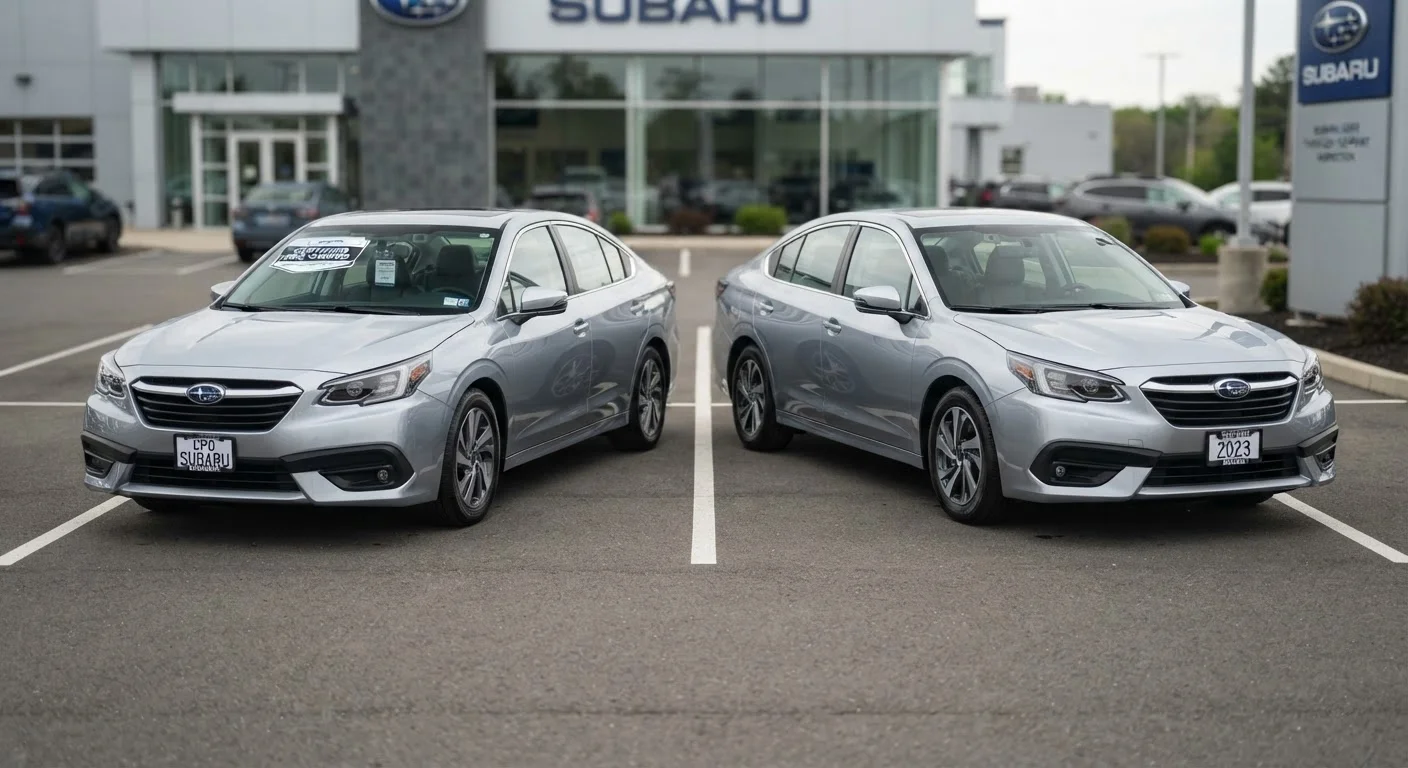
Key Takeaways
Option A
Certified Pre-Owned (CPO)
The manufacturer-backed, inspected used car with structured guarantees.
Best for: Buyers who want reduced uncertainty and some warranty coverage without paying new-car prices.
Option B
Standard Used
The flexible, lower-cost path with variable condition and no built-in guarantees.
Best for: Budget-conscious buyers willing to do their own due diligence or accept a higher risk-to-price trade-off.
If you want warranty coverage and reduced uncertainty after purchase
Certified Pre-Owned (CPO)
CPO programs provide a structured inspection process and a manufacturer-backed limited warranty, giving you a defined safety net that standard used sales do not.
If you're working with a tight budget and can arrange your own inspection
Standard Used
Standard used vehicles often sell at lower prices, and pairing one with an independent pre-purchase inspection can surface the same concerns a CPO review would catch.
If you want to minimize the chance of immediate costly repairs
Certified Pre-Owned (CPO)
CPO programs typically require mechanics to inspect and recondition vehicles to meet set standards, reducing - though not eliminating - the likelihood of near-term failures.
If you're buying an older or higher-mileage vehicle that won't qualify for CPO
Standard Used
CPO eligibility is typically limited to vehicles under a set age and mileage threshold, so older inventory exists only in the standard used market.
What 'Certified' Actually Requires
The word certified carries weight in automotive marketing, but its meaning is defined entirely by whoever is doing the certifying. Factory-backed CPO programs - offered by vehicle manufacturers through franchised dealerships - set specific eligibility requirements: typically a maximum age of five to seven years and a mileage cap often between 60,000 and 80,000 miles, though these thresholds vary by brand.
To pass, a vehicle must clear a multi-point inspection - commonly ranging from 100 to 200 checkpoints depending on the manufacturer - covering mechanical systems, safety components, and cosmetic condition. Items that fail must be repaired or replaced before certification is awarded. The result is a vehicle that has been systematically evaluated against a published standard.
Standard used vehicles carry no such requirement. A dealer or private seller may choose to inspect a car before listing it, but there is no mandated process. Condition is disclosed - to varying degrees - in the listing and during negotiation, and the responsibility for evaluating that condition falls largely on the buyer. For a practical guide to protecting yourself in that process, see how to arrange a pre-purchase inspection.
| Criterion | Certified Pre-Owned | Standard Used |
|---|---|---|
| Eligibility requirements | Age and mileage limits set by manufacturer | No formal requirements |
| Inspection standard | 100-200 point manufacturer checklist | Varies; no mandated process |
| Warranty coverage | Manufacturer-backed limited warranty | None by default; dealer option varies |
| Typical price | Higher (premium for certification) | Lower; wider range |
| Vehicle age range | Usually 5-7 years or newer | Any age |
| Who backs the program | Manufacturer (or dealership for non-OEM programs) | Seller only |
| Reconditioning required | Yes, to pass inspection standards | At seller's discretion |
Warranty Coverage: What's Included and What Isn't
The warranty attached to a CPO vehicle is the most tangible benefit of the label. Manufacturer CPO warranties generally extend or supplement whatever remains of the original factory warranty, often adding powertrain coverage for two to five additional years beyond the original sale date. Some programs include roadside assistance, loaner vehicles, and trip-interruption benefits.
However, CPO warranties are not bumper-to-bumper coverage by default. Most are powertrain-focused, meaning the engine, transmission, and drivetrain are covered, while wear items - brakes, tires, batteries - and many electronic components may not be. Reading the warranty documentation before purchase, not after, is essential.
Dealer-Certified vs. Manufacturer-Certified
Not all CPO programs carry the same authority. Manufacturer-backed CPO programs are administered through franchised dealerships and are governed by the automaker's published standards. Dealer-certified programs, offered by independent dealers or even some franchise dealers on non-qualifying inventory, are self-defined and may not include a manufacturer warranty at all. Always confirm which type of certification applies to the specific vehicle you're evaluating.
Standard used vehicles are sold without manufacturer warranty unless factory coverage happens to still be in effect. Some dealers offer limited dealer warranties on used inventory, but these are typically short in duration and narrow in scope. Third-party extended service contracts are available for both CPO and standard used vehicles - what extended warranties actually cover is worth understanding before you sign anything at the finance desk.
Price Premium and Whether It's Justified
CPO vehicles consistently command higher prices than comparable standard used cars. Industry data from sources such as Edmunds and Cox Automotive has historically shown CPO premiums in the range of several hundred to a few thousand dollars over non-certified equivalents, depending on the vehicle and market conditions. That gap reflects the cost of inspection, reconditioning, and the warranty itself - which the manufacturer prices into the program.
Whether that premium makes sense depends on what you're buying. On a late-model vehicle still within its original warranty period, the CPO bump may add limited value. On a vehicle approaching the end of factory coverage, the extended warranty component becomes more meaningful. Comparing total cost of ownership - purchase price plus anticipated maintenance and repair exposure - is more informative than comparing sticker prices alone.
It's also worth noting that CPO labeling has expanded in recent years, and some dealerships operate independent certification programs that are not manufacturer-backed. These carry weaker guarantees. Confirming whether a CPO vehicle is backed by the manufacturer or the dealership alone is a key question to ask before assuming the programs are equivalent. To understand what a multi-point inspection actually covers under these programs, see how shops structure their inspection process.