

Key Takeaways
Extended Warranties vs. Service Contracts: The Terminology Matters
The term extended warranty is used loosely in dealerships, but it carries a specific legal meaning. A true warranty is a promise made by a manufacturer - it comes with the vehicle at no added cost. What dealers sell after that initial coverage expires is more accurately called a vehicle service contract (VSC), a product regulated differently in most states.
This distinction matters because it affects your rights. Under the Magnuson-Moss Warranty Act, manufacturers must clearly disclose warranty terms. Service contracts, by contrast, are governed by state insurance or service contract statutes, which vary considerably. When something goes wrong and a claim is disputed, knowing which framework applies shapes your options. Before signing any vehicle purchase paperwork, see our dealership signing checklist to ensure you have the full picture.
What These Contracts Typically Cover
Service contracts generally fall into two structural categories:
- Exclusionary (bumper-to-bumper style): These cover everything on the vehicle except a listed set of exclusions. Because the exclusion list defines what is not covered, they tend to be more comprehensive - and typically more expensive.
- Named-component (stated-coverage): These enumerate exactly which parts are covered. If a failing part isn't on the list, it's not covered. Coverage gaps can be significant.
Most contracts include powertrain components (engine, transmission, drive axles), and higher tiers extend to electrical systems, air conditioning, steering, and advanced electronics. Some contracts also include roadside assistance, rental car reimbursement, and trip interruption benefits - worth noting, but rarely the deciding factor.
55%
Consumers who never use their VSC
Industry analyses have consistently found that a majority of vehicle service contract holders never file a claim over the contract's term.
3-4 years
Typical factory powertrain warranty length
Most mainstream automakers offer powertrain coverage of 3 to 5 years or 36,000 to 60,000 miles, creating potential overlap with early VSC terms.
Varies by state
Service contract regulation
Vehicle service contracts are regulated at the state level in the U.S., meaning consumer protections, cancellation rights, and licensing requirements differ across states.
What Is Almost Always Excluded
Regardless of tier, most service contracts share a core set of exclusions consumers regularly overlook:
- Maintenance items: Oil changes, filters, brake pads, tires, wiper blades, and coolant are almost universally excluded.
- Wear items: Brake rotors, belts, and clutch components wear at predictable rates and are typically excluded.
- Pre-existing conditions: Any condition present at the time of purchase is excluded. Contracts often require an inspection or impose a waiting period for this reason.
- Damage from neglect or misuse: Skipping scheduled maintenance is one of the most common reasons claims are denied. Keep your service records.
- Cosmetic and appearance items: Paint, upholstery, trim, and glass are generally not included unless you purchase a separate appearance protection add-on.
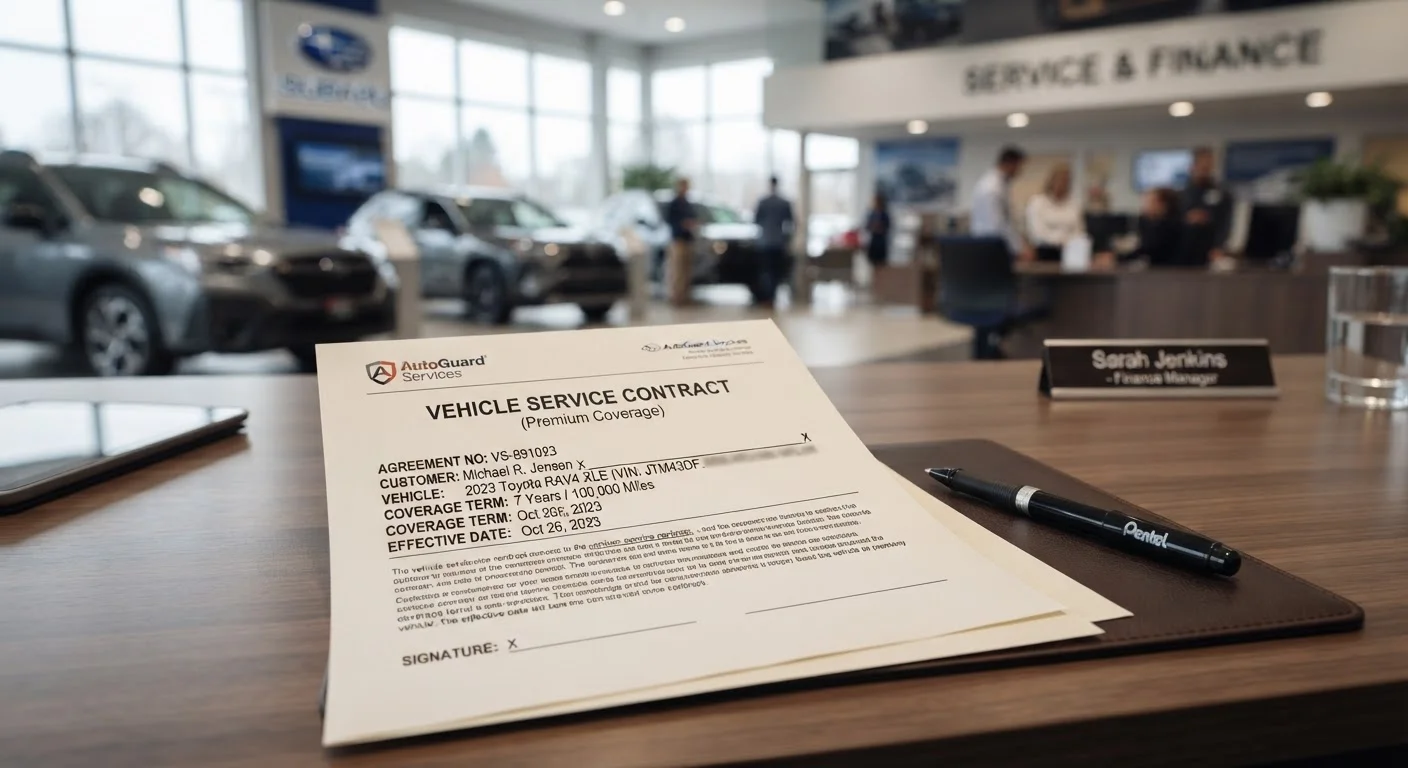
Request the actual contract document - not a brochure or summary sheet - before agreeing to anything. Summaries routinely omit exclusions that appear in the fine print.
The summary sheet shown in the finance office is a marketing document. The exclusion language that determines real-world claim outcomes lives in the full contract, which you have a right to review before signing.
Cross-check your factory warranty end date against the service contract's start date to identify any period of duplicate coverage you'd be paying for.
Overlapping coverage is one of the most common ways consumers overpay. If your factory warranty runs for another two years, a contract that begins today provides no incremental benefit during that window.
For vehicles approaching higher mileage, understanding what your contract excludes is as important as knowing what it includes. Review our car maintenance hub for guidance on the upkeep records that support future claims.
Who Backs the Contract Matters
A service contract is only as reliable as the company obligated to pay claims - and that company is often not the dealership. Contracts are typically backed by a third-party administrator, and in some states, by an insurance underwriter behind that administrator. If the administrator becomes insolvent, your contract may have little value.
Before purchasing, ask for the full name of the administrator (not just the branded contract name) and research the company. Some states maintain registries of licensed service contract providers. This is also relevant when comparing a dealer-sold contract against a manufacturer-backed CPO program - manufacturer programs are generally more straightforward in terms of claim administration. Our CPO vs. used comparison explains how certified pre-owned coverage differs from third-party service contracts.
Administrator Insolvency Is a Real Risk
Third-party service contract administrators do fail. When they do, consumers are typically left without coverage and with limited legal recourse. Before purchasing any contract backed by a third party, ask for the administrator's full legal name, research their standing in your state's registry if one exists, and confirm whether an insurance underwriter backs the contract as an additional layer of protection.
Key Terms and Clauses to Scrutinize
Beyond what is and isn't covered, several contractual mechanics determine the practical value of a service contract:
- Deductible structure
- Some contracts charge a deductible per repair visit; others charge per covered component repaired in a single visit. Per-component deductibles add up quickly on complex repairs.
- Repair facility restrictions
- Some contracts require repairs at a dealership service center; others allow any licensed repair facility. This affects your flexibility, especially when traveling.
- Claim authorization process
- Most contracts require the repair facility to contact the administrator for pre-authorization before beginning work. Understand how long this typically takes and what happens if parts are urgently needed.
- Transferability
- A transferable contract can be a selling point if you sell the vehicle privately, potentially increasing resale value.
- Cancellation and refund terms
- Most contracts allow cancellation within a defined period for a full refund, and on a prorated basis thereafter. Confirm this before signing.
Questions to Ask Before You Decide
The finance office closing pitch is designed to move quickly. Slow it down by asking direct questions:
- Who is the contract administrator, and who is the financial guarantor?
- Is this an exclusionary or named-component contract?
- Where can I take my vehicle for repairs?
- What is the deductible structure - per visit or per component?
- Does the contract overlap with my remaining factory warranty? If so, which takes precedence?
- What is the cancellation policy and refund schedule?
- Can I purchase this contract after today, and if so, within what timeframe?
That last question matters. Most service contracts are available for purchase within a window after sale - often 30 to 90 days, sometimes longer. You are not typically required to decide on the spot, regardless of how the offer is framed. Taking time to read the full contract document before committing is always reasonable.
This article is for general informational purposes only and does not constitute legal, financial, or professional automotive advice. Contract terms, state regulations, and product availability vary widely. Always read the complete service contract document and consult a qualified professional for guidance specific to your situation.