

Key Takeaways
Data Cap
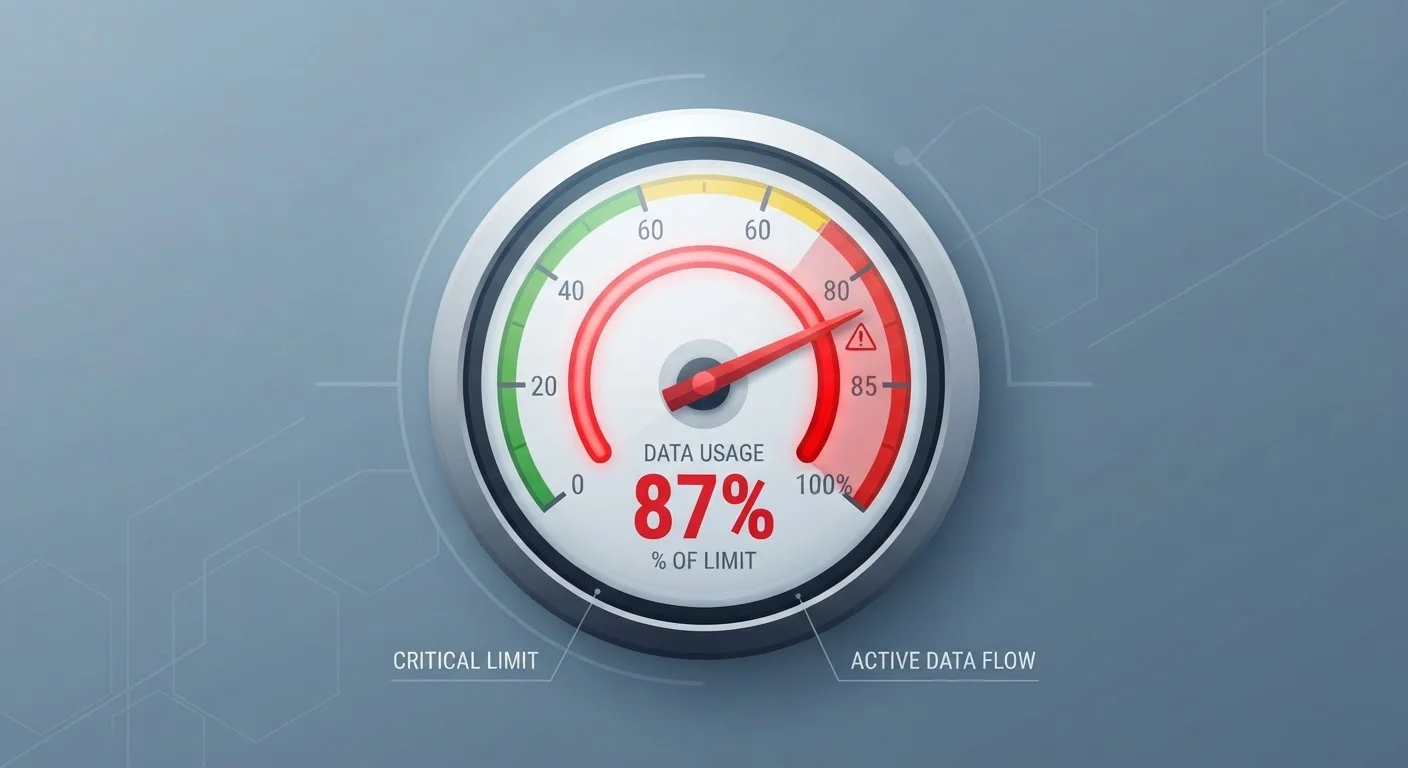
A data cap is a monthly limit on how much data your internet service provider (ISP) allows you to upload or download before applying a penalty or restriction. Once you hit that limit, your ISP may charge extra fees, slow your connection, or cut off service until the billing cycle resets. Caps are measured in gigabytes (GB) or terabytes (TB) and apply to your cumulative household usage.
ISPs measure data consumption at the modem or router level. Traffic from every connected device - smartphones, smart TVs, laptops, security cameras - counts toward the same shared household total.
How ISPs Measure and Enforce Data Caps
Every byte of data that flows between your devices and the internet - web pages loaded, emails sent, videos buffered, smart home devices syncing - is counted by your ISP at the point where your home connects to their network. This measurement happens at the modem level, which means using a VPN or switching devices does not reset or disguise your consumption total.
Hard caps trigger automatic responses when the threshold is crossed: either an overage charge or a speed reduction. Soft caps, by contrast, exist on some plans where no hard cutoff applies, but speeds may still be throttled during peak network hours as a congestion-management measure. The two policies can look similar from a consumer standpoint but operate differently in the fine print. See our ISP contract fine print guide to understand how these policies are disclosed.
Billing Cycle Resets Don't Carry Over
Unused data from one billing cycle does not roll over to the next on most ISP plans. If you use only 400 GB of a 1 TB cap one month, you still start fresh - not at 1,600 GB - when the new cycle begins. This makes it important to assess your average usage rather than relying on light-use months to offset heavy ones.
Why Data Caps Exist
ISPs cite network congestion management as the primary justification for data caps. The argument is that a small percentage of very heavy users can degrade service quality for the majority of customers on shared network infrastructure, particularly on cable and DSL networks where bandwidth is pooled among neighbors.
Critics and telecommunications researchers have long argued that caps also serve a revenue function - generating overage fees and incentivizing upgrades to more expensive plans. Whether caps meaningfully reduce congestion or primarily serve financial interests is a debated point in telecom policy circles. The practical reality for consumers is that caps exist on many plans regardless of their underlying rationale, and they need to be planned around.
“Data caps are not primarily a technical necessity - most congestion can be managed through network investment. They function more as a pricing mechanism that shapes consumer behavior and generates additional revenue.”
— Gigi Sohn, Telecommunications policy expert and former FCC counsel
Which Activities Consume the Most Data
Understanding what drives usage helps you assess whether a plan's cap will realistically affect you. Video streaming is by far the largest consumer. Standard-definition video uses roughly 1 GB per hour; HD streaming consumes 3-7 GB per hour; 4K Ultra HD streaming can use 15-25 GB per hour depending on the platform's compression settings.
Online gaming - contrary to common assumption - uses relatively modest data during play (often 40-150 MB per hour), but game downloads and updates can be massive, sometimes exceeding 50-100 GB per title. Video conferencing is moderate, running roughly 0.5-1.5 GB per hour per participant. Smart home devices, background app updates, and connected security cameras add a persistent low-level drain that accumulates over a month. For a broader picture of how speed and data interact in practice, see our explanation of what Mbps means for daily use.
When a Data Cap Actually Matters - and When It Doesn't
A 1 TB cap will be invisible to a one- or two-person household that streams moderately and works primarily with text-based applications. It becomes a real constraint for a household with multiple simultaneous 4K streams, several remote workers on video calls, and frequent large game downloads - that combination can push well past 1 TB in a single month.
The cap also matters more when your ISP's overage fees are steep or uncapped in total. Some providers charge a flat fee for an additional data block; others charge per-GB with no ceiling, which can result in unexpectedly high bills. If your ISP offers a cap-free tier at a premium, it may be worth calculating whether average overage costs would exceed the price difference.
Notably, the type of internet technology matters too. Fiber connections are more commonly offered without caps because their infrastructure handles high-usage households more efficiently. Cable and fixed wireless plans are more likely to include cap policies. Our plain-language guide to the U.S. internet market explains how infrastructure differences shape what consumers can access in their area.
Finally, be cautious about plans marketed as offering unlimited data - a term that requires scrutiny. As our coverage of why unlimited data plans are not all the same explains, throttling thresholds and deprioritization policies can significantly limit what "unlimited" delivers in practice.