

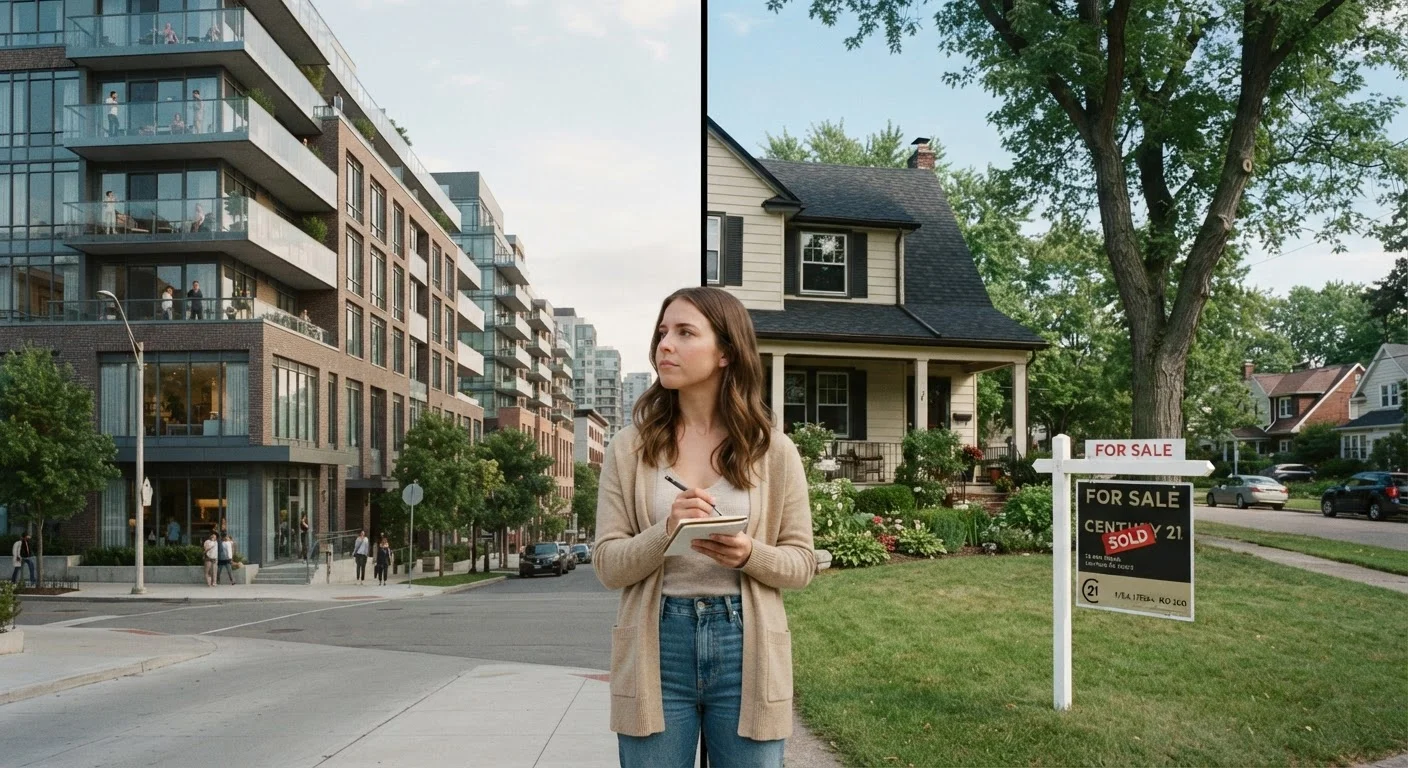
Key Takeaways
Option A
Renting
The flexible, lower-commitment path to housing.
Best for: People who prioritize mobility, have limited upfront capital, or are in transitional life stages.
Option B
Buying
The equity-building, stability-focused path to housing.
Best for: People with long time horizons, stable income, and sufficient savings for a down payment and ongoing ownership costs.
If you expect to relocate within the next three years
Renting
Transaction costs of buying and selling - typically 8-10% of the home price combined - are difficult to recoup in a short window. Renting preserves flexibility without the exit penalty.
If you have stable income, strong savings, and a long-term local commitment
Buying
Over a longer horizon, building equity and locking in a fixed mortgage payment can outpace rent increases and create meaningful net worth.
If you are in a high-cost market where price-to-rent ratios exceed 20
Renting
When home prices are very high relative to local rents, the financial math often favors renting and investing the down payment capital elsewhere - though individual circumstances vary.
If you want predictability and are ready for homeownership responsibilities
Buying
A fixed-rate mortgage locks in your principal and interest payment, while renting exposes you to annual rent increases at a landlord's discretion.
If your savings are insufficient for a down payment plus emergency reserves
Renting
Stretching finances thin to buy can leave you vulnerable to unexpected repair costs or income disruption; building savings first often puts you in a stronger ownership position later.
Why This Decision Resists Simple Answers
"Renting is throwing money away." "Buying is always a good investment." These popular phrases have persisted for decades - and both are misleading oversimplifications. The rent-vs.-buy decision is highly contextual, shaped by local market conditions, personal finances, lifestyle preferences, and time horizon. No single rule applies to everyone.
The goal of this framework is not to tell you which path is correct. It is to give you the structured questions and financial concepts you need to reason through the choice for your own situation. For a deeper look at the numbers behind the comparison, see running the real financial comparison.
| Criterion | Renting | Buying |
|---|---|---|
| Upfront cost | Security deposit, first/last month | Down payment, closing costs (3-6%+) |
| Monthly cost predictability | Rises at lease renewal | Fixed with fixed-rate mortgage |
| Equity building | None | Yes, over time |
| Maintenance responsibility | Landlord handles structural repairs | Owner bears all costs |
| Flexibility to relocate | High - typically 30-60 days notice | Low - selling takes time and money |
| Tax considerations | No property tax or deductions | Property taxes; mortgage interest may be deductible |
| Market risk exposure | Minimal | Significant - values can fall |
| Customization | Limited by lease terms | Full control as owner |
The Core Financial Variables
The most reliable starting point is your local price-to-rent ratio - calculated by dividing the median home purchase price in an area by the annual rent for a comparable property. A ratio below 15 generally suggests buying is more financially competitive; above 20, renting tends to look more attractive on a pure cost basis. Markets between 15 and 20 require more careful personal analysis.
But the ratio is only the beginning. Buying involves costs that never appear in a mortgage payment estimate: property taxes, homeowner's insurance, private mortgage insurance (if your down payment is below 20%), HOA fees where applicable, and maintenance - often estimated at 1-2% of home value annually. These can add hundreds or thousands of dollars per month to your true housing cost.
1-2%
Annual home maintenance cost estimate
A commonly cited rule of thumb among housing professionals is that homeowners should budget 1-2% of their home's value each year for maintenance and repairs.
8-10%
Combined buy-and-sell transaction costs
When accounting for buyer closing costs and seller agent commissions, total round-trip transaction costs often represent 8-10% of a home's purchase price.
5-7 years
Typical break-even horizon for buying
Real estate practitioners commonly cite a five-to-seven-year minimum stay as the threshold at which buying begins to outperform renting financially in many U.S. markets.
Renting, by contrast, concentrates your housing cost into a single monthly payment with a landlord handling structural maintenance. However, rent is subject to change at lease renewal, and you do not accumulate equity. To understand how landlords approach pricing decisions, the factors landlords use to set rent can be instructive for renters as well.
Lifestyle and Time Horizon
Financial modeling alone rarely settles this question. Your expected tenure in a location may be the most decisive factor. Transaction costs - agent commissions, closing costs, transfer taxes - typically represent 8-10% of a home's value when combined across purchase and eventual sale. Those costs require time in the home to be absorbed by equity growth and price appreciation.
Most practitioners suggest a minimum five-to-seven-year horizon before buying begins to outperform renting financially, though this varies significantly by market. If your career, family situation, or personal goals make mobility likely in the near term, renting preserves optionality that homeownership does not.
Ownership also brings responsibilities that renting does not: scheduling repairs, managing contractors, maintaining systems, and absorbing costs when things fail. For some buyers, this control is a significant benefit; for others, it is a burden. Honest self-assessment here matters. If you ultimately decide to buy, the choice between new construction and existing homes introduces another meaningful decision point.
Making the Call With Confidence
Use these questions as a personal checklist before deciding:
- Time horizon: Do you expect to stay in this area for at least five years?
- Financial readiness: Can you cover a down payment, closing costs, and a six-month emergency reserve without depleting savings?
- Local market: What is the price-to-rent ratio in the specific neighborhoods you are considering?
- Income stability: Is your income reliable enough to sustain a mortgage through economic uncertainty?
- Lifestyle fit: Do you want the flexibility to relocate, or do you value stability and the ability to customize your space?
Once you decide to buy, the structure of your financing matters too. Fixed-rate vs. adjustable-rate mortgages carry meaningfully different risk profiles depending on how long you plan to stay and your tolerance for payment variability.
This article is for general informational and educational purposes only and does not constitute financial, legal, or real estate advice. Readers should consult a licensed financial adviser, tax professional, or real estate attorney before making housing decisions based on their individual circumstances.