

Key Takeaways
Our Verdict
Buying outperforms renting financially when you have a long time horizon, a stable income, sufficient savings for upfront costs, and are purchasing in a market where price-to-rent ratios are moderate. Renting is often the smarter financial choice in high-cost markets, for those who need mobility, or when savings are better deployed elsewhere. There is no universal winner - the comparison only resolves when you run the numbers for your specific situation.
| Best for | Recommended |
|---|---|
| Those planning to stay in one location for seven or more years | Buying |
| Those in high-cost metros or needing geographic flexibility | Renting |
| Those with strong savings, stable income, and favorable local price-to-rent ratios | Buying |
| Those early in their careers or with uncertain income trajectories | Renting |
Why the Conventional Wisdom Gets It Wrong
For decades, homeownership has been framed as a financial no-brainer - an automatic path to wealth. Renting, by contrast, is often dismissed as "throwing money away." Neither characterization holds up to scrutiny. Renting is paying for housing, shelter, and flexibility; buying is paying for housing plus taking on a leveraged asset with real risks and real costs. The comparison is genuinely complex, and treating it otherwise leads to decisions people regret.
The honest starting point is recognizing that both options involve spending money every month - the question is what you get in return and whether the math works for your situation. See our broader framework for the rent-or-buy decision for the lifestyle factors that sit alongside the financial ones explored here.
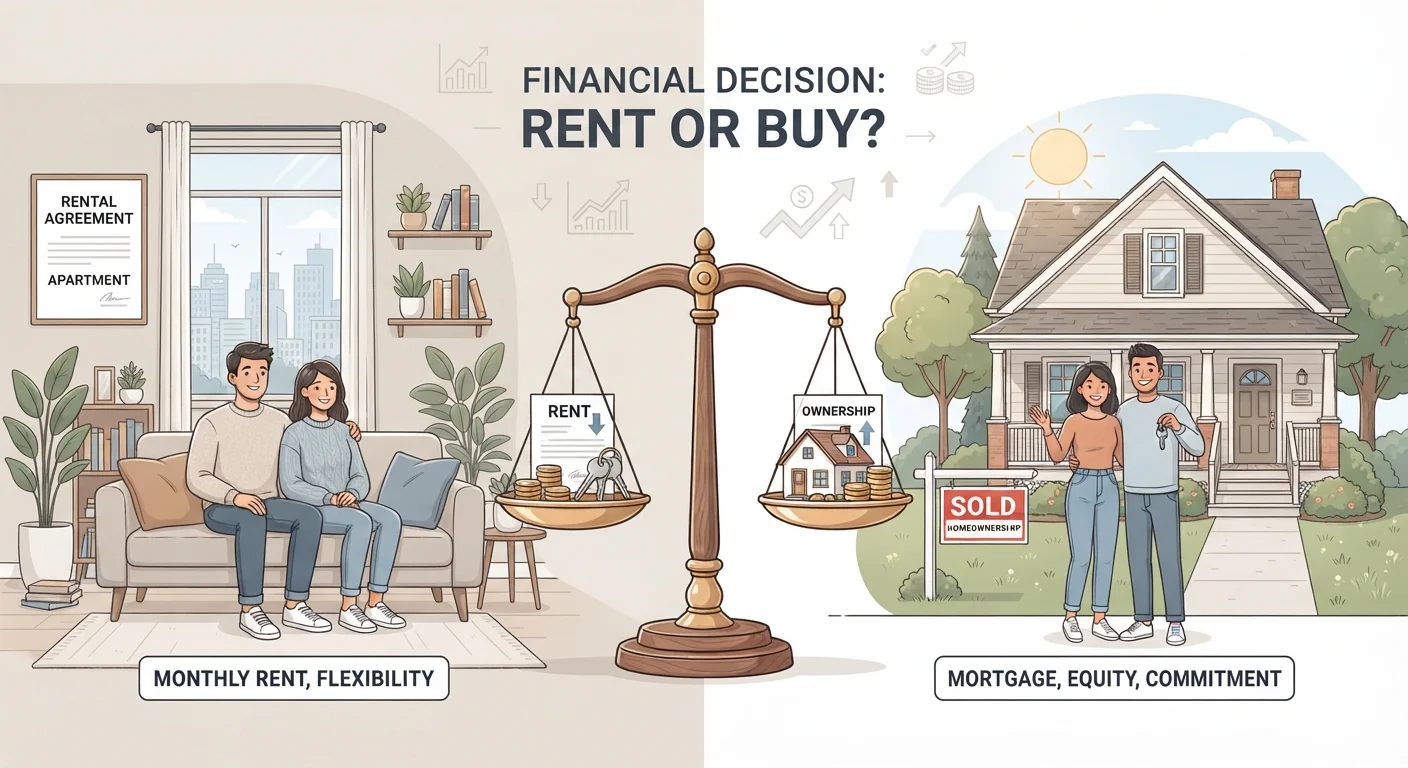
| Renting | Buying | |
|---|---|---|
| Upfront cost | First/last month + security deposit | Down payment + 2%-5% closing costs |
| Monthly cost predictability | Predictable until lease renewal | Variable (taxes, maintenance, insurance) |
| Equity accumulation | None | Grows over time via paydown and appreciation |
| Flexibility to relocate | High - end lease and move | Low - selling takes time and money |
| Exposure to home value changes | None | Full upside and downside risk |
| Maintenance responsibility | Landlord typically handles | Fully owner's responsibility |
| Tax considerations | No direct tax benefits | Mortgage interest/property tax deductions (varies) |
The True Cost of Buying
Most buyers focus on the monthly mortgage payment, but that figure represents only a portion of what homeownership actually costs. A more complete picture includes:
- Down payment: Typically 3%-20% of the purchase price, plus closing costs of 2%-5% - a meaningful cash outlay before you make a single mortgage payment.
- Property taxes: Vary widely by state and municipality, but commonly add 1%-2% of home value annually.
- Homeowners insurance: Generally $1,000-$2,500 per year for a median-priced home, though costs vary by region and coverage.
- Maintenance and repairs: A widely cited rule of thumb is budgeting 1% of home value per year, though older homes or larger properties can run higher.
- HOA fees: Where applicable, these can range from modest to significant - sometimes exceeding $500/month in some communities.
For a thorough breakdown, see the true cost of owning a home beyond the mortgage payment.
Build a Full-Cost Monthly Budget Before Deciding
Before comparing a mortgage payment to a rent payment, tally the complete monthly cost of ownership: mortgage principal and interest, property taxes, insurance, HOA fees if any, and a maintenance reserve. That figure - not the mortgage alone - is what you are actually comparing to rent. Many buyers discover the monthly gap is far smaller than they expected, or in some markets, larger.
The Price-to-Rent Ratio: A Core Diagnostic Tool
The price-to-rent ratio (PTR) is calculated by dividing a home's purchase price by its annual rent equivalent. A PTR of 15 or below generally signals that buying is financially competitive; ratios above 20 suggest renting may be more economical, all else equal. In many major US metros, PTRs have been well above 25 in recent years, meaning renters in those markets can often invest the difference between renting and owning costs and come out ahead - particularly over shorter time horizons.
This ratio is a starting point, not a verdict. Local appreciation expectations, your marginal tax rate, and how long you plan to stay all alter the math considerably.
20+
Price-to-rent ratio in many major US metros
A PTR above 20 generally indicates renting is more economical on a pure monthly-cost basis, according to real estate economists.
5-7 years
Typical break-even horizon for buying vs. renting
Most financial analyses suggest buyers need at least five to seven years in a home to recoup transaction costs through appreciation and equity.
1%-3%
Annual home maintenance cost as share of home value
Industry guidelines suggest budgeting 1%-3% of a home's value annually for maintenance and repairs, with older homes trending higher.
Breaking Even: The Time Horizon Test
Buying involves substantial one-time costs - closing costs, moving costs, and setup expenses - that take years to recoup. A commonly cited break-even threshold is five to seven years; before that point, the transaction costs alone can make buying more expensive than renting even if home values rise modestly. If there is any realistic chance you will relocate within five years, the financial case for buying weakens considerably.
Equity buildup also accelerates over time. In the early years of a standard amortizing mortgage, the majority of each payment covers interest rather than principal. Genuine equity accumulation through mortgage paydown picks up pace only in the middle and later years of a loan term.
What Renters Can Do With the Difference
A common oversight in rent-vs.-buy analyses is treating the down payment as money that simply disappears when renting. In reality, a renter who does not deploy savings into a down payment has capital available to invest. If that capital earns a meaningful long-term return - as broadly diversified index investments have historically, though past performance does not guarantee future results - the opportunity cost of tying up funds in a home becomes a real consideration.
This dynamic does not automatically favor renting; home price appreciation and the leverage effect of a mortgage can also generate significant returns. The honest answer is that the outcome depends heavily on local market conditions, the specific investment alternatives available to you, and your personal financial discipline. Consulting a licensed financial adviser before making this comparison for your own situation is advisable.
This article is for general informational and educational purposes only and does not constitute financial, tax, legal, or real estate advice. Consult a qualified professional before making housing or investment decisions.