

Key Takeaways
Separating Evidence from Garden Lore
Companion planting - the practice of growing certain plants near each other to gain mutual benefits - has been part of gardening culture for centuries. Some pairings have a real mechanistic basis. Others have been repeated so often they feel like facts but haven't held up when researchers have tested them systematically.
This doesn't mean folklore is worthless. Generations of practical observation have real value. But treating every traditional pairing as proven can lead to frustration when results don't materialize. The combinations below represent a range: some are well-supported, some are mixed, and one is a good reminder that popular advice isn't always correct. If you're just getting started with food gardening, approaching companion planting with clear expectations from the beginning will save you time and disappointment.
How to Evaluate Companion Planting Claims
When you encounter a claimed pairing, ask: is there a clear physical or chemical mechanism? Has it been tested outside of anecdote? Many popular combinations are based on observation under specific conditions that may not match yours. Treating unverified pairings as working hypotheses - rather than established facts - leads to better outcomes and more useful personal data over time.
Pairings Worth Knowing
Legumes and Heavy Feeders (Corn, Squash, Brassicas)
This is one of the most evidence-backed concepts in companion planting. Legumes - beans, peas, clover - host Rhizobium bacteria in their root nodules, which convert atmospheric nitrogen into a plant-available form. When legume roots decay at the end of the season, neighboring heavy feeders can access that stored nitrogen.
The key limitation: the benefit is largely post-season. The legume needs to die back and decompose for the nitrogen to transfer meaningfully. Inter-planting them simultaneously for an in-season nitrogen boost is a common misconception. Plant legumes as a cover crop or early-season predecessor to get the clearest payoff.
Legumes transfer nitrogen mainly after they die back - the payoff is largely post-season.
The Three Sisters: Corn, Beans, and Squash
The Three Sisters - a traditional Indigenous planting system - combines corn, beans, and squash in the same bed. The logic is sound on multiple fronts: corn provides a vertical structure for bean vines to climb, beans fix nitrogen, and squash leaves shade the soil, suppressing weeds and retaining moisture.
Research and extensive practical experience both support the physical interactions here. It's not magic; it's thoughtful polyculture. Spacing matters significantly - corn needs to be dense enough to support beans but not so crowded that it shades out the squash too aggressively. This combination rewards careful layout planning.
The Three Sisters succeeds because each plant fills a distinct physical role in the shared space.
Tomatoes and Basil
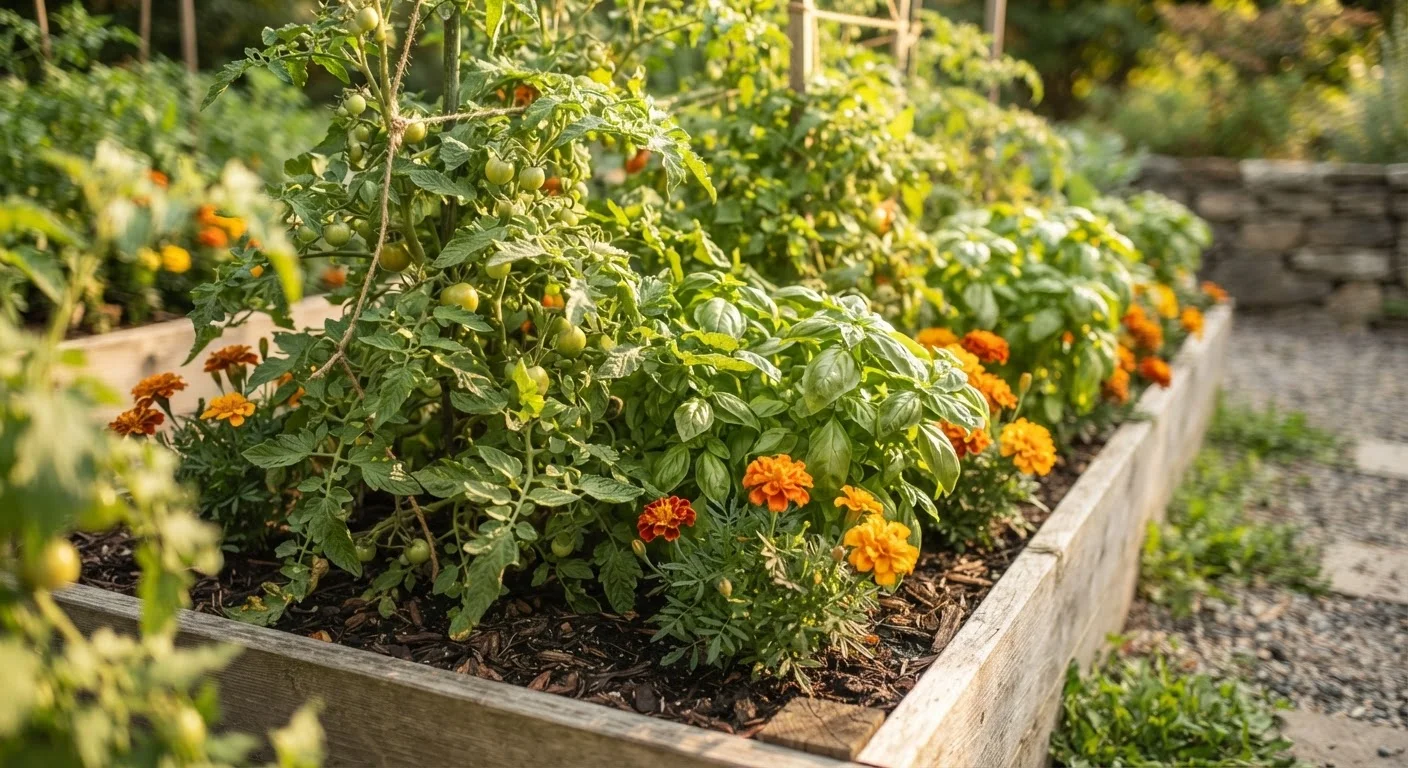
This is perhaps the most beloved pairing in American vegetable gardens, and the evidence is genuinely mixed. Controlled studies on whether basil's volatile compounds repel thrips, aphids, or spider mites from nearby tomatoes have produced inconsistent results. The mechanism is biologically plausible - aromatic compounds can deter some insects - but the effect appears highly variable depending on conditions.
What basil does reliably offer is attracting pollinators when it flowers, and it makes productive use of space between tomato plants. If you enjoy growing basil and tomatoes, there's no reason not to combine them - just don't rely on basil as pest control.
Basil and tomatoes coexist well, but basil's pest-deterrent effect on tomatoes is inconsistent in practice.
Marigolds as a Nematode Suppressor
Of all the companion planting combinations involving flowers, French marigolds (Tagetes patula) have the strongest research backing for a specific claim: suppressing root-knot nematodes in the soil. Studies have shown that marigold root exudates can reduce nematode populations - but only when marigolds are planted densely and allowed to grow for a full season, then turned under.
The casual practice of planting a few marigolds around the garden border for broad pest repellency is largely unsupported. That said, marigolds do attract beneficial insects and are a valuable addition to any vegetable garden for that reason alone.
Marigolds suppress soil nematodes effectively, but only when grown densely for a full season and turned in.
Dill, Fennel, and What Not to Plant Together
Companion planting isn't only about beneficial pairings - allelopathy (chemical inhibition between plants) is equally real. Fennel is one of the clearest examples: it produces compounds that inhibit the growth of many common vegetables, including tomatoes, peppers, and beans. It's generally best grown in its own dedicated space or at the garden's edge.
Dill has a more nuanced reputation. Young dill is often cited as beneficial near brassicas for attracting predatory wasps. However, mature dill can cross-pollinate with and negatively affect fennel, and it may inhibit some crops if it bolts and sets seed heavily nearby. Observing how mature dill behaves in your specific garden is worthwhile before committing it to a central bed position. Learning which plants support local beneficial insects can help you make smarter choices in this space.
Fennel is genuinely allelopathic - keep it isolated from most vegetable crops.
Tall Crops Providing Shade for Heat-Sensitive Neighbors
One of the most straightforward and reliable forms of companion planting involves using vertical growth to create microclimates. Tall crops - sunflowers, trellised cucumbers, pole beans - can shield heat-sensitive plants like lettuce, spinach, or cilantro from intense afternoon sun, extending their productive season into summer.
This is pure physics, not folklore. Placing shade-tolerant crops on the north side of tall plants (in the northern hemisphere) minimizes competition for sun while providing meaningful temperature relief. It requires thinking about sun angles and plant heights in your specific garden layout, but the payoff is real and predictable.
Placing shade-tolerant crops beside tall plants is a reliable, physics-based strategy with consistent results.
Keep a Simple Garden Journal
Recording what you planted together and what you observed - pest pressure, yield, plant vigor - over two or three seasons gives you locally specific data that no general guide can provide. Even brief notes made at planting time and again at harvest create a meaningful reference for future decisions.
Putting It Into Practice
The most productive approach is to treat companion planting as a series of educated hypotheses rather than guaranteed outcomes. Start with the combinations that have a clear physical or chemical rationale - nitrogen fixation, shade provision, or documented pest confusion - and track what you observe. Your microclimate, soil type, and local pest pressure all influence results in ways that no general guide can fully predict.
Keep in mind that companion planting works best when it sits inside a broader healthy garden system. Mulching consistently and building good soil with compost will contribute more to overall plant health than any single pairing. And if you're weighing how your garden is configured, the dynamics explored in raised beds versus in-ground planting can also affect how well companion strategies play out.