

Key Takeaways
Why Spray Foam Sparks So Much Confusion
Spray polyurethane foam (SPF) has become one of the most heavily marketed insulation products available to homeowners. It's promoted as an all-in-one solution for energy savings, air sealing, and moisture control - and while it genuinely excels in certain applications, the marketing often outpaces the nuance.
Part of the confusion stems from the fact that there are two fundamentally different products sold under the same name. Open-cell foam is soft, vapor-permeable, and less expensive. Closed-cell foam is rigid, vapor-resistant, and significantly more costly. They behave differently under heat, humidity, and structural stress - and mixing up which one you need is a common and expensive mistake.
Before committing to spray foam for any part of your home, it pays to separate what the product genuinely does from what installers and marketers sometimes imply. For a broader look at how air sealing fits into your home's energy picture, see our guide to sealing air leaks.
Common Myths - and What the Evidence Actually Shows
The claims surrounding spray foam insulation range from accurate to significantly overstated. The myth-and-fact breakdowns below address the most widespread misconceptions homeowners encounter when researching or pricing this upgrade.
Myth
Spray foam insulation is so effective that it replaces the need for any other air sealing.
Fact
Spray foam does seal air as it insulates, but gaps in application - especially around penetrations and transitions - still require attention.
Closed-cell spray foam does double duty as an insulator and air barrier when applied correctly and continuously. However, spray foam is applied by hand and in real conditions. Gaps around electrical boxes, plumbing penetrations, and framing transitions are common. Assuming the foam has sealed everything without post-installation verification can leave meaningful air leakage paths in place. A blower door test after installation is the only reliable way to confirm the assembly performs as intended.
Myth
Higher R-value per inch means spray foam is always the better insulation choice.
Fact
R-value per inch is one metric. Cost, moisture dynamics, and the specific building assembly determine whether foam is actually the best fit.
Closed-cell foam's R-value of approximately R-6 to R-7 per inch is genuinely higher than most alternatives. But in many assemblies - such as a vented attic floor - blown cellulose or fiberglass achieves the required total R-value at a fraction of the cost. The per-inch figure matters most in space-constrained installations where you can't simply add depth. Treating R-value per inch as the only variable leads homeowners to overspend on foam in situations where less expensive materials perform equally well.
Myth
Spray foam prevents all moisture problems in a home.
Fact
Closed-cell foam resists vapor diffusion, but open-cell foam does not - and either type can contribute to moisture issues if used in the wrong assembly.
This is one of the most consequential myths. Open-cell foam is vapor-permeable, meaning humid air can still move through it. In climate zones with significant heating or cooling loads, open-cell foam in certain wall or roof assemblies can allow moisture to accumulate at the sheathing - potentially leading to mold or rot. Closed-cell foam is a vapor retarder, which solves this in many assemblies but can trap moisture if installed over wet framing. The right foam type depends on your climate zone, the direction of vapor drive, and the full wall or roof assembly design.
Myth
Once spray foam is installed, your energy bills will drop dramatically right away.
Fact
Energy savings from spray foam vary widely depending on what was there before, your climate, and whether other parts of the building envelope were addressed.
Spray foam can produce meaningful energy savings, particularly when replacing no insulation or badly degraded insulation. But homes are systems. If your windows, doors, ductwork, or HVAC equipment are the primary source of energy loss, upgrading insulation alone may produce modest results. Expectations set by marketing - dramatic percentage reductions in heating and cooling costs - often reflect best-case scenarios that don't account for the many other variables in a real home. An energy audit before installation gives you a realistic baseline for what to expect.
Myth
Any contractor can apply spray foam - the product does most of the work.
Fact
Spray foam requires calibrated equipment, proper temperature management, and experienced technique; poor application produces a chemically compromised product.
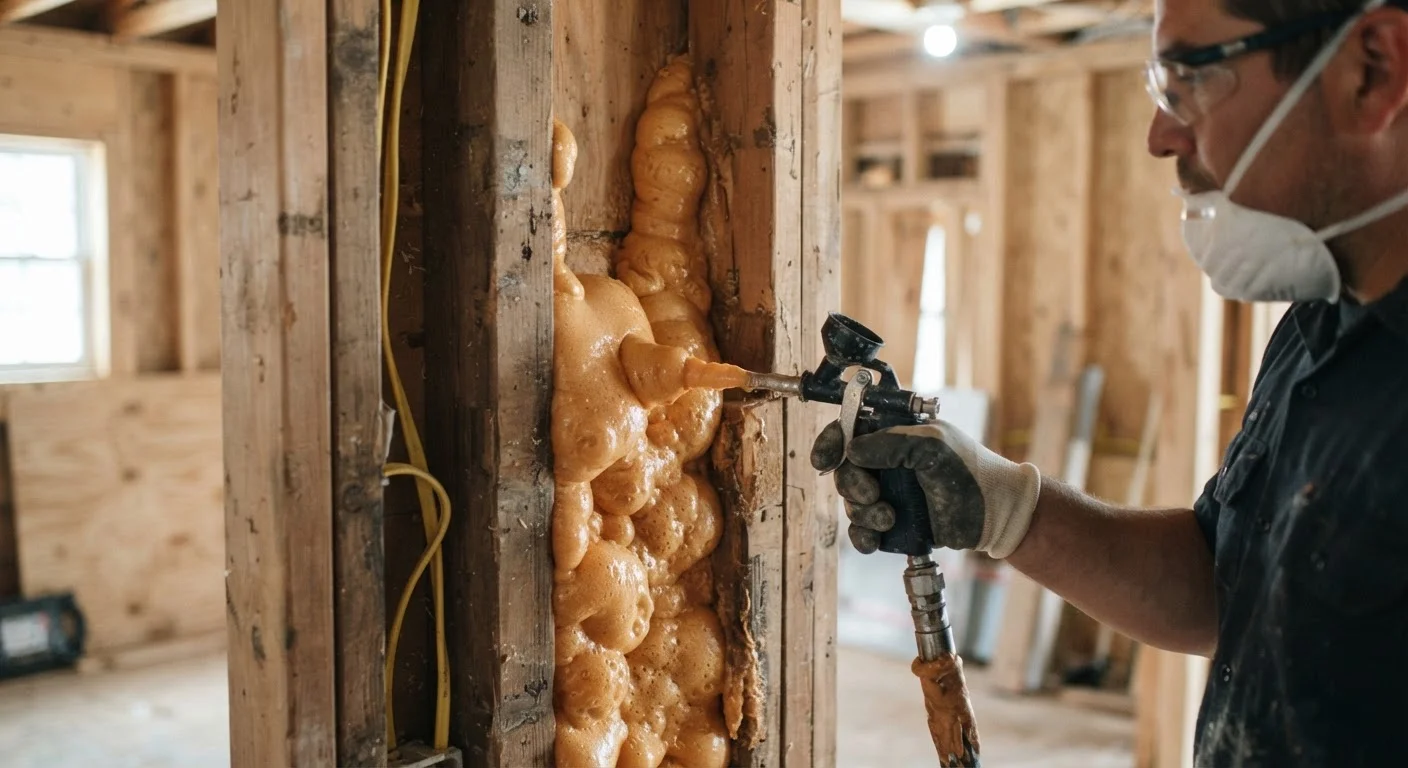
Unlike batt insulation, which a skilled DIYer can install, spray foam involves a reactive chemical system that must be mixed at precise ratios and temperatures. Substrate temperature, ambient humidity, and equipment pressure all affect the outcome. Foam applied outside its processing window may appear normal but have significantly reduced R-value, poor adhesion, or incomplete curing. Verifying that an installer is trained and experienced - and understanding what recourse exists if the installation underperforms - is an important part of the contracting process.
What Installers Don't Always Mention Up Front
Even when spray foam is the right choice, there are practical realities that don't always make it into the sales conversation.
Don't Insulate Over Wet or Damp Framing
Applying spray foam over framing with elevated moisture content can trap existing moisture and create conditions for mold growth or structural deterioration over time. Framing should be dry and at or below 19% moisture content before foam is applied. If your home has had any recent water intrusion, have the affected area fully dried and inspected first.
Off-gassing during and after installation is one of them. Freshly applied SPF releases chemical fumes as it cures - typically requiring occupants to vacate the home for 24 to 72 hours. Cured foam is generally considered stable, but the curing window requires proper ventilation and adherence to installer guidance.
Removal is difficult. Unlike batt insulation that can be pulled out if a pipe leaks or a wall needs opening, spray foam bonds to framing and sheathing. Repairs behind foam-insulated walls often involve cutting and chipping, which adds labor cost and can damage the surrounding structure.
R-value degrades with improper mixing. Spray foam is a two-component chemical system. If the ratio or temperature is off during application, the foam may not fully cure - producing a product with a fraction of its rated insulating value. This is why installer experience and equipment calibration matter enormously. For context on how insulation choices fit into a full attic project, our attic insulation walkthrough covers the key decisions involved.
Making a Decision That Fits Your Home
Spray foam is a legitimate, high-performing insulation option in the right circumstances - particularly for sealing complex geometries, insulating rim joists, or creating unvented attic assemblies where building science supports it. But it is not a universal upgrade that every home needs or benefits from equally.
Before proceeding, a qualified energy auditor or building performance contractor can assess your home's specific assembly and climate zone. Local building codes may also dictate which foam type is appropriate and whether a thermal barrier (such as drywall) must cover it. Many jurisdictions require permits for insulation work that affects fire safety ratings - always verify local requirements before work begins.
Spray foam tends to deliver the clearest value when it addresses a specific, documented problem - not as a wholesale replacement for a working insulation system. For a grounded look at how renovation decisions like this one can go wrong, home maintenance myths that cost homeowners money is worth reading alongside this one.