

Key Takeaways
Bathroom Ventilation
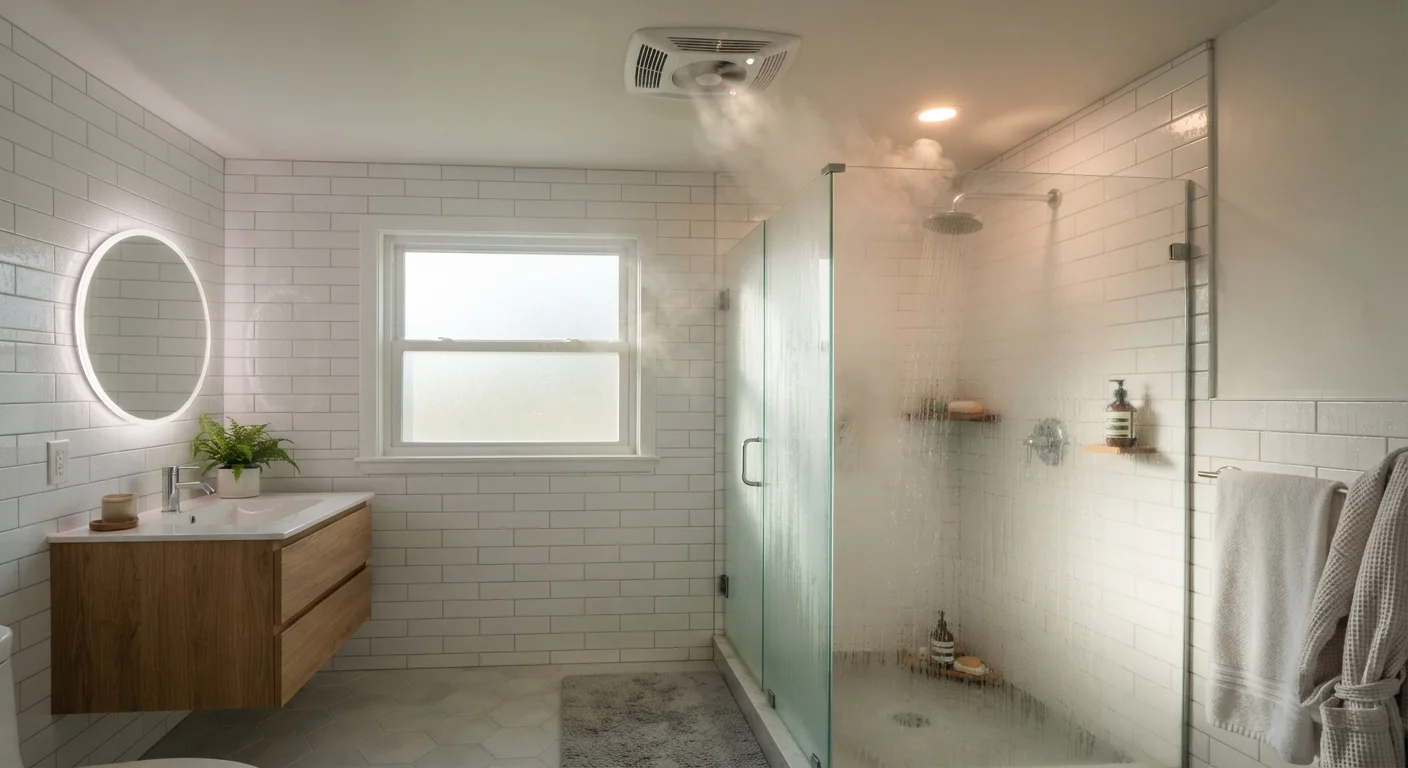
Bathroom ventilation refers to the process of removing warm, humid air from a bathroom and exhausting it outside the home. This is typically accomplished by an exhaust fan mounted in the ceiling or wall. Effective ventilation prevents moisture from accumulating on surfaces, which can cause mold growth, structural damage, and peeling finishes over time.
Ventilation capacity is measured in cubic feet per minute (CFM) - the volume of air a fan moves each minute. Building codes in most U.S. jurisdictions reference standards from ASHRAE and the HVI (Home Ventilating Institute) when setting minimum CFM requirements.
The Hidden Cost of Moisture You Can't See
Most homeowners think about bathroom ventilation only when a mirror fogs up or a ceiling develops a suspicious dark spot. By that point, moisture has usually been accumulating for months. Warm, humid air produced by showers and baths settles on cool surfaces - walls, ceilings, grout lines, and the wood framing behind drywall - where it creates the conditions mold and mildew need to thrive.
The damage isn't always visible right away. Paint begins to bubble and peel. Caulk separates from tile. Drywall softens. In poorly ventilated bathrooms over the long term, the structural framing itself can absorb enough moisture to develop rot. Repairs at that stage are far more disruptive and costly than installing or upgrading a fan ever would have been. As the home maintenance myths that cost homeowners money explains, small overlooked issues often snowball into significant expenses.
50%
Of homes with mold have bathroom moisture issues
The EPA notes that excess indoor moisture is among the leading contributors to mold growth in residential buildings, with bathrooms cited as a primary source.
1 CFM
Per square foot - the standard fan sizing baseline
The Home Ventilating Institute recommends a minimum of 1 CFM per square foot of floor area as the starting point for bathroom exhaust fan sizing.
15-20 min
Recommended post-shower fan run time
ASHRAE guidance and ventilation professionals generally recommend running a bathroom fan for at least 15-20 minutes after showering to clear residual humidity.
How Bathroom Exhaust Fans Actually Work
An exhaust fan draws air out of the bathroom and pushes it through ductwork to the exterior of the home - through either a roof cap or a wall vent. The fan motor spins a blower wheel that creates negative pressure, pulling room air in through the grille and forcing it out through the duct.
The critical detail is the exhaust destination. Duct runs that terminate in an attic, soffit cavity, or crawlspace are a common installation error - and a serious one. Moist bathroom air released into an attic creates the same problems you were trying to avoid in the bathroom, just in a less visible location. Proper installation routes the duct to a dedicated exterior termination point with a damper that closes when the fan is off, preventing outside air and pests from entering.
Duct length and bends also affect performance. Every 90-degree elbow and every additional foot of duct run reduces the effective airflow. When replacing or sizing a fan, account for the actual duct run rather than assuming rated CFM will match real-world output.
Duct Diameter Affects Airflow
Most bathroom fans use 4-inch ductwork, but higher-CFM fans may require 6-inch duct to perform at rated capacity. Installing a powerful fan on undersized duct creates back-pressure that dramatically reduces actual airflow. Always match the duct diameter to the fan manufacturer's specifications.
Sizing Your Fan: The CFM Formula
Fan capacity is measured in CFM - cubic feet per minute. The widely used baseline: 1 CFM per square foot of bathroom floor area for rooms up to 100 square feet. A 60-square-foot bathroom needs at least a 60 CFM fan; an 80-square-foot bathroom needs at least 80 CFM.
For larger bathrooms, or rooms with multiple fixtures, the Home Ventilating Institute recommends adding CFM by fixture: approximately 50 CFM per toilet, shower, and separate bathtub. A bathroom with a separate shower and soaking tub in a 120-square-foot space could reasonably require 150 CFM or more.
Noise is measured in sones. A fan rated at 1.0 sone or below is considered quiet - roughly equivalent to a library. Older or cheaper fans often run at 3-4 sones, which is noticeably loud. Quieter fans are more likely to actually be used, which matters more than any other specification.
Humidity-sensing fans are worth considering for households where the fan is frequently left on too short or skipped entirely. These fans detect relative humidity and run automatically until the air returns to a set threshold - removing the guesswork and the habit dependency.
Signs Your Current Ventilation Isn't Enough
If you're unsure whether your existing fan is adequate, look for these indicators:
- Mirrors stay fogged for more than a few minutes after a shower ends
- Condensation forms regularly on walls, windows, or the toilet tank
- Paint or wallpaper is peeling near the ceiling or around the shower
- Grout or caulk shows dark discoloration that returns after cleaning
- A musty smell lingers even after the room dries out
The tissue paper test is a quick field check: hold a single sheet of tissue near the running fan grille. If it holds against the grille, suction is present. If it falls, the fan is either clogged, undersized, or failing. Cleaning the grille and blades is the first step - dust accumulation alone can cut airflow dramatically.
Moisture problems in the bathroom rarely stay isolated. Water that penetrates walls can migrate into adjacent rooms and even affect structural components. This is part of why moisture control is a recurring theme in broader home maintenance - as covered in our guide to planning a basement finish, moisture management shapes nearly every renovation decision.
When to Call a Professional
Replacing a like-for-like exhaust fan in an existing ceiling cutout is often a manageable DIY task for homeowners comfortable with basic electrical work. However, several scenarios warrant professional involvement:
- Running new ductwork through finished walls or a roof
- Installing a fan in a bathroom that has never had one (requires new electrical circuits in most cases)
- Upgrading to a higher-CFM fan that requires a larger duct diameter
- Any work that requires a permit in your jurisdiction
Electrical work in bathrooms is governed by the National Electrical Code and typically requires a GFCI-protected circuit. Many municipalities require a permit for new fan installations. Check with your local building department before starting any work that goes beyond swapping a fan unit on an existing wiring run.
Proper ventilation is part of a larger picture of home health. Gaps in air sealing, for instance, can work against your ventilation system by allowing unconditioned air to enter the home in unexpected ways - something worth exploring in our article on sealing air leaks.