

Key Takeaways
Option A
Debt Avalanche
The mathematically optimal approach to minimizing interest paid.
Best for: Disciplined borrowers who want to pay the least possible in interest over time, regardless of how long early wins take.
Option B
Debt Snowball
The motivation-driven strategy built on quick psychological wins.
Best for: People who need visible progress to stay on track and are willing to pay slightly more in interest to keep momentum going.
If you want to minimize total interest paid
Debt Avalanche
By directing extra payments to the highest-rate debt first, the avalanche reduces the amount of interest accruing across your entire debt load - potentially saving hundreds or thousands of dollars compared to the snowball.
If you need early wins to stay motivated
Debt Snowball
Clearing smaller balances quickly creates a sense of progress that research suggests helps many borrowers remain committed to their repayment plan long-term.
If your highest-rate debts also happen to be your smallest balances
Debt Avalanche
In this scenario, the avalanche and snowball produce nearly identical results - choose the avalanche for its mathematical efficiency while still enjoying quick payoffs.
If you have a history of abandoning debt plans midway
Debt Snowball
Behavioral follow-through matters more than optimal math if an approach is abandoned early. The snowball's visible momentum may be more valuable than the avalanche's long-term savings for this profile.
The Core Mechanics of Each Method
Both the debt avalanche and debt snowball are structured repayment strategies. They share a foundational mechanic: you make minimum payments on all your debts each month, then direct any additional money toward one specific target debt. Once that target is paid off, its former payment rolls into the next target. The difference lies entirely in how you choose that target.
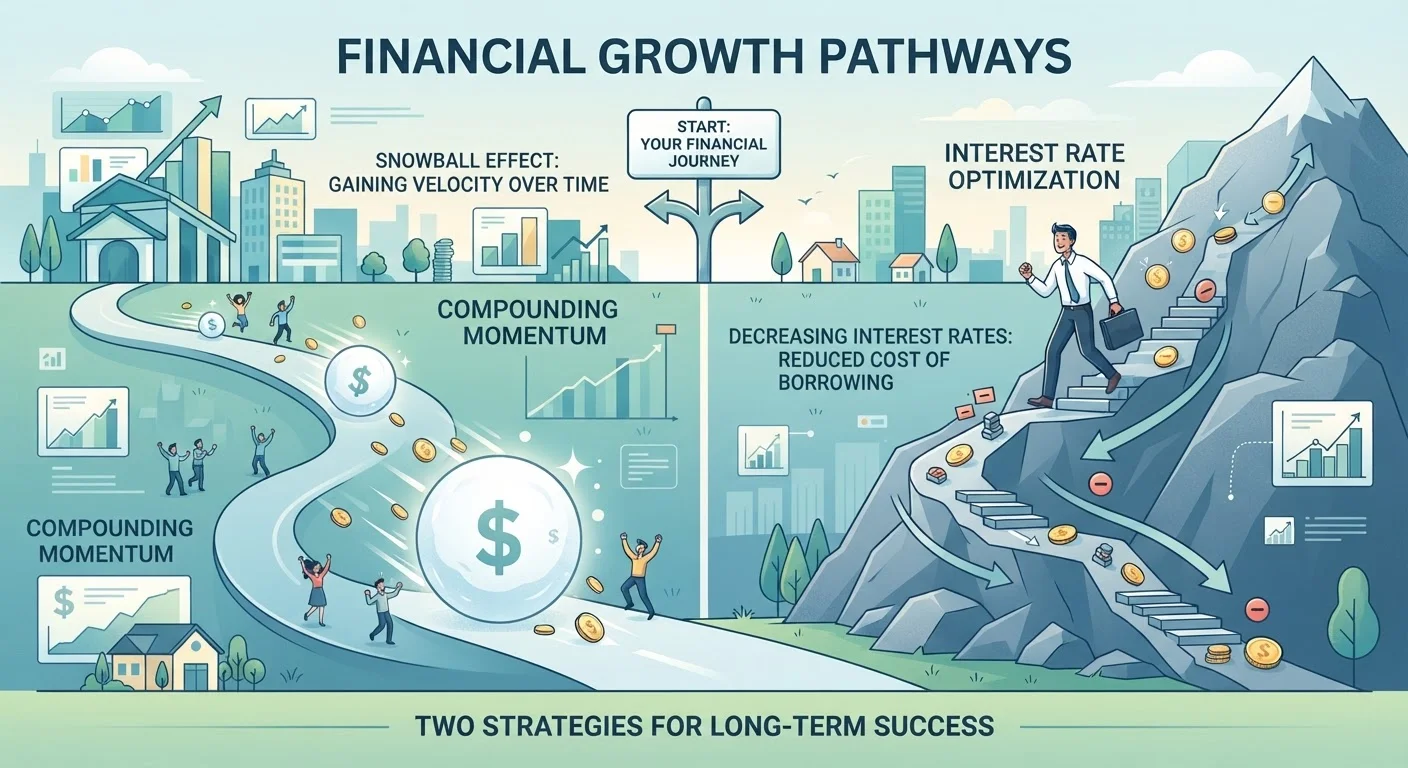
With the debt avalanche, you rank your debts by annual percentage rate (APR) - the interest rate - from highest to lowest. Your extra money goes to the highest-rate debt first. When it's gone, you move to the next highest rate, and so on. Because interest is the cost of carrying debt, eliminating high-rate balances first reduces what you pay in total over time.
With the debt snowball, you rank your debts by outstanding balance from smallest to largest. Your extra money attacks the smallest balance first. Paying off a full account quickly - even if it carries a modest interest rate - gives you a concrete win and frees up that account's minimum payment to accelerate the next debt on the list.
To understand which works for you, it helps to be clear on your current obligations. Our guide on secured vs. unsecured debt explains how different debt types behave and why the type of debt matters when prioritizing repayment.
| Criterion | Debt Avalanche | Debt Snowball |
|---|---|---|
| Payoff order | Highest APR debt first | Smallest balance first |
| Total interest paid | Lower (mathematically optimal) | Potentially higher |
| Time to first payoff | Longer if high-rate debt is large | Faster - smallest balance cleared quickly |
| Psychological impact | Delayed visible progress | Quick wins boost motivation |
| Best suited for | Disciplined, numbers-focused borrowers | Motivation-driven borrowers |
| Complexity | Requires tracking APRs | Simple balance ranking |
What Each Method Actually Costs - and What It Saves
The avalanche method's mathematical advantage is real. When higher-rate balances carry more of your debt load, eliminating them first prevents interest from compounding on large amounts over an extended period. The exact savings depend on your specific balances, rates, and how much extra you can pay each month - but the principle is consistent: interest saved grows in proportion to the rate differential between your debts.
The snowball method typically costs more in total interest because lower-rate debts may remain active longer while you clear small, possibly lower-rate accounts first. However, behavioral economics research has explored whether the motivation generated by quick payoffs helps people stay committed - and sustained effort on a slightly less efficient plan can outperform abandoning an optimal one. Neither strategy guarantees an outcome; your results will depend on your actual behavior over time.
~$1,000+
Potential interest savings with avalanche vs. snowball
The exact gap varies widely by debt mix, but analyses of representative debt portfolios commonly show four-figure savings when the highest-rate balance is also substantial.
65%
Americans carrying credit card debt month to month
According to Federal Reserve consumer credit data, a majority of cardholders carry a revolving balance, making repayment strategy selection particularly consequential.
20%+
Typical credit card APR in recent years
Federal Reserve data has shown average credit card interest rates exceeding 20% annually in recent periods, underscoring the cost of leaving high-rate balances unaddressed.
Both strategies require a budget that consistently produces surplus cash beyond minimum payments. If you haven't mapped out a monthly spending plan, reviewing popular budgeting frameworks can help you identify how much you realistically have available each month to apply toward debt reduction.
Choosing the Right Method for Your Situation
There is no universal right answer, and this article is general financial education - not personalized advice. The right method is the one that reflects both your financial reality and your behavior patterns honestly.
If your highest-rate debt is also a large balance, the avalanche is likely the stronger choice on paper. If that high-rate debt feels distant and discouraging, some financial planners suggest a hybrid approach: clear one or two small balances first to build momentum, then switch to avalanche ordering. This isn't mathematically optimal but it acknowledges that motivation is a real resource.
If you're carrying multiple debt types - a mix of credit card balances, personal loans, or installment debt - consider also whether consolidation makes sense before committing to either strategy. Our analysis of when debt consolidation helps and when it doesn't covers the trade-offs in detail.
Whatever method you choose, the habits you build now compound over time. The principles for keeping debt manageable over a lifetime go beyond any single payoff strategy - and are worth understanding as a complement to whichever approach you adopt.
This article is for general informational and educational purposes only and does not constitute personalized financial, tax, or legal advice. Consult a qualified financial professional before making decisions about your own debt repayment situation.