

Key Takeaways
Dynamic Currency Conversion
Dynamic currency conversion (DCC) is a service offered at many international payment terminals, hotel desks, and ATMs that lets you pay in your home currency - such as U.S. dollars - rather than the local currency of the country you're in. The conversion happens on the spot, and the rate used is set by the merchant or their payment processor, not your bank. While it offers the appearance of clarity, it typically costs more than letting your own card handle the conversion.
DCC providers profit by applying an exchange rate that includes a markup above the mid-market rate, often ranging from 3% to 12% or more depending on the operator. Your card issuer's foreign transaction fee, if any, is then applied on top of this already-inflated amount.
What Happens When the Terminal Asks Which Currency You'd Like
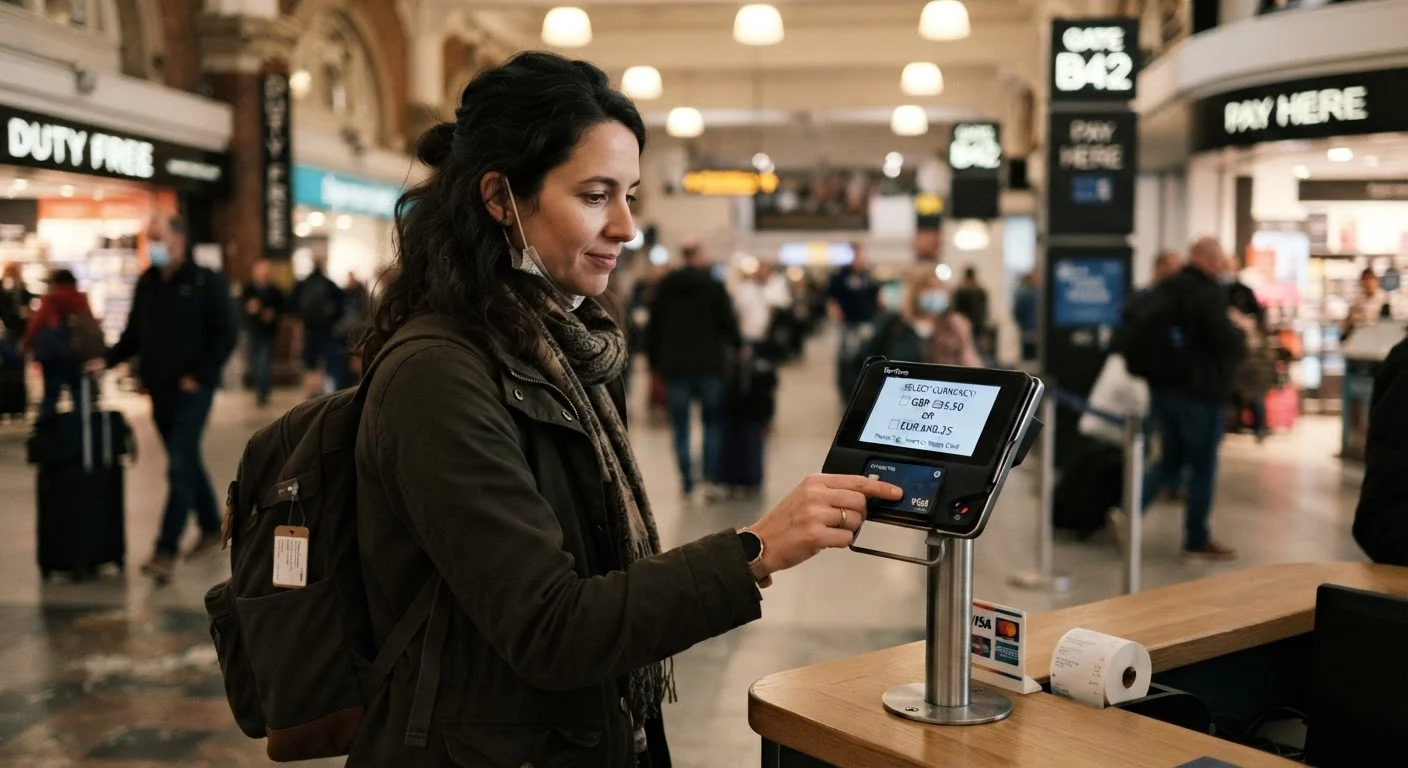
You've just landed, you're buying a coffee or checking into your hotel, and the payment terminal shows you a price in U.S. dollars alongside an exchange rate. It feels helpful - familiar, even. This is dynamic currency conversion at work.
DCC is offered by the merchant's payment processor, not your bank. The processor sets an exchange rate that includes a profit margin, then presents you with a dollar amount that looks straightforward but is quietly more expensive than the alternative. You're paying for the convenience of seeing a number in your home currency.
The key thing to understand: you don't have to accept it. Every time DCC is offered, you have the option to decline and pay in local currency instead. When you do that, your bank or card network applies its own exchange rate - which, in nearly all cases, is more favorable than the DCC rate.
Default to Local Currency at Every Terminal
Whenever a payment terminal or ATM abroad gives you a currency choice, selecting the local currency is the safer default. It removes the DCC markup from the equation and lets your card network - which typically offers more competitive rates - handle the conversion. Make it a habit before your trip so it becomes automatic.
For a broader look at how currency choices affect your spending abroad, see our guide to travel money, which covers cards, cash, and exchange mechanics in plain terms.
Why the DCC Rate Typically Costs More
Exchange rates are not fixed. There's a mid-market rate - the midpoint between what buyers and sellers trade currency for - and then there's the rate you actually receive, which includes a margin for whoever is processing the conversion. Your card network (Visa, Mastercard, and others) applies a margin above mid-market, and your bank may layer on a foreign transaction fee as well.
DCC adds another party: the merchant's payment processor. That processor sets its own rate, which often includes a markup of several percentage points. Independent analyses of DCC rates have consistently found them to be less favorable than card-network rates, frequently by a significant margin.
3%-12%
Typical DCC markup range above mid-market rate
Consumer finance researchers and payment industry analyses have estimated DCC markups commonly fall in this range, though specific rates vary by processor and merchant.
1%-3%
Typical card foreign transaction fee
Most credit and debit cards that charge a foreign transaction fee fall within this range, generally making local-currency payment less expensive than DCC even when a fee applies.
If your card carries no foreign transaction fee, paying in local currency means only the card network's thin margin applies. Even if your card does charge a fee - typically 1%-3% - it's usually still less than the DCC markup. This is why travel finance guidance consistently recommends declining DCC as a default practice.
You can find a broader discussion of these trade-offs - including how airport exchange kiosks compare to ATMs - in our article on airport currency exchanges vs. local ATMs.
Where You'll Encounter DCC - and How to Decline It
DCC appears in a few common travel situations:
- Retail and restaurant terminals: The screen may default to dollars before you confirm. Look for a 'pay in ' option or ask the cashier to switch it.
- Hotel checkouts: Front desks sometimes run DCC automatically. Before signing, check whether the charge is in local currency or dollars.
- ATMs abroad: After you enter your withdrawal amount, many machines ask whether you want the transaction processed in dollars or local currency. Always choose local currency.
In each case, the right move is the same: pause, read the screen, and choose local currency. If anything is unclear, it's reasonable to ask before the transaction is finalized.
DCC is one of several costs that quietly reduce what your travel budget actually buys. Our piece on hidden costs that erode travel budgets covers other charges worth anticipating before you go.
Putting DCC in Context With Your Broader Card Strategy
Understanding DCC is most useful when it's paired with knowing what your specific card actually charges for international transactions. Some cards waive foreign transaction fees entirely, making local-currency payment genuinely low-cost. Others charge 2%-3%, which still tends to beat DCC but narrows the gap.
If you regularly travel internationally, it may be worth reviewing your card's terms around foreign transactions before your next trip. The goal isn't to find a perfect card, but to understand the costs so you can make informed choices at the terminal.
For trips that span more than one country, the currency question gets more layered. Our guide to managing money across multiple countries addresses how to stay organized when exchange rates and card acceptance vary by destination.
And if you're weighing whether to carry cash at all, cash vs. cards abroad walks through the genuine trade-offs on both sides without prescribing a single approach.
Dynamic currency conversion isn't a scam - it's a legitimate (if expensive) service. What matters is that you understand what's being offered before you accept it.