

Key Takeaways
Our Verdict
For most travelers, a local ATM at your destination offers the most transparent path to competitive exchange rates, assuming your bank's foreign fees are low or waived. Airport kiosks are the costliest option and are best used only for small, urgent amounts. In-city exchange bureaus can be competitive but require careful vetting.
| Best for | Recommended |
|---|---|
| Travelers who want competitive rates with minimal effort | Local ATM at destination |
| Those needing a small amount of cash immediately upon landing | Airport kiosk (small transaction only) |
| Travelers in destinations where ATM access is limited or fees are high | In-city exchange bureau (vetted) |
| Frequent travelers seeking full control over exchange costs | Low-fee bank account with ATM fee reimbursement |
Why the Exchange Location Matters More Than You Think
When you convert dollars into a foreign currency, you're engaging in a transaction where the margin - the gap between the rate you receive and the true mid-market rate - determines how much value you lose. That margin varies enormously depending on where you exchange money. Understanding how exchange rates work is the foundation for making smarter choices on the road.
The three most common options for travelers are airport currency exchange kiosks, ATMs at your destination, and in-city exchange bureaus. Each carries a different cost structure, and none is universally perfect for every situation.
5-15%
Typical airport kiosk rate markup
Consumer financial researchers have consistently found airport currency exchange margins ranging from 5% to over 15% above the mid-market rate, depending on the operator and currency pair.
1-3%
Typical foreign transaction fee on bank withdrawals
Most U.S. banks charge between 1% and 3% of the transaction value for international ATM withdrawals, in addition to any flat fee from the foreign ATM operator.
Airport Currency Exchange Kiosks: Convenient but Costly
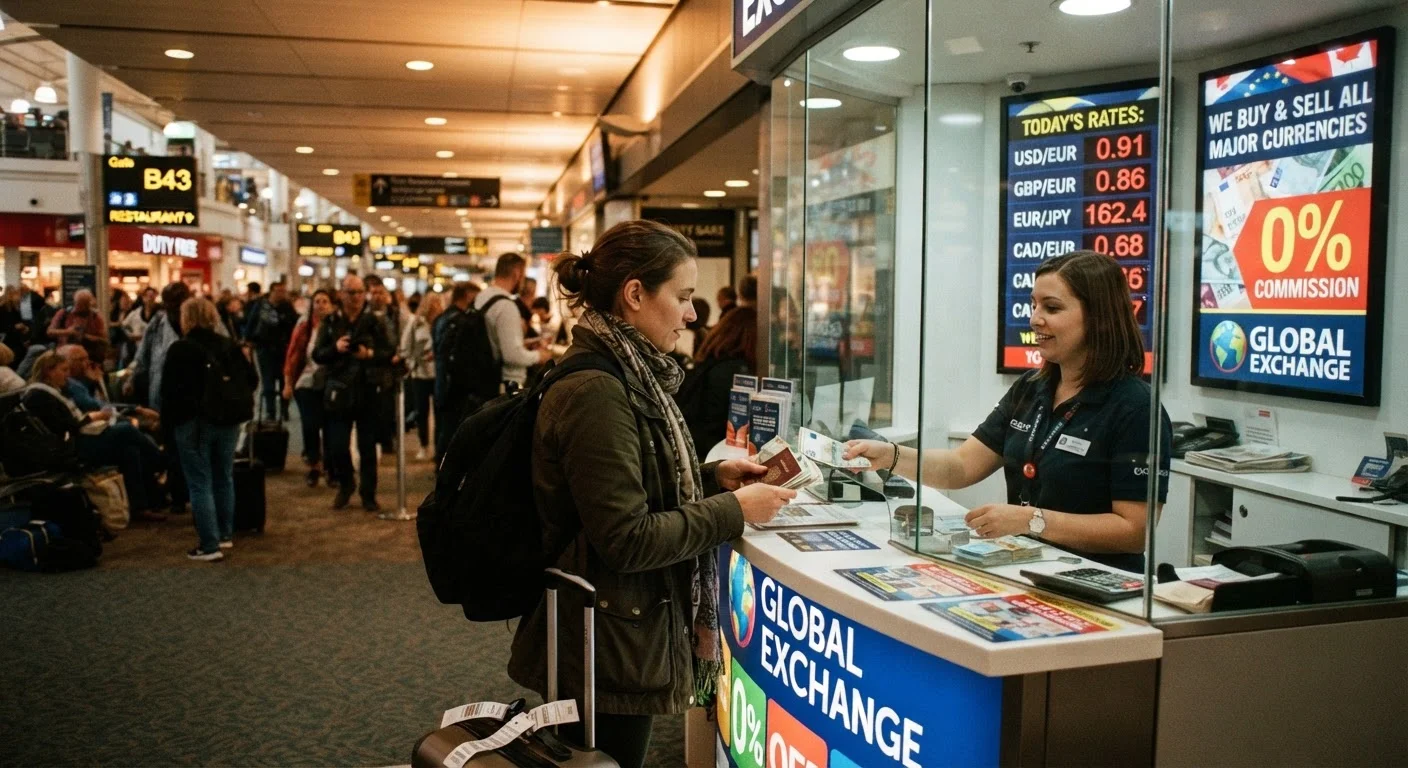
Airport kiosks operate in an environment with high foot traffic, limited competition, and customers who often haven't researched rates in advance. That combination allows operators to build substantial margins into their posted rates. The displayed rate - what you'll actually receive per dollar - is often significantly worse than the mid-market rate. Some operators also charge a flat service fee on top of the unfavorable rate.
That said, airport kiosks serve a real purpose: if you land and need local currency immediately for a taxi, transit card, or tip, having a small amount on hand matters. The practical approach is to exchange only what you need for the first few hours - enough to get from the airport to your accommodation - and rely on better sources for the remainder of your budget.
Avoid Exchanging Large Sums at the Airport
The convenience of airport kiosks comes at a steep price when large amounts are involved. A 10% unfavorable rate on a $500 exchange means $50 lost compared to a fairer rate - before any flat fees are added. Limit airport exchanges to what you genuinely need for the first hour or two of your trip, and plan to use an ATM or vetted bureau for the rest.
Local ATMs: Usually the Strongest Option
Withdrawing cash from a local ATM at your destination typically delivers a rate close to the interbank (mid-market) rate, because your home bank is accessing its network at wholesale pricing. The total cost depends on two factors: your bank's foreign transaction fee (often 1-3% of the withdrawal) and any flat fee charged by the foreign ATM operator. If you hold an account that reimburses ATM fees or waives foreign transaction charges, the ATM becomes a very competitive channel.
A few practical considerations: withdraw larger amounts less frequently to minimize per-transaction fees; always choose to be charged in the local currency rather than dollars if the ATM offers a choice (the latter triggers dynamic currency conversion, which adds cost); and use ATMs attached to reputable banks rather than standalone kiosks in tourist areas, where fees can be higher.
For a broader look at how cards and cash interact while traveling, see our guide on cash vs. cards abroad.
In-City Exchange Bureaus: Variable but Occasionally Competitive
Exchange bureaus in city centers, particularly in destinations that see high tourist volumes, range from excellent to predatory. The best bureaus - often found in local neighborhoods rather than tourist hotspots - offer rates that rival or beat ATMs, with no additional fee. The worst post attractive headline rates but apply hidden commissions at the counter or quote a different rate for small amounts.
When evaluating a bureau, ask the total amount you will receive before handing over any money. Confirm there is no additional commission beyond the rate shown. Reputable bureaus will state this clearly. Avoid bureaus with signs that say "0% commission" without disclosing the spread built into the rate - that spread is the real cost. Also check whether the bureau requires a minimum exchange amount, which can affect small transactions.
This source works well for larger exchanges in destinations where bureaus are regulated and competitive, such as many Western European cities. In regions with less oversight, ATMs remain the more predictable choice.
Side-by-Side Comparison
The table below summarizes how each option typically performs across the factors that matter most to travelers. Individual results will vary depending on your bank, destination country, and specific operator.
| Airport Kiosk | Local ATM | In-City Exchange Bureau | |
|---|---|---|---|
| Rate vs. mid-market | Often 5-15% worse | Usually 1-3% worse | 0-8% worse (varies widely) |
| Additional fees | Common flat fees | Bank & ATM operator fees | Sometimes hidden commission |
| Convenience | Very high - available on arrival | Moderate - requires ATM access | Low - requires research and travel |
| Rate transparency | Rate posted, fees may be buried | Bank discloses fees in advance | Must confirm total at counter |
| Best use case | Small urgent amount only | Most withdrawals, most destinations | Large amounts in competitive markets |
| Risk of poor deal | High | Low to moderate | Moderate to high |
For a fuller picture of how to think about travel money - including when cards outperform cash entirely - see our overview of travel money basics. If you're weighing whether to rely on a credit or debit card instead, our comparison of credit cards vs. debit cards for international travel covers the key differences.
This article is for general informational purposes only and does not constitute financial or travel advice. Exchange rates, fees, and availability vary by destination, bank, and operator. Always verify current terms with your financial institution and check official government sources for travel advisories before your trip.