

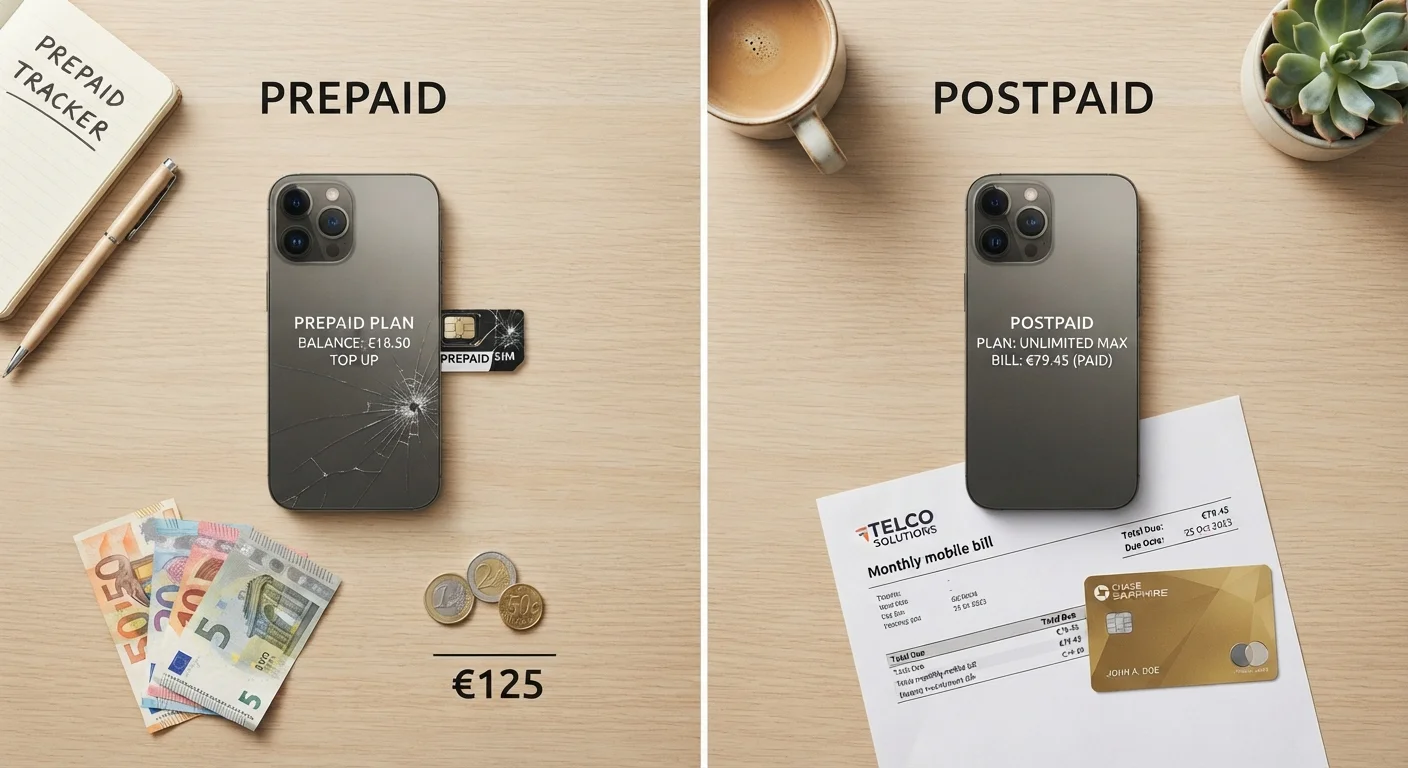
Key Takeaways
Option A
Prepaid Phone Plans
The pay-first, no-commitment approach to wireless.
Best for: Consumers who want cost predictability, flexibility, or don't need the latest flagship device tied to a carrier contract.
Option B
Postpaid Phone Plans
The traditional billing model with broader perks and device financing.
Best for: Households that want bundled family lines, premium priority data, and access to carrier device installment programs.
If you want a predictable monthly bill with no surprise overages
Prepaid Phone Plans
Prepaid accounts are funded before service activates, so spending is capped at whatever you load. There is no mechanism for your bill to exceed what you paid.
If your household runs multiple lines and values bundled streaming or hotspot perks
Postpaid Phone Plans
Postpaid family plans typically offer per-line discounts at higher line counts, plus bundled extras like streaming subscriptions and international features that prepaid tiers rarely match.
If you have limited or no credit history and want to avoid a credit check
Prepaid Phone Plans
Prepaid activation requires no credit inquiry, making it accessible to those building credit or preferring not to open a new billing account.
If you want to finance a new flagship device directly through your carrier
Postpaid Phone Plans
Carrier installment plans - spreading a phone's cost over 24 or 36 months - are almost exclusively available to postpaid customers with an active billing account.
If you travel internationally only occasionally and want domestic simplicity
Prepaid Phone Plans
For light international users, prepaid avoids the complexity of postpaid international add-ons, and short-term international SIMs remain an option when needed.
The Core Difference: When Money Changes Hands
The single structural distinction between prepaid and postpaid wireless is timing. With a prepaid plan, you pay before service is used - either as a flat monthly charge loaded to your account or as a balance drawn down per day or per usage. With a postpaid plan, the carrier extends you a line of credit for a billing cycle, and you pay the resulting bill at the end of the month.
That timing difference cascades into almost every other aspect of how the plans work: eligibility, pricing, perks, and what happens when you want to leave. For a broader look at how carriers structure their pricing, see our breakdown of wireless plan pricing.
| Criterion | Prepaid | Postpaid |
|---|---|---|
| Payment timing | Before service begins | After billing cycle ends |
| Credit check required | No | Yes, typically |
| Contract or termination fee | None | Possible with device financing |
| Network priority (congestion) | Lower priority | Higher priority on premium tiers |
| Device financing | Rarely available | Standard offering |
| Multi-line discounts | Limited | Common and deeper |
| Bundled perks (streaming, roaming) | Few or none | Frequently included |
| Bill predictability | High - capped at funded amount | Moderate - taxes and fees vary |
Where Prepaid Has the Advantage
Prepaid plans have closed much of the network quality gap that once made them a clear second-tier option. Today, most major prepaid brands run on the same underlying networks as their postpaid counterparts - often operated by the same parent company. The tangible advantages prepaid retains are structural:
- No credit check. Activation is open to anyone, regardless of credit history.
- No contract or termination fee. You can stop service at any point without financial penalty.
- Spending predictability. Because service is funded upfront, there are no overage charges or unexpected bill spikes.
- Lower headline price. Equivalent data allowances frequently cost less per line on prepaid, particularly for single-line customers.
The trade-off is network priority. When a cell tower is congested, postpaid customers on the same network typically get bandwidth first. For most users in most locations, this is imperceptible - but during large events or in heavily loaded urban areas, prepaid users may notice slower speeds. If you're still orienting yourself on plan fundamentals, a first-timer's guide to choosing a phone plan covers networks and data in accessible detail.
~40%
U.S. wireless subscribers on prepaid
Industry analysts have estimated that roughly four in ten U.S. wireless connections are on prepaid or MVNO plans, reflecting broad mainstream adoption rather than a niche use case.
$5-$15
Typical per-line taxes and fees added to postpaid bills
Government regulatory fees, carrier administrative charges, and local taxes routinely add this range above the advertised monthly rate on postpaid accounts.
Where Postpaid Has the Advantage
Postpaid plans earn their higher price points through features that prepaid tiers rarely replicate at the same depth:
- Priority data. On congested networks, postpaid accounts are deprioritized less aggressively, or not at all on premium tiers.
- Device financing. Carrier installment plans that spread a phone's cost over 24-36 months are almost exclusively a postpaid feature. See how carrier device financing actually works before agreeing to any installment arrangement.
- Multi-line pricing. Family accounts with three or more lines typically receive per-line discounts that compress the per-person cost significantly.
- Bundled perks. Streaming subscriptions, international roaming allowances, and higher hotspot data caps are more commonly available - and more generous - on postpaid premium tiers. Understanding what each plan tier actually includes helps you assess whether those perks justify the added monthly cost.
The postpaid model does require a credit check during account opening, and leaving mid-cycle may result in prorated charges. Device financing adds another layer: if your phone is tied to a carrier installment plan, switching carriers before payoff typically requires settling the remaining balance.
Hidden Costs on Both Sides
Neither structure is immune to fees that inflate the visible price. Postpaid bills routinely include regulatory recovery fees, administrative charges, and taxes that can add $5-$15 per line above the advertised rate. Autopay discounts - often $5-$10 per line - are standard on postpaid plans but require a linked payment method to activate.
Prepaid plans are generally simpler on this front: the price advertised is closer to what you pay, and many prepaid plans quote tax-inclusive pricing. However, activation fees, SIM kit costs, and international calling rates can add unexpected charges if not reviewed before purchase.
MVNOs: A Middle-Ground Worth Knowing
Mobile Virtual Network Operators (MVNOs) are carriers that lease network capacity from major carriers and sell prepaid service under their own brand. They often offer prepaid pricing with broad network coverage - sometimes on the same towers as the host carrier's postpaid customers. The trade-off is that MVNOs typically receive the lowest network priority during congestion and may have limited customer service options. If you're evaluating prepaid, understanding whether a plan is sold directly by a major carrier or through an MVNO matters for comparing coverage claims.
The clearest way to compare the true cost of any plan - prepaid or postpaid - is to calculate the monthly all-in cost: advertised price, minus any autopay discount you'll actually use, plus estimated taxes and fees, divided by the number of lines on the account.