

Key Takeaways
Gutter Clogging
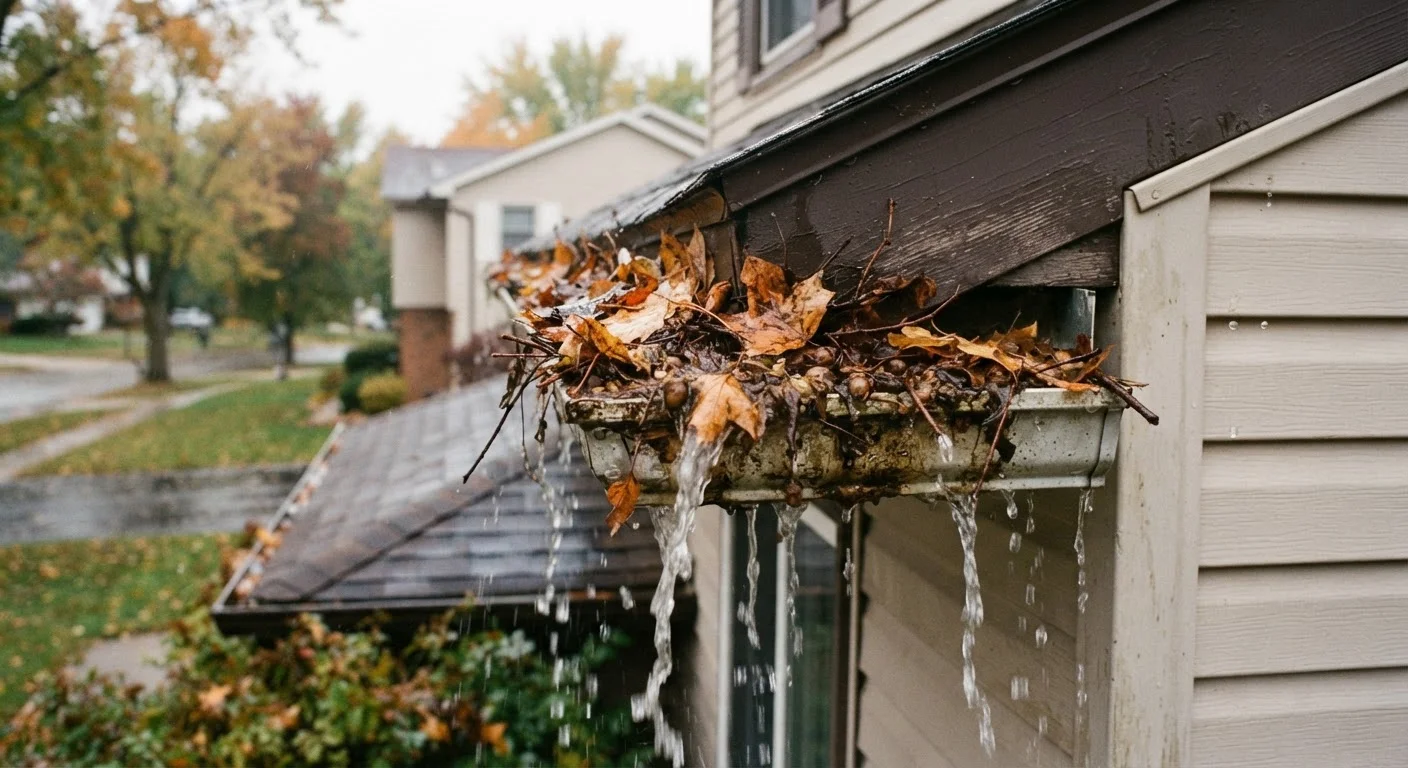
Gutter clogging happens when leaves, twigs, seeds, shingle grit, and other debris accumulate inside your home's gutters until water can no longer flow freely toward the downspouts. The blockage causes water to pool, overflow, or back up - often before homeowners notice anything is wrong. Because debris builds up incrementally and out of sight, clogs tend to develop far more quickly than most people expect.
Wet, compacted organic matter creates anaerobic conditions that accelerate decomposition and can add significant weight load to gutter hangers, potentially pulling sections away from the fascia board.
Why Debris Builds Up Faster Than You'd Expect
Most homeowners picture gutter cleaning as an annual autumn ritual - a single afternoon on a ladder before winter sets in. The reality is more demanding. A single mature oak tree can deposit dozens of pounds of leaves into nearby gutters over a two-week period. Add seed pods from maple trees in spring, pine needles shedding year-round, and shingle granules washing off aging roofs during every rainstorm, and you have a near-continuous supply of clogging material.
What makes clogs so deceptive is how quickly wet debris compacts. A loose handful of dry leaves occupies a lot of volume. Rained on and compressed, those same leaves form a dense mat that water cannot penetrate. A gutter that looked clear in September can be fully blocked by mid-October. This is why a once-a-year approach often leaves homeowners dealing with damage they thought they were preventing.
~$10,000
Average cost of foundation water damage repair
According to home repair cost surveys, foundation water intrusion - frequently linked to drainage failures including clogged gutters - carries average repair bills in the five-figure range.
2-4x
More frequent cleaning needed near trees
Industry guidance from roofing and gutter professionals consistently recommends two to four cleaning cycles per year for homes with mature trees overhanging or adjacent to the roofline.
48 hours
Time for mold to begin growing in wet debris
The EPA notes that mold can begin developing in moist organic material within 24 to 48 hours, meaning compacted wet leaves sitting in gutters create conditions that support mold growth on adjacent wood surfaces.
It's worth understanding that gutters and downspouts function as a connected system. A downspout choked with compacted debris at its elbow joint can back up an entire run of gutter even when the gutter channel itself looks passable. Always check downspouts separately - flush them with a garden hose and confirm water exits freely at ground level.
What Clogged Gutters Actually Do to Your Home
Overflowing water has to go somewhere. When gutters can't channel it to downspouts, it pours over the edge closest to your home's foundation, saturates window wells, seeps behind siding, and pools against basement walls. Over time this steady pressure is one of the more common - and preventable - contributors to moisture intrusion. If you're weighing bigger-ticket repairs, the guide to prioritizing home repairs can help you understand how gutter-related water damage fits into the larger picture.
The roof itself isn't immune. When gutters overflow backward rather than forward, standing water wicks under roofing materials at the eaves. In freezing climates, trapped water in a clogged gutter creates ideal conditions for ice dams - ice formations that force meltwater beneath shingles and into the attic or ceiling structure.
Fascia boards - the wooden trim directly behind and supporting the gutter - absorb water from overflowing or sagging gutters. Rotted fascia requires the gutter to be removed for repair, turning a simple cleaning job into a carpentry project. These are exactly the kinds of compounding consequences that common home maintenance myths tend to overlook when they suggest gutters are low priority.
A homeowner in a neighborhood lined with large silver maples cleans his gutters each November and considers the job done for the year. By April, the gutters are packed with seed pods that dropped through the winter and early spring, and water is pouring over the front edge during every rain.
A family notices a damp smell in their finished basement every spring but can't identify a leak. An inspection reveals that their rear gutters have been partially clogged for at least two seasons, directing overflow against the foundation wall.
After installing foam gutter inserts, a homeowner skips all gutter maintenance for three years. When she finally climbs up to inspect, she finds the foam is saturated, has begun to decompose, and is hosting a healthy crop of moss and small weeds.
A homeowner in a northern climate skips his late-fall gutter cleaning, leaving a thick layer of wet leaves sitting in the gutter channel through December. An early freeze locks the debris in place and ice dams form at the eaves, eventually forcing water under the shingles and into the ceiling of a bedroom below.
A Season-by-Season Cleaning Framework
Rather than treating gutter maintenance as a single annual task, think of it as a seasonal rhythm tied to what your specific landscape is shedding.
- Late spring (May-June): Clear pollen, seed pods, and any debris left from winter storms. Check that downspout extensions are still directing water at least three feet from the foundation.
- Midsummer (July-August): A quick visual inspection suffices unless storms have been severe or trees overhang the roofline closely. Look for standing water in gutter channels, which signals a partial blockage or improper slope.
- Late fall (November): The most critical cleaning of the year. Wait until the majority of leaves have dropped before cleaning so you aren't back on the ladder two weeks later. Flush gutters with a hose after clearing debris to confirm free flow.
- Late winter (February-March): Inspect for damage from ice and heavy snow loads. Look for separated joints, pulled-away hangers, and any sections that have developed a backward slope toward the house.
Time Your Fall Cleaning Strategically
Resist the urge to clean gutters at the first sign of falling leaves. If you clean too early in autumn, a second wave of shedding will refill the gutters before winter. Wait until at least 80-90% of leaves have dropped from nearby trees - typically late October through mid-November depending on your region - so one thorough cleaning carries you through to spring.
New homeowners often don't realize how much their specific tree situation changes the calculus. If your property has large trees close to the roofline, the standard twice-a-year schedule is a floor, not a ceiling. The first-year homeowner guide covers this and other maintenance realities that catch people off guard in the early months of ownership.
Practical Steps for Effective Gutter Maintenance
Cleaning gutters effectively takes the right sequence, not just effort. Start at the downspout end and work away from it - pushing debris toward a low point makes it easier to remove and prevents a newly cleared downspout from getting re-clogged during cleaning. Use a small plastic scoop or gloved hands to remove bulk debris before hosing, rather than trying to flush heavy buildup with water pressure alone.
After clearing debris, run a hose from the far end of the gutter toward the downspout. Water should move quickly and exit at the bottom without backing up. If water drains slowly, there is likely a secondary blockage in the downspout - use the hose at full pressure directed downward into the downspout opening to dislodge it. Persistent clogs may require a plumber's snake.
Check the gutter slope while water is running. The gutter should angle slightly downward toward the downspout - roughly a quarter-inch of drop for every ten feet of run. A section holding standing water has either lost its slope due to hanger failure or accumulated debris has pushed it out of alignment. Hanger replacement is a straightforward repair for most homeowners.
If you're considering gutter guards, understand what you're buying. Guards that use micro-mesh screens perform better against fine debris than open-top foam inserts, but even the best designs require occasional clearing of the guard surface itself. No product turns gutter maintenance into a zero-effort task - it reduces frequency, not the need entirely.