

Key Takeaways
Option A
Solid Hardwood Flooring
The traditional, time-tested option milled from a single piece of wood.
Best for: Dry, climate-controlled living spaces where long-term refinishing and maximum longevity are priorities.
Option B
Engineered Wood Flooring
The moisture-resilient, versatile alternative built for real-world conditions.
Best for: Basements, kitchens, and regions with significant humidity swings where dimensional stability matters.
If you're installing in a main-level living room or bedroom with stable humidity
Solid Hardwood Flooring
Stable, dry conditions are where solid hardwood thrives. You'll also have the most refinishing flexibility over decades of ownership.
If you're finishing a basement or installing over radiant heat
Engineered Wood Flooring
Engineered wood's cross-ply core handles moisture and temperature fluctuations without the cupping and gapping risks associated with solid hardwood.
If long-term refinishing potential is your top priority
Solid Hardwood Flooring
A solid plank's full wood thickness allows multiple sandings over its lifetime, making it easier to refresh or change the stain color in the future.
If you want the look of real wood in a high-humidity or below-grade space
Engineered Wood Flooring
Engineered wood provides an authentic hardwood surface layer while its layered construction makes it suitable for environments where solid wood would expand and buckle.
How Each Floor Is Actually Built
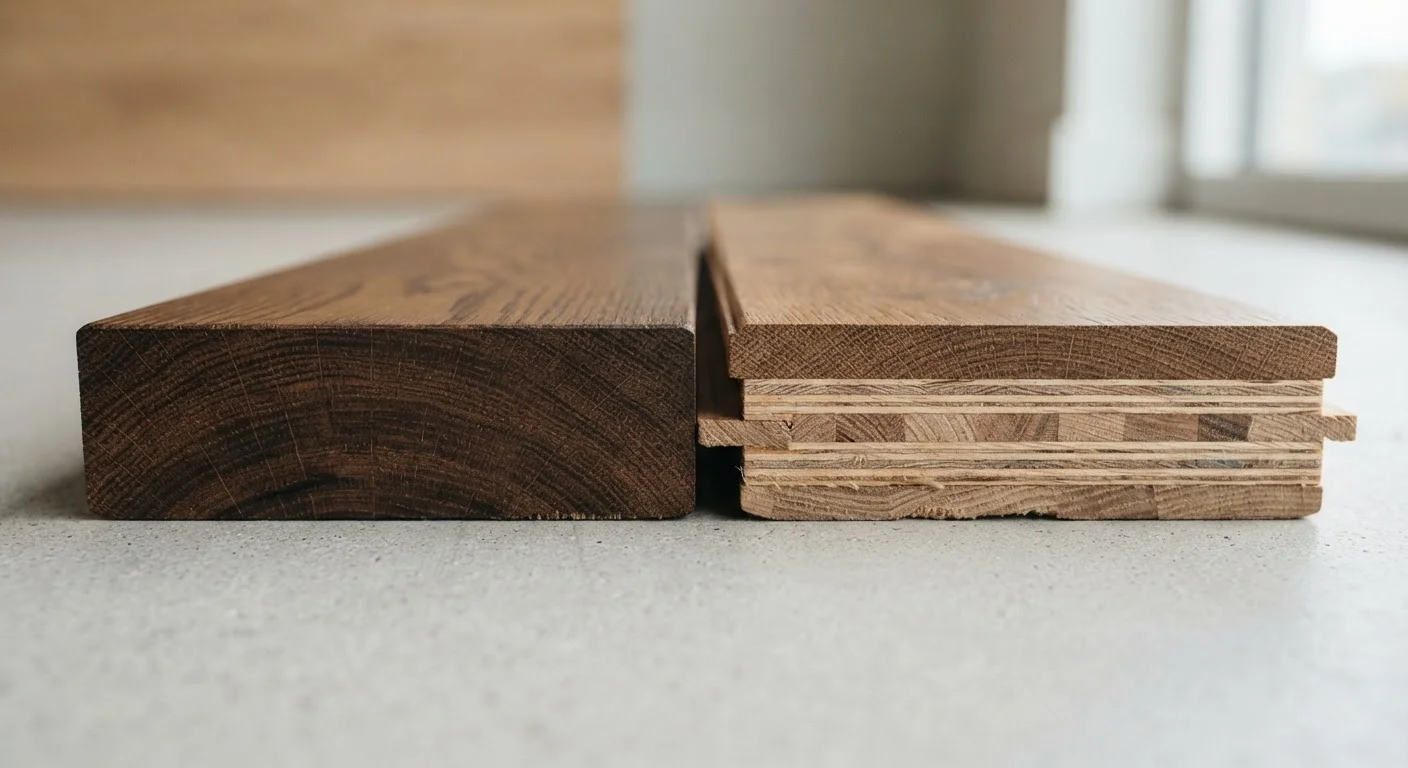
The most important distinction between solid hardwood and engineered wood isn't visible from above - it's in the construction beneath your feet.
Solid hardwood is exactly what the name suggests: each plank is milled from a single, continuous piece of timber. Common thicknesses run from ¾ inch down to ⅜ inch. Because the entire plank is one species of wood throughout, it responds uniformly to changes in temperature and humidity - expanding and contracting as a whole unit.
Engineered wood flooring, by contrast, is a layered composite. A thin veneer of real hardwood - called the wear layer - sits on top of multiple cross-laminated plies of wood or high-density fiberboard. Those plies are bonded with the grain running in alternating directions, which dramatically counteracts the natural tendency of wood to swell or shrink. The result is a plank that behaves more predictably across a wider range of conditions.
Understanding this construction is directly relevant to what "structural" means in a renovation context, because subfloor compatibility, load distribution, and moisture barriers all factor into which option is appropriate for your space.
| Criterion | Solid Hardwood | Engineered Wood |
|---|---|---|
| Construction | Single piece of milled timber | Hardwood veneer over cross-laminated plies |
| Moisture resistance | Low - prone to cupping and gapping | Higher - stable across humidity changes |
| Suitable locations | Above-grade, climate-controlled rooms | Above, on, or below grade; over radiant heat |
| Refinishing potential | Multiple times over lifespan | Limited by wear layer thickness |
| Typical plank thickness | ¾ inch to ⅜ inch | ⅜ inch to ¾ inch (varies by product) |
| Surface appearance | Real wood throughout | Real wood veneer - visually identical |
| Installation methods | Nail/staple down; glue down | Float, glue, nail, or staple down |
Moisture, Movement, and Where Each Floor Belongs
Wood is a hygroscopic material - it absorbs and releases moisture from the surrounding air. This is the central reason these two flooring types aren't interchangeable in every room.
Solid hardwood expands noticeably in humid conditions and contracts in dry ones. In above-grade rooms with controlled HVAC, this movement is manageable with proper installation gaps. But in basements, over concrete slabs, or in kitchens and bathrooms with frequent moisture exposure, solid hardwood faces a much higher risk of cupping (edges rising), crowning (center rising), or gapping.
Engineered wood's cross-ply core resists this movement more effectively. Its alternating grain layers work against each other to keep the plank flatter and more dimensionally stable. This makes it the more suitable option for below-grade installations, rooms over radiant heating systems, and climates where indoor humidity swings are common.
¾ inch
Standard solid hardwood plank thickness
Most solid hardwood flooring sold in the U.S. is ¾ inch thick, providing substantial material for sanding and refinishing over time.
1-6 mm
Engineered wear layer thickness range
The hardwood veneer atop engineered planks varies significantly by product tier, directly affecting how many times the floor can be refinished.
That said, engineered wood isn't waterproof. Prolonged standing water or flooding will damage it just as it would damage solid hardwood. The advantage is in everyday humidity variation, not in submersion resistance.
Refinishing, Longevity, and the Long View
One of solid hardwood's most valued attributes is its refinishing potential. Because the entire plank is real wood, it can be sanded down and refinished multiple times - often four to six times over its lifespan depending on thickness - allowing homeowners to repair surface damage, change the stain color, or simply restore the original luster.
Engineered wood's refinishing capability depends entirely on the thickness of its wear layer. Thinner veneer layers (around 1-2 mm) may only tolerate one light sanding, if any. Higher-end engineered products with wear layers of 4-6 mm can typically be refinished once or twice. This is an important factor to evaluate when comparing options, since wear layer thickness varies widely across the market.
In terms of overall lifespan, solid hardwood installed in appropriate conditions and maintained well can last generations. Engineered wood, while durable, generally has a more finite functional life before replacement becomes more practical than refinishing. Neither outcome is guaranteed - both depend heavily on foot traffic, maintenance, and whether the floor was installed correctly for its environment.