

Key Takeaways
Nutrition Facts Label
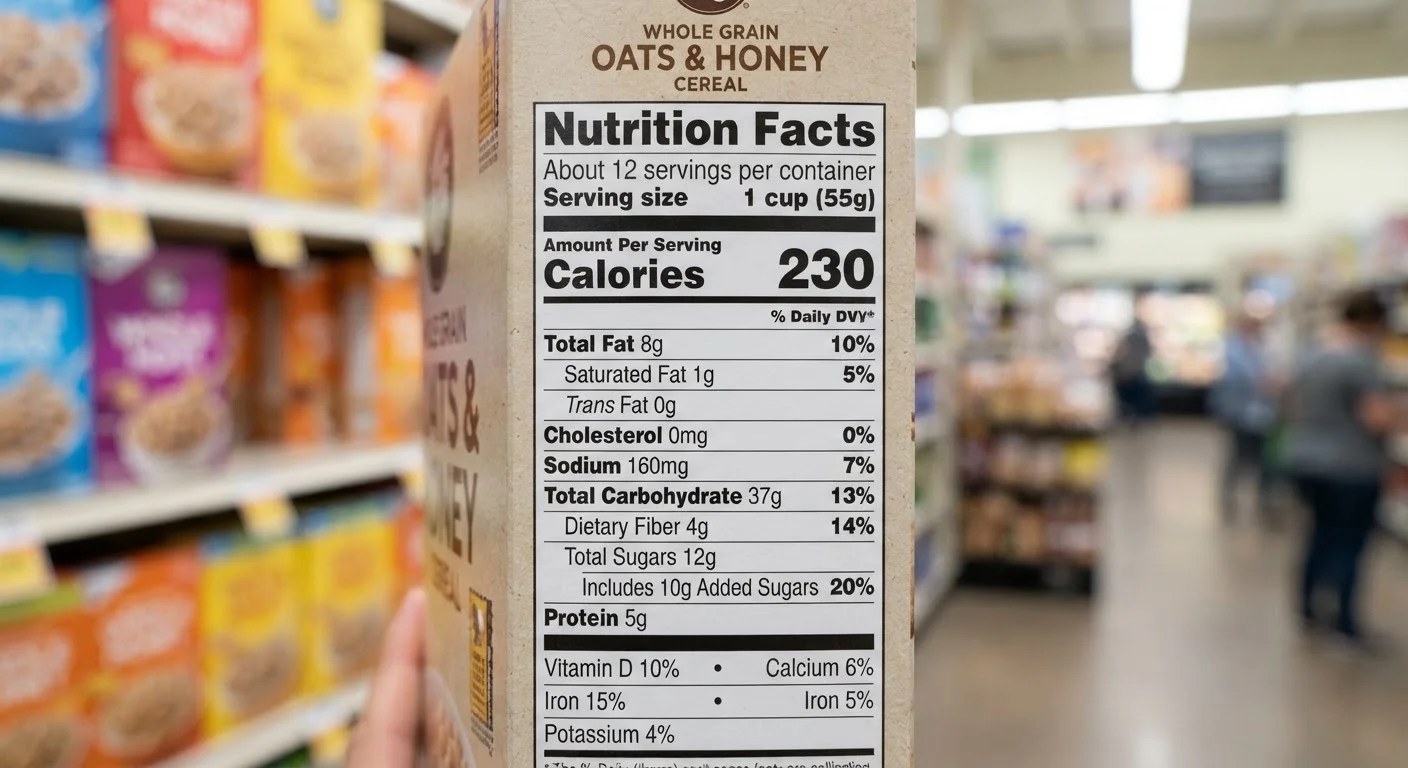
The Nutrition Facts label is the standardized black-and-white panel required on most packaged foods sold in the United States. It discloses the serving size, calorie count, and amounts of key nutrients - giving consumers a consistent, regulated way to understand what they're eating.
The current label format was updated by the FDA in 2020 to reflect newer dietary science, including the addition of 'added sugars' as a distinct line item and updated Daily Value percentages based on revised dietary guidelines.
Start With Serving Size - Everything Flows From There
The very first thing to read on any Nutrition Facts label isn't the calorie count - it's the serving size. Every number that follows is calibrated to that single serving. A bag of chips listing 150 calories per serving doesn't tell you much until you notice the bag contains three servings.
The FDA standardizes serving sizes using reference amounts based on what people typically consume, not what they should consume. That distinction matters. A 20-ounce bottle of juice may list one serving as 8 ounces, meaning the full bottle contains 2.5 servings - and 2.5 times every nutrient listed.
The updated label also now requires that if a package is reasonably consumed in one sitting, it must display nutrition for the entire package alongside the single-serving information. This dual-column format makes the real-world math much more transparent.
The Two-Step Label Check
Before reading any other number on the label, check two things in order: the serving size, then the number of servings per container. This tells you the denominator for every other figure on the panel. Skip this step and the rest of the label can mislead you without technically being inaccurate.
Decoding % Daily Value: Your Quickest Nutrition Benchmark
The right-hand column of the label - % Daily Value (%DV) - is one of the most useful tools for quick comparisons. It tells you how much a nutrient in one serving contributes toward recommended daily intake targets, all anchored to a 2,000-calorie reference diet.
A practical rule of thumb recognized by the FDA: 5% DV or less means a food is low in that nutrient; 20% DV or more means it's high. Use this to rapidly scan whether a food is loading you up on sodium or genuinely delivering meaningful fiber.
Keep in mind that the 2,000-calorie baseline is a general reference point. Your actual needs vary with age, sex, body size, and activity level. The %DV is best used for comparison shopping and identifying nutritional outliers - not as a personalized prescription. For tailored guidance, a registered dietitian is your best resource.
77%
Americans exceed recommended sodium intake
According to CDC data, the vast majority of U.S. adults consume more sodium than the 2,300mg daily limit recommended in federal dietary guidelines.
5% or less
%DV threshold for a 'low' nutrient source
The FDA defines 5% Daily Value or less per serving as 'low' for any nutrient, making this a quick benchmark when scanning labels for sodium, saturated fat, or added sugars.
17g
Average daily fiber intake among U.S. adults
The Dietary Guidelines for Americans set an adequate intake of around 25-38g of fiber per day depending on age and sex; most adults fall well short of that target.
Nutrients to Watch - in Both Directions
The label groups nutrients into two broad categories, though it doesn't always state this explicitly. Nutrients to limit include saturated fat, trans fat, sodium, and added sugars - consistent overconsumption of these is linked in research to increased risk of cardiovascular disease, hypertension, and metabolic conditions. Nutrients to prioritize include dietary fiber, vitamin D, calcium, iron, and potassium - areas where many Americans fall short.
The addition of added sugars as a distinct line item in the updated label is particularly valuable. A plain yogurt and a flavored yogurt might have similar total sugar counts, but the flavored variety may pack 20 grams of added sugars on top of naturally occurring lactose. That distinction matters for understanding your actual intake.
For a deeper look at what fiber specifically delivers - and which everyday foods provide it - see the evidence behind eating more fiber.
What the Label Can't Tell You - and Why Context Matters
The Nutrition Facts label is an excellent tool, but it has real limits. It can't convey how a food fits within your overall dietary pattern, account for the way nutrients interact, or distinguish between highly processed ingredients and minimally processed ones that happen to share the same macronutrient profile.
Front-of-package marketing - words like "natural," "multigrain," or "light" - operates largely outside the label's regulated structure. These terms can create a health halo that the actual label contradicts. Reading a food label without getting misled by front-of-package claims explains exactly what those terms mean legally, and when to look past them.
It's also worth separating label literacy from broader nutrition science. Understanding what a label reports is a skill; knowing which nutrients to prioritize, and why, is a separate layer. If you encounter persistent nutrition claims that seem contradictory or confusing, nutrition myths that refuse to die offers an evidence-based reality check on the most common ones.
Ready to apply what you've learned here to your actual meals? Building a balanced plate walks through how to use food group and portion concepts alongside label reading to put practical nutrition into everyday practice.
This article provides general nutrition information for educational purposes only and is not a substitute for personalized advice from a registered dietitian or qualified healthcare professional.