
Mediterranean Eating Pattern vs. Standard American Diet: A Nutritional Comparison

Key Takeaways
Our Verdict
Decades of research consistently position the Mediterranean eating pattern as nutritionally superior to the typical Standard American Diet across most key health markers, particularly cardiovascular and metabolic outcomes. The Standard American Diet's reliance on ultra-processed foods, added sugars, and refined grains is well-documented as a driver of chronic disease risk. That said, practical, affordable improvements are accessible to most people regardless of where they currently start.
| Best for | Recommended |
|---|---|
| Those focused on heart health and long-term disease prevention | Mediterranean Eating Pattern |
| Those seeking a realistic starting framework with minimal dietary change | Gradual Mediterranean-style shifts from a current American diet baseline |
| Those managing budget constraints while improving diet quality | Mediterranean-inspired eating using affordable staples like legumes, canned fish, and seasonal produce |
Defining the Two Patterns
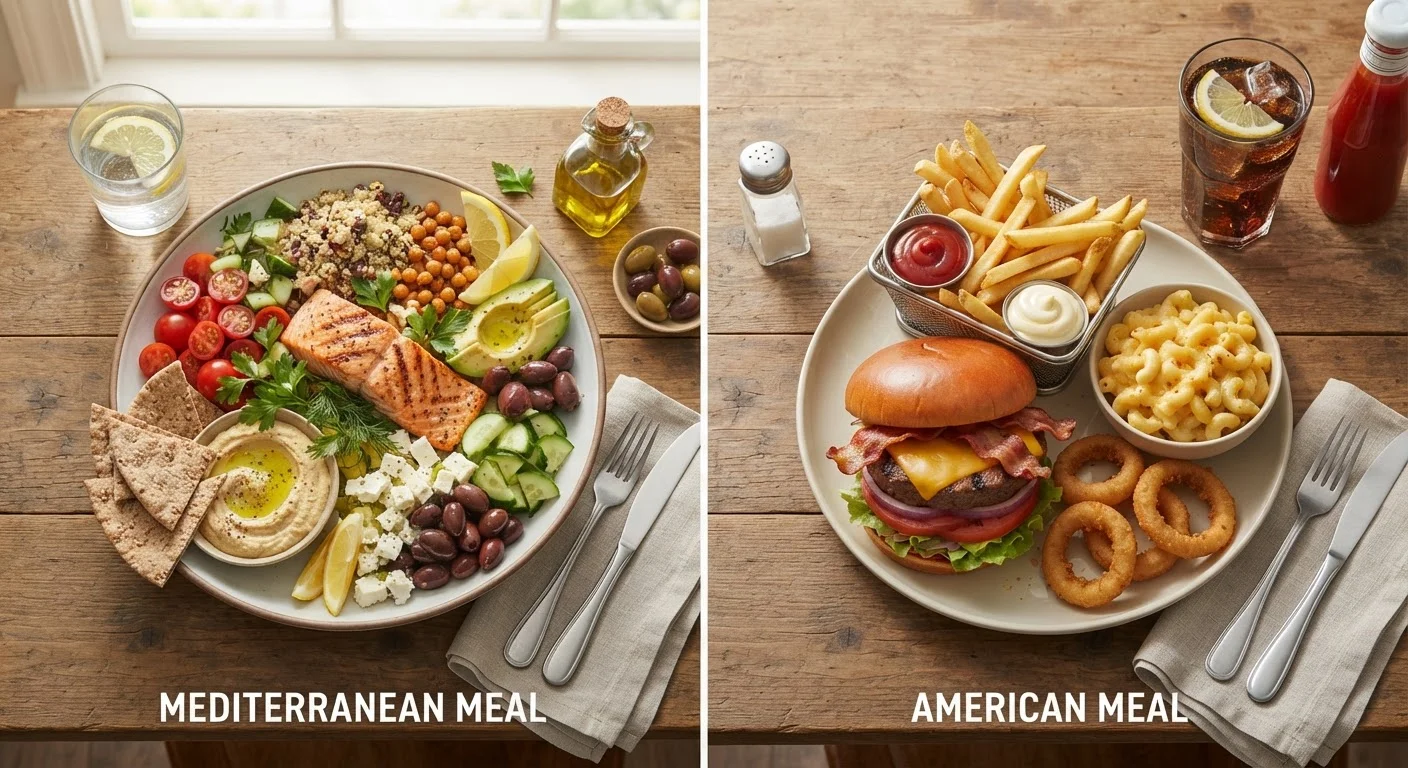
The Mediterranean eating pattern is not a single rigid diet but a broad dietary tradition observed across countries bordering the Mediterranean Sea. Its hallmarks include abundant vegetables, fruits, legumes, whole grains, nuts, seeds, and olive oil as the primary fat source, with fish eaten regularly, moderate dairy (mainly yogurt and cheese), limited red meat, and minimal processed foods.
The Standard American Diet (SAD) - sometimes called the Western dietary pattern - is characterized by high intake of ultra-processed foods, refined carbohydrates, red and processed meats, added sugars, sodium, and saturated fat, alongside low consumption of vegetables, fruits, fiber, and whole grains. Surveys such as the National Health and Nutrition Examination Survey (NHANES) have documented this profile consistently across U.S. adults.
Understanding these patterns matters because diet quality operates cumulatively. No single food determines health outcomes - the overall pattern over time does. For a deeper look at the role of dietary fat in this equation, see how saturated and unsaturated fats differ.
Key Nutritional Differences
The most striking differences between the two patterns lie in fat quality, fiber, and added sugar.
| Mediterranean Pattern | Standard American Diet | |
|---|---|---|
| Primary fat source | Olive oil, nuts, fatty fish | Saturated fat, processed oils |
| Carbohydrate quality | Whole grains, legumes, vegetables | Refined grains, added sugars |
| Fiber intake | High - from plants and legumes | Low - refined foods dominate |
| Protein sources | Fish, legumes, moderate poultry | Red meat, processed meat |
| Sodium levels | Moderate - herbs used for flavor | High - from packaged and fast foods |
| Vegetable and fruit intake | High and diverse | Below recommended levels |
| Ultra-processed food proportion | Low | Very high |
Fat quality is a central dividing line. The Mediterranean pattern derives most of its fat from olive oil, nuts, and fatty fish - sources rich in monounsaturated and omega-3 polyunsaturated fats. The Standard American Diet skews heavily toward saturated fat from processed meats and full-fat dairy products, plus trans fats from certain packaged goods.
Fiber intake diverges sharply too. Legumes, whole grains, and vegetables in the Mediterranean pattern deliver substantially more dietary fiber than the refined grains that dominate the American diet. Dietary fiber supports gut microbiome diversity, blood sugar regulation, and satiety.
Added sugar is another point of contrast: the American diet is a leading global source of added sugar consumption, much of it from sweetened beverages, desserts, and processed snacks. The Mediterranean pattern includes naturally sweet foods like fruit but added sugars are minimal.
What Research Says About Health Outcomes
30%
Relative reduction in cardiovascular events
The PREDIMED trial found approximately a 30% relative risk reduction in major cardiovascular events among Mediterranean diet groups versus a low-fat control diet.
~57%
U.S. calories from ultra-processed foods
Research published in BMJ Open estimated that ultra-processed foods accounted for roughly 57% of total caloric intake among U.S. adults.
95%
Americans under-consuming dietary fiber
The U.S. Dietary Guidelines Advisory Committee has identified dietary fiber as a shortfall nutrient, with the vast majority of Americans not meeting recommended intake levels.
The evidence base for the Mediterranean eating pattern is extensive. The PREDIMED trial - a large randomized controlled study conducted in Spain - found that participants assigned to a Mediterranean diet supplemented with extra-virgin olive oil or nuts had a significantly lower incidence of major cardiovascular events compared to those following a low-fat control diet.
Observational research has also associated Mediterranean-style eating with reduced risk of type 2 diabetes, certain cancers, cognitive decline, and all-cause mortality. It is worth noting that most long-term diet research is observational, which means it can identify associations but not definitively establish causation in every case.
The Standard American Diet, by contrast, is consistently associated in the research literature with elevated rates of obesity, hypertension, dyslipidemia, and insulin resistance. The mechanistic pathways - chronic inflammation, oxidative stress, gut microbiome disruption - are areas of active scientific investigation.
If you're sorting evidence-based guidance from popular misconceptions, common nutrition myths and what the evidence shows is a useful companion read.
Practical Steps Toward a Mediterranean-Style Pattern
Shifting dietary patterns doesn't require an overnight overhaul. Research on behavior change suggests that incremental, sustainable swaps are more durable than wholesale dietary restarts.
- Swap refined grains for whole grains - choose whole wheat bread, brown rice, or farro over white bread and white rice.
- Add a plant protein weekly - lentils, chickpeas, and white beans are inexpensive, versatile, and fiber-rich.
- Use olive oil as a primary cooking fat in place of butter or shortening where cooking temperature allows.
- Increase fish consumption - canned sardines, salmon, and tuna offer omega-3s at a lower cost than fresh fillets.
- Front-load vegetables - building meals around vegetables first, then adding protein and grains, shifts the nutritional center of gravity without eliminating familiar foods.
Start With One Meal, Not a Full Overhaul
Trying to restructure every meal at once is a common reason dietary changes don't stick. Identify one daily meal - often lunch or dinner - and experiment with Mediterranean-style ingredients there first. Once that feels routine, extend the approach to a second meal. Small, consistent shifts compound meaningfully over months.
Cost is a real concern for many households. Fortunately, the Mediterranean pattern's plant-based staples - dried legumes, seasonal produce, canned fish - can be among the most affordable foods in any supermarket. For detailed strategies, see eating well on a budget. If you're just beginning to think about overall dietary structure, building a balanced plate from scratch offers foundational guidance.
This article is for general informational and educational purposes only and does not constitute medical or nutritional advice. Consult a qualified healthcare provider or registered dietitian before making significant changes to your diet, particularly if you have an existing health condition.