

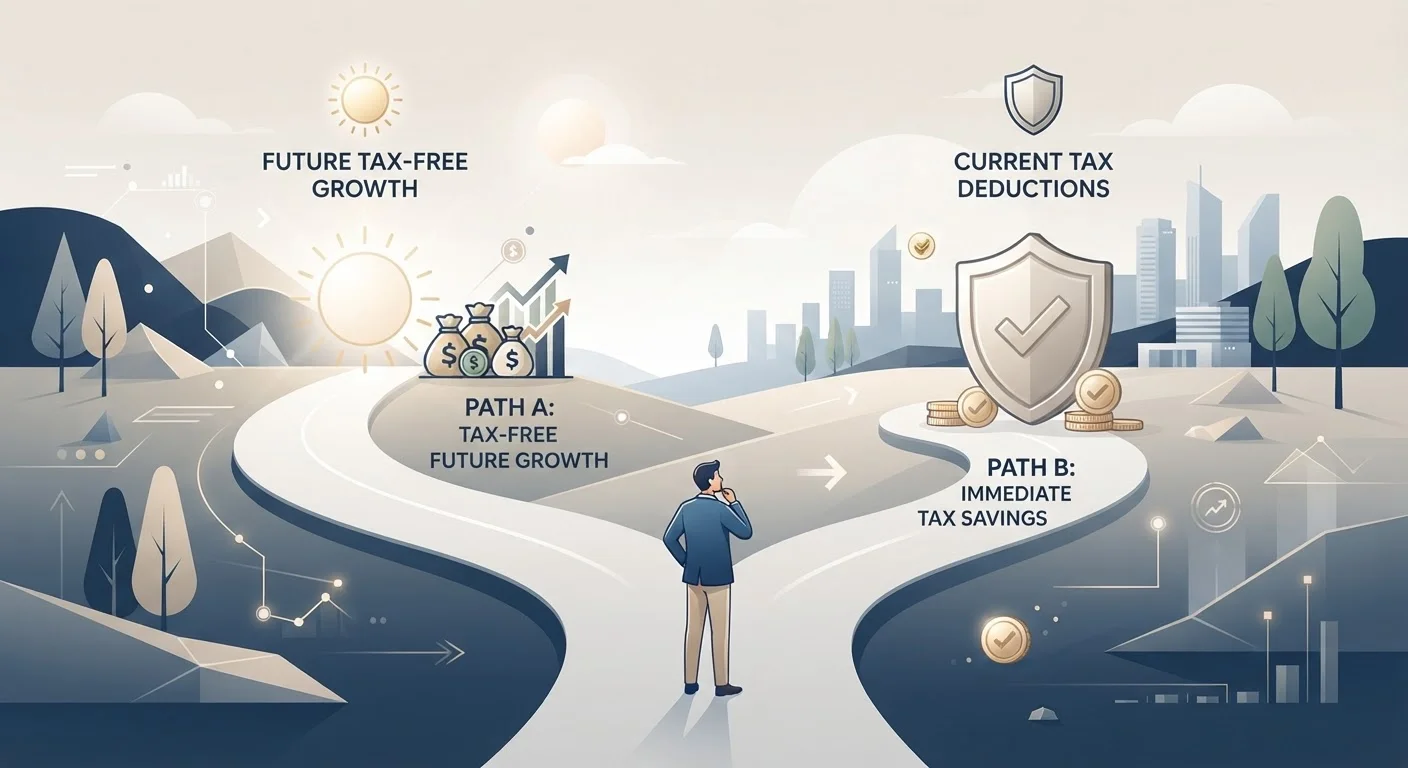
Key Takeaways
Option A
Roth IRA
The pay-now, grow-tax-free account.
Best for: Savers who expect to be in a higher tax bracket in retirement than they are today.
Option B
Traditional IRA
The defer-now, pay-later account.
Best for: Savers who want to reduce their taxable income today and expect a lower tax rate in retirement.
If you're early in your career with lower current income
Roth IRA
Paying taxes now at a lower rate and enjoying tax-free growth over decades tends to be advantageous when your future earning power - and likely your tax rate - is higher.
If you're in your peak earning years and want to lower your tax bill today
Traditional IRA
A deductible Traditional IRA contribution reduces your taxable income now, which is most valuable when your current marginal tax rate is relatively high.
If you want maximum flexibility for estate planning or avoiding RMDs
Roth IRA
Roth IRAs have no required minimum distributions during the account owner's lifetime, making them a flexible tool for passing wealth to heirs.
If your income exceeds Roth IRA eligibility thresholds
Traditional IRA
Roth IRA contributions are phased out above certain income limits set by the IRS, whereas anyone with earned income can contribute to a Traditional IRA regardless of income level.
If you're uncertain about your future tax situation
Roth IRA
Tax-free withdrawals in retirement eliminate one variable from an uncertain future; many financial educators suggest that tax diversification - holding both types - is a reasonable middle ground.
The Core Difference: When You Get Your Tax Break
Both Roth and Traditional IRAs are individual retirement accounts designed to encourage long-term saving through tax advantages. The fundamental distinction is timing: a Traditional IRA may give you a tax deduction today, while a Roth IRA rewards you with tax-free income in retirement.
With a Traditional IRA, contributions may be fully or partially deductible from your taxable income in the year you make them - depending on your income and whether you have access to a workplace retirement plan. Your money grows tax-deferred, meaning you owe no taxes on gains year to year. When you take distributions in retirement, those withdrawals are taxed as ordinary income.
With a Roth IRA, contributions are made with dollars you've already paid income tax on - no upfront deduction. However, your money grows tax-free, and qualified withdrawals in retirement are entirely free of federal income tax. To qualify, the account must be at least five years old and you must be 59½ or older at the time of withdrawal.
Understanding how tax-advantaged accounts fit into a broader savings strategy is essential context. See our overview of how tax-advantaged accounts fit into a long-term savings strategy for a fuller picture of 401(k)s, HSAs, and 529s alongside IRAs.
| Criterion | Roth IRA | Traditional IRA |
|---|---|---|
| Tax treatment of contributions | After-tax (no deduction) | May be tax-deductible |
| Tax treatment of withdrawals | Tax-free (if qualified) | Taxed as ordinary income |
| Income limits to contribute | Yes - phases out at higher income | No income limit to contribute |
| Deductibility income limits | N/A | Yes - if covered by workplace plan |
| Required minimum distributions | None during owner's lifetime | Required starting at age 73 |
| Early withdrawal of contributions | Anytime, penalty-free | Subject to taxes and penalties |
| Best if tax rate is higher... | In the future (retirement) | Now (working years) |
Eligibility, Contribution Limits, and Income Rules
For the 2024 tax year, the IRS sets the combined annual contribution limit for all IRAs at $7,000 per person ($8,000 if you're age 50 or older). This limit is shared across both account types - you can split contributions between a Roth and Traditional IRA, but the total cannot exceed the cap.
Roth IRA income limits: Your ability to contribute to a Roth IRA phases out at higher incomes. For 2024, the phase-out range begins at $146,000 for single filers and $230,000 for married couples filing jointly. Above the upper limit, direct Roth contributions are not permitted. (Note: IRS limits adjust periodically; always verify current thresholds on IRS.gov.)
Traditional IRA deductibility: Anyone with earned income can contribute to a Traditional IRA, but the deductibility of those contributions phases out if you - or your spouse - are covered by a workplace retirement plan and your income exceeds certain thresholds. Even a non-deductible Traditional IRA contribution grows tax-deferred, which still provides value.
The 'Backdoor Roth' - A Note on Strategy
High earners who exceed Roth IRA income limits sometimes use a strategy called a 'backdoor Roth,' which involves making a non-deductible Traditional IRA contribution and then converting it to a Roth IRA. This approach is legal under current IRS rules but involves complexity - particularly if you hold other pre-tax IRA funds. Anyone considering this strategy should consult a qualified tax professional before proceeding, as the tax implications depend heavily on individual circumstances.
Once you've chosen an account type, the investments you hold inside it matter too. Our article on index funds versus actively managed funds can help you think through how to invest within your IRA.
Withdrawals, RMDs, and Early Access Rules
How and when you access your money differs significantly between the two account types.
$7,000
2024 annual IRA contribution limit
Per IRS guidance, individuals under 50 may contribute up to $7,000 combined across all IRA accounts in 2024.
Age 73
Traditional IRA RMD start age
Under the SECURE 2.0 Act, the required minimum distribution age for Traditional IRAs increased to 73 for those who turn 72 after December 31, 2022.
$8,000
Catch-up contribution limit (age 50+)
The IRS allows an additional $1,000 catch-up contribution for IRA holders aged 50 and older, bringing the total annual limit to $8,000 for 2024.
Traditional IRA withdrawals before age 59½ are generally subject to ordinary income tax plus a 10% early withdrawal penalty, with limited exceptions. Starting at age 73, you must begin taking required minimum distributions (RMDs) - a set percentage of your account balance each year - whether you need the money or not.
The Roth IRA is more flexible in two key ways. First, your contributions (not earnings) can be withdrawn at any time without taxes or penalties, since you already paid tax on them - though tapping retirement savings early is generally inadvisable. Second, there are no RMDs during the account owner's lifetime. This makes the Roth IRA a powerful tool if you want to let assets continue growing into late retirement or pass wealth to the next generation.
Your risk tolerance and investment timeline also shape which account structure complements your overall plan. Separately, if you're comparing structured financial decisions in other areas of your life, our piece on fixed-rate vs. adjustable-rate mortgages illustrates a similar now-vs-later trade-off framework applied to home financing.
This article is for general informational and educational purposes only. It does not constitute personalized financial, tax, or investment advice. IRS rules, contribution limits, and income thresholds change periodically. Consult a qualified financial adviser or tax professional for guidance tailored to your specific situation.