

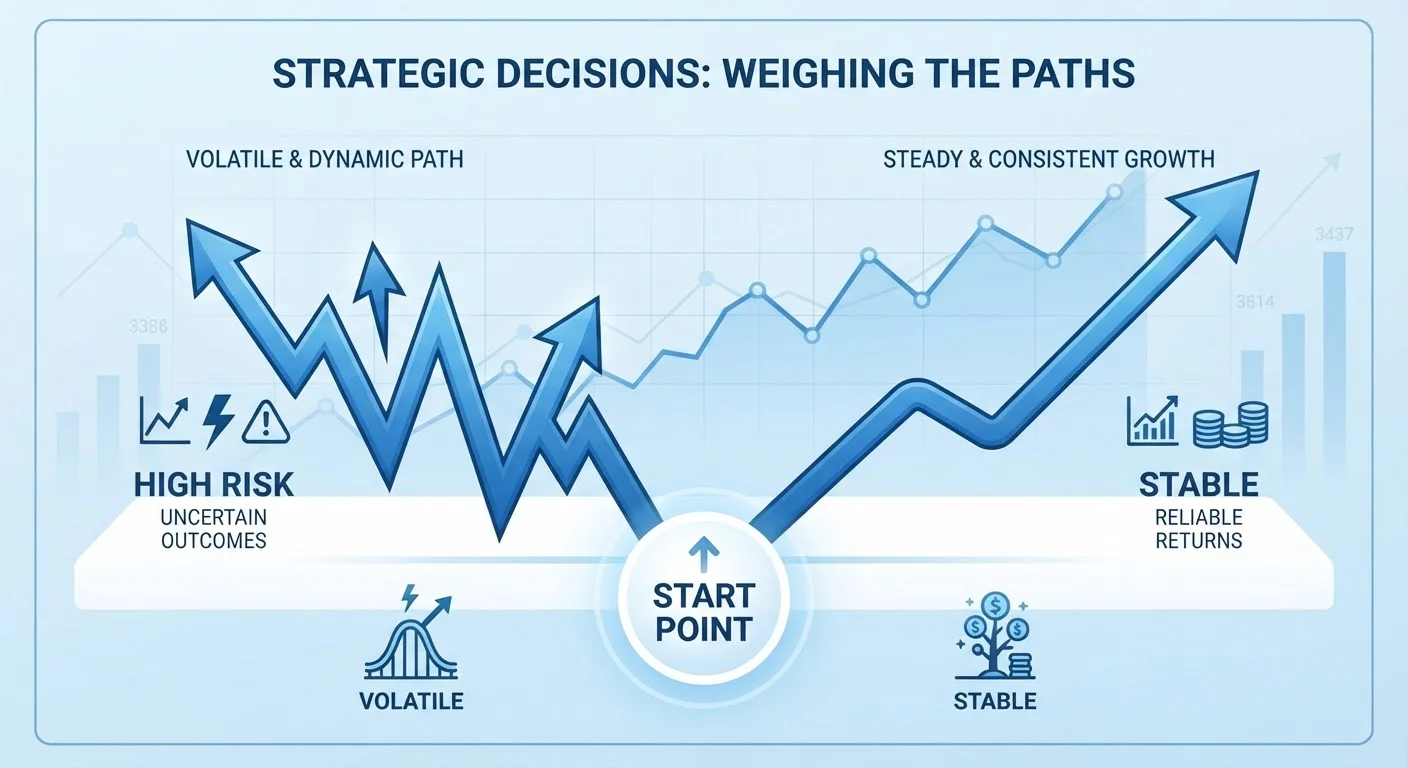
Key Takeaways
Option A
Index Funds
The market-matching, low-cost passive approach.
Best for: Investors who want broad market exposure, minimal fees, and a hands-off long-term strategy.
Option B
Actively Managed Funds
The research-driven, manager-led selection strategy.
Best for: Investors seeking potential outperformance who are willing to pay higher fees for professional stock selection.
If you're a long-term, cost-conscious investor building wealth steadily
Index Funds
Decades of performance data show that low-cost index funds outperform most active managers over long horizons after accounting for fees.
If you're investing in niche or less-efficient market segments
Actively Managed Funds
In markets where information is harder to access - such as small-cap or emerging markets - skilled active managers may have a stronger edge.
If you're just starting out and want simplicity
Index Funds
Index funds require no stock-picking knowledge and provide instant diversification, making them accessible and practical for new investors.
If you have specific sector or thematic goals and a higher risk appetite
Actively Managed Funds
Active managers can build concentrated positions or tilt toward specific themes in ways a broad index cannot replicate.
How Each Approach Works
Understanding the difference between index funds and actively managed funds starts with how each is built and operated.
An index fund is designed to replicate the performance of a specific market benchmark - such as the S&P 500 or the total U.S. bond market. The fund holds the same securities, in roughly the same proportions, as the index it tracks. No manager is making judgment calls about which stocks to own. The strategy is purely passive: match the market, not beat it.
An actively managed fund, by contrast, employs a portfolio manager (or team) who makes deliberate decisions about which securities to buy, hold, or sell. The goal is to outperform a benchmark index through research, timing, and selection. This hands-on approach requires more infrastructure - analysts, trading desks, ongoing research - which is reflected in higher costs.
Before deciding which fits your situation, it helps to understand the difference between saving and investing and how investment vehicles fit into a broader financial plan.
| Criterion | Index Funds | Actively Managed Funds |
|---|---|---|
| Management style | Passive - tracks a benchmark | Active - manager selects holdings |
| Typical expense ratio | 0.03%-0.20% | 0.50%-1.25%+ |
| Goal | Match market returns | Outperform market benchmark |
| Historical long-term performance | Beats most active funds after fees | Majority underperform benchmark |
| Diversification | Broad, built-in | Varies by strategy |
| Transparency | High - mirrors published index | Lower - holdings may lag disclosure |
| Best market environment | Efficient, large-cap markets | Less efficient or niche markets |
What the Evidence Actually Shows
The debate between passive and active investing isn't just philosophical - it has a substantial body of research behind it.
S&P Dow Jones Indices publishes an annual report known as the SPIVA Scorecard, which tracks the performance of actively managed funds against their benchmark indices. Consistently across multiple time horizons and fund categories, the majority of active funds have underperformed their respective benchmarks after fees. Over 15-year periods, the underperformance rate in U.S. large-cap categories has frequently exceeded 80-90% of active funds.
80-90%
Active large-cap funds underperforming index over 15 years
According to S&P Dow Jones Indices' SPIVA Scorecard, the large majority of U.S. large-cap active funds have historically trailed their benchmark over long periods.
~1%
Typical annual fee gap between active and index funds
Industry data shows actively managed funds often cost 0.5%-1.25% annually, versus 0.03%-0.20% for many broad index funds.
$40,000+
Estimated long-term cost of higher fees on a $100K portfolio
Financial modeling examples suggest a 1% annual fee difference can erode tens of thousands of dollars from a portfolio over a 30-year horizon, though actual results vary.
The primary culprit is cost. Actively managed funds typically carry expense ratios ranging from 0.5% to over 1% annually, while many index funds charge 0.03% to 0.20%. Those fractions of a percent compound meaningfully over decades. A seemingly small annual cost difference can translate to thousands of dollars in forgone growth over a 30-year investment horizon.
That said, evidence is more mixed in certain market segments. Some research suggests active managers may add value in less efficient markets - such as small-cap stocks or emerging markets - where price discovery is harder and information advantages are more achievable. However, identifying those managers in advance remains difficult.
It's also worth addressing a common misconception: past outperformance by an active fund does not reliably predict future outperformance. Common investing myths, including the belief that a winning manager will keep winning, can lead to costly decisions.
Making the Right Choice for Your Situation
Neither approach is universally right. Your decision should reflect your investment goals, timeline, and comfort with costs and complexity.
For most long-term investors - particularly those building retirement savings - the evidence broadly favors low-cost index funds. They offer instant diversification, predictable market-rate returns, and minimal drag from fees. Investors with limited capital can often access index funds at very low minimums. For more context on starting small, see investing on a tight budget.
Actively managed funds aren't without merit, particularly in specialized roles within a portfolio. Some investors use a core-and-satellite approach: building a foundation with index funds while allocating a smaller portion to active strategies targeting specific sectors or regions where they believe an active manager may have an edge.
Whichever path you lean toward, understanding how your holdings interact with your broader portfolio matters. Asset allocation principles can help guide how you balance different fund types across asset classes.
If you hold funds inside a retirement account, the tax treatment adds another layer. The structure of your retirement account - Roth versus Traditional IRA, for example - can influence which fund type is most tax-efficient in a given account.
This article is for general informational and educational purposes only and does not constitute personalized financial, investment, or tax advice. Consult a qualified financial adviser before making decisions based on your individual circumstances.