

Key Takeaways
Option A
Zero-Based Budgeting
The meticulous, dollar-by-dollar approach.
Best for: People who want maximum control over every spending category and are willing to put in the planning time each month.
Option B
The 50/30/20 Rule
The streamlined, percentage-driven framework.
Best for: People who want a simple structure that doesn't require tracking every individual expense in detail.
If you have irregular income or complex financial obligations
Zero-Based Budgeting
Rebuilding the budget from zero each month lets you adapt allocations precisely to what you actually earn, which is crucial when income fluctuates.
If you're new to budgeting and want something easy to start
The 50/30/20 Rule
Its three-category structure requires minimal setup and is forgiving enough to stay with long-term without spreadsheet fatigue.
If you're working to eliminate debt aggressively
Zero-Based Budgeting
Granular control lets you redirect specific dollar amounts toward debt repayment rather than relying on a broad savings percentage.
If you have a stable salary and consistent spending patterns
The 50/30/20 Rule
Predictable income maps cleanly onto percentage targets, making the rule low-maintenance while still promoting healthy savings habits.
If you want to understand exactly where your money goes each month
Zero-Based Budgeting
Assigning every dollar forces a level of category-by-category awareness that broad percentages simply can't provide.
How Each Method Actually Works
Before choosing a budgeting framework, it helps to understand the mechanics behind each one. If you're starting from scratch, our introduction to personal budgeting covers core concepts worth reviewing first.
Zero-Based Budgeting
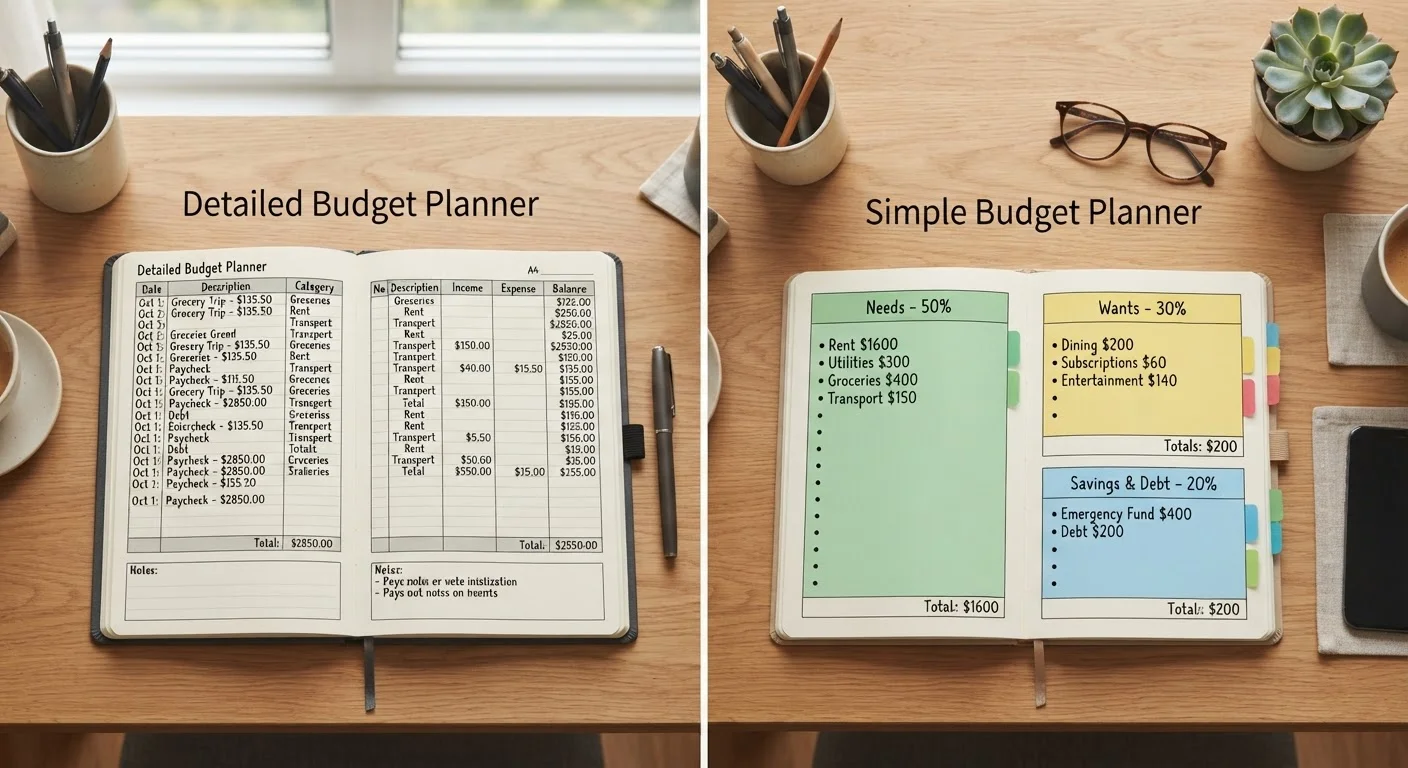
With zero-based budgeting (ZBB), you start each month by listing your total expected income. You then assign every single dollar to a specific category - rent, groceries, utilities, savings, entertainment - until the difference between income and assigned expenses equals zero. The name doesn't mean you spend everything; it means every dollar has a designated job, including dollars earmarked for savings or investing.
The process resets each month. You're not rolling forward a template - you're actively deciding how to allocate based on that month's actual income and priorities.
The 50/30/20 Rule
The 50/30/20 rule sorts after-tax income into three broad buckets: 50% toward needs (housing, utilities, groceries, minimum debt payments), 30% toward wants (dining out, subscriptions, entertainment), and 20% toward savings and debt repayment beyond minimums. The framework is intentionally simple - you're not tracking individual line items, just making sure your spending roughly lands in the right proportions. For a broader comparison that includes a third popular method, see how the 50/30/20 rule, zero-based budgeting, and the envelope method compare.
| Criterion | Zero-Based Budgeting | 50/30/20 Rule |
|---|---|---|
| Core concept | Every dollar assigned a job | Income split into three percentage buckets |
| Monthly setup time | 30-60 minutes | 5-15 minutes |
| Ongoing tracking effort | High - line-item detail | Low - broad category checks |
| Best income type | Variable or irregular income | Stable, predictable income |
| Flexibility | Fully customizable each month | Fixed percentage structure |
| Savings visibility | Explicit dollar amounts | Percentage target (20%) |
| Ideal experience level | Motivated beginners to experienced | Beginners and time-pressed individuals |
Time, Effort, and Flexibility
One of the most practical differences between these methods is what they ask of you on an ongoing basis.
Zero-based budgeting requires meaningful time investment - typically 30 to 60 minutes at the start of each month to build the budget, plus regular check-ins to track whether actual spending aligns with the plan. If you're the kind of person who finds detailed tracking motivating, this structure can feel rewarding. If it feels like a chore, compliance tends to drop off quickly.
The 50/30/20 rule can be set up in minutes. After calculating your monthly after-tax income and reviewing broad spending patterns, you mainly need to check periodically whether you're within range. It offers far less granularity - which is a feature for some and a drawback for others. If you've ever wondered whether strict category tracking is actually worth it, weighing the case for and against strict spending categories explores that tradeoff in depth.
~40%
Americans without a formal budget
Surveys conducted by the National Foundation for Credit Counseling have consistently found that a significant share of U.S. adults do not maintain a detailed household budget.
20%
Savings target in the 50/30/20 rule
The 20% savings and debt-repayment allocation is a general guideline and may need adjustment based on individual income levels and financial goals.
Neither approach is inherently superior - the method you'll actually stick with is the one best suited to your habits and temperament.
Which Framework Fits Your Situation?
Your financial circumstances matter as much as your personality when choosing a budgeting method.
Variable income: Freelancers, contractors, or anyone with month-to-month income swings often find zero-based budgeting more effective because it accommodates changing numbers. Applying fixed percentages to unpredictable income can produce misleading targets.
High cost-of-living areas: If housing and essential costs reliably consume more than 50% of your income, the 50/30/20 framework may set unrealistic expectations. Zero-based budgeting lets you define categories without being constrained by predetermined proportions.
Early savings goals: If your primary financial goal is building an emergency fund or accelerating retirement contributions, zero-based budgeting's specificity makes it easier to protect those dollars intentionally. The 50/30/20 rule's 20% savings bucket is a good starting point but may lack the precision needed for specific milestones.
Once you've decided on a method, the next practical step is putting it into action. Our guide to setting up your first monthly budget walks through the process in concrete steps. And regardless of the framework you choose, a regular review keeps the plan relevant - see our 20-minute monthly budget check-in for a structured approach.
This article is for general informational and educational purposes only and does not constitute personalized financial advice. Consult a qualified financial professional regarding decisions specific to your circumstances.