

Key Takeaways
Our Verdict
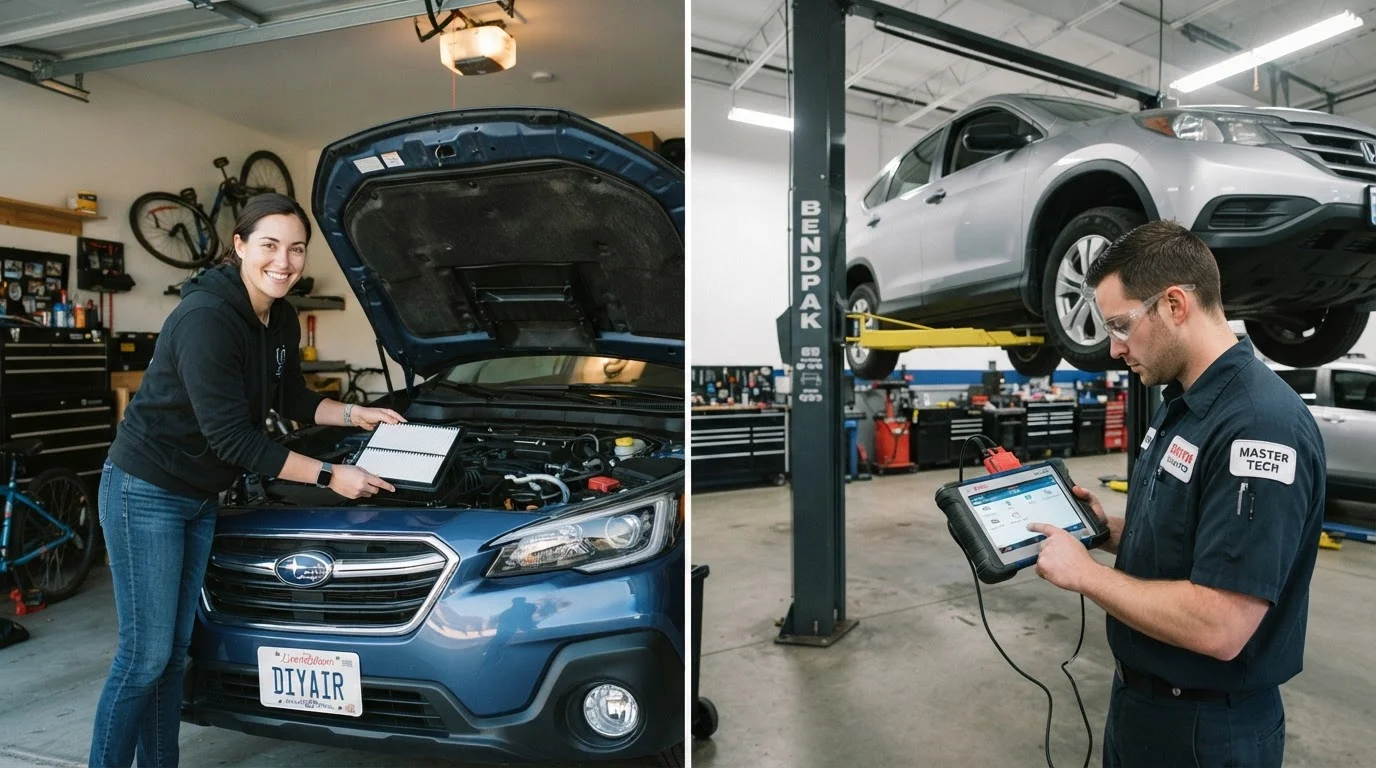
There is no single right answer to the DIY-versus-shop question - it depends on the specific task, your skills, your tools, and the consequences of getting it wrong. Simple maintenance tasks reward the home mechanic with real savings and useful knowledge, while safety-critical or highly technical repairs are almost always worth paying a professional to handle correctly.
| Best for | Recommended |
|---|---|
| Drivers comfortable with basic tools who want to reduce routine maintenance costs | DIY maintenance |
| Safety-critical systems like brakes, steering, and airbags | Professional shop service |
| Complex diagnostics, recalls, or work that could void a warranty | Professional shop service |
| First-time car owners building mechanical confidence gradually | DIY for simple tasks, shop for everything else |
The Real Question Behind Every Maintenance Decision
Every car owner eventually faces the same fork in the road: handle this yourself or hand it off to a shop? The answer is rarely obvious, and blanket rules - "always DIY to save money" or "always use a professional to be safe" - miss the point entirely. What matters is an honest read of the specific job against your actual capabilities, tools, and risk tolerance.
This framework will help you make that call with confidence, regardless of how mechanically experienced you are. For a broader look at the long-term value of keeping up with maintenance at all, see the long-term case for routine maintenance.
Start With Your Owner's Manual
Before attempting any maintenance task, consult your vehicle's owner's manual. It specifies correct fluid types, torque values, service intervals, and often flags tasks that must be performed by a certified technician to preserve warranty coverage. A $20 printed manual from an auto parts store or a reputable online service manual is one of the most valuable tools a home mechanic can own.
Tasks That Belong in Your Driveway
A meaningful category of maintenance jobs require only modest mechanical ability, standard tools, and a safe, level workspace. Getting these right delivers real savings and builds genuine vehicle literacy.
- Engine air filter replacement: Typically a matter of unclipping a housing, swapping the filter, and reassembling. Most vehicles require no tools at all.
- Cabin air filter replacement: Usually accessible behind the glove box or under the dashboard. The manufacturer's service manual shows the exact location.
- Wiper blade replacement: Straightforward on virtually every vehicle; detailed instructions are printed on most blade packaging.
- Oil and filter changes: Manageable for anyone with a floor jack, jack stands, a drain pan, and the correct oil specification for their vehicle. The key word is correct - always verify viscosity and capacity in the owner's manual.
- Battery terminal cleaning and battery replacement: Low-voltage, low-risk work when the vehicle is off. Note that on some modern vehicles, disconnecting the battery resets electronic modules - check your manual first.
- Tire inflation and rotation: Checking and adjusting tire pressure takes two minutes and a $15 gauge. Rotation requires a jack and stands; a torque wrench is strongly recommended to avoid over- or under-tightening lug nuts.
The common thread: these jobs have low failure consequences, require no special diagnostic equipment, and the correct procedure is well-documented in owner's manuals and reputable service guides.
Tasks That Belong in a Shop
Other jobs introduce consequences serious enough that the calculus shifts decisively toward a qualified mechanic - even for experienced home wrenchers.
| Task | DIY-Friendly | Shop Recommended | |
|---|---|---|---|
| Air filter (engine/cabin) | Yes - minimal tools, low risk | Not necessary for most drivers | |
| Oil and filter change | Yes - with proper tools and spec | If no safe workspace available | |
| Wiper blade replacement | Yes - straightforward | Not necessary | |
| Brake pad replacement | Conditionally - with experience | Preferred for first-timers | |
| Suspension/steering components | Not recommended without alignment tools | Yes - alignment required | |
| Airbag/SRS system work | No - serious injury risk | Yes - specialized training required | |
| Electrical/module diagnostics | Basic code reading only | Yes - professional scan tools needed | |
| Recall repairs | No - must be done at dealership | Yes - at no cost to owner |
- Brake system work: Pad replacement is often doable at home, but rotor resurfacing, brake line repair, and caliper replacement involve hydraulic systems where a mistake means compromised stopping power. Brake fluid work can introduce air into lines, requiring bleeding equipment and technique.
- Suspension and steering components: Control arms, tie rods, and wheel bearings affect vehicle handling directly. Improper torque specs or alignment after replacement can make a vehicle unsafe at highway speeds.
- Airbag and supplemental restraint system (SRS) components: These systems contain explosive propellants and operate at high voltage. Unintended deployment can cause serious injury. This work requires specialized training.
- Transmission and drivetrain repair: Complexity, specialized tooling, and the cost of getting it wrong make professional service the standard choice for most drivers.
- Electrical diagnostics: Modern vehicles rely on interconnected control modules. Diagnosing fault codes accurately requires professional-grade scan tools and the expertise to interpret live data - a basic code reader only scratches the surface.
- Recall-related repairs: These must be completed at a franchised dealership at no cost to you. Attempting them yourself forfeits the remedy.
If you're weighing similar decisions in other areas of ownership, the same logic applies - see our practical framework for DIY versus hiring out for a transferable way of thinking through risk and skill.
The Middle Ground: When the Job Depends on Your Setup
Some tasks sit in a genuine gray zone - doable at home in principle, but only if certain conditions are met.
Brake pad replacement is a good example. Many competent home mechanics replace pads successfully. But the job requires compressing the caliper piston (which can damage ABS systems on some vehicles if done incorrectly), proper torque on caliper bolts, and a test drive to bed in the pads safely. If you're doing it for the first time, having an experienced friend alongside isn't just helpful - it's genuinely advisable.
Spark plug replacement is straightforward on inline four-cylinder engines with accessible plug wells. On a V6 or V8 where rear plugs sit under an intake manifold, the job can take hours, require gasket replacement, and risk snapping a plug off in the head - an expensive mistake.
The honest filter to apply: What is the worst realistic outcome if I make a mistake? If the answer is a minor inconvenience and a trip to a shop, the risk profile is acceptable for a capable home mechanic. If the answer is a safety failure or a repair bill that dwarfs what a shop would have charged, the math usually favors professional service.
Part of being a confident car owner is knowing your limits - a principle that applies as much to vehicles as it does to any other domain of ownership. Our buying and ownership hub covers more of the practical knowledge every driver should have.