

Key Takeaways
MSRP (Sticker Price)
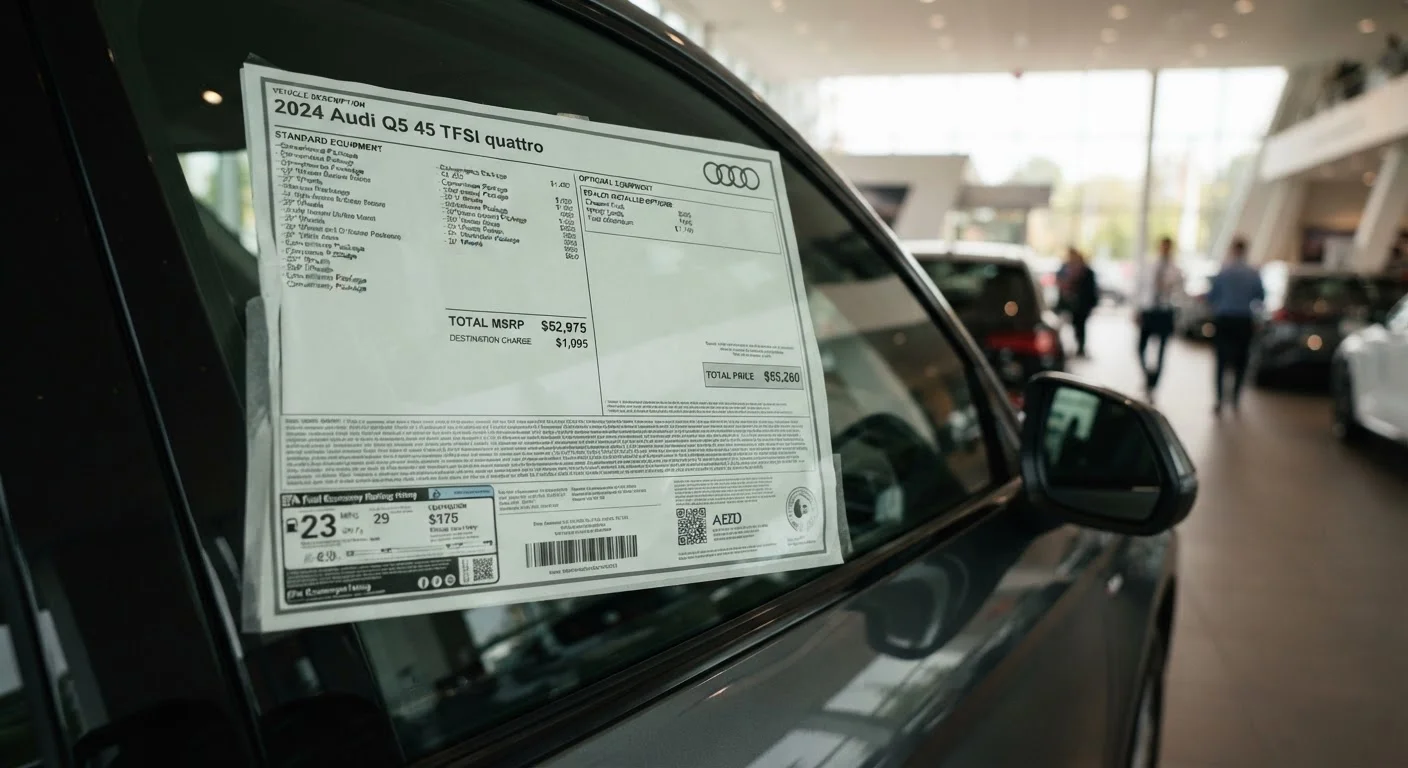
The Manufacturer's Suggested Retail Price - commonly called the sticker price - is the price a car's manufacturer recommends a dealer charge for a vehicle. It appears on the Monroney label attached to every new car's window by federal law. It covers the base vehicle and any factory-installed options, but it does not include taxes, registration fees, dealer charges, or financing costs.
The Monroney label is legally required on all new cars sold in the U.S. under the Automobile Information Disclosure Act of 1958. Dealers may charge more or less than MSRP depending on market conditions.
Why the Sticker Price Is Just the Beginning
Walk into any dealership, glance at the window sticker, and you'll see a number that looks like the price of the car. In a narrow sense, it is - but it's rarely what you'll pay when you sign the paperwork. The gap between the MSRP and your actual out-of-pocket cost can run from a few hundred to several thousand dollars, depending on the vehicle, the state, and the dealership's fee structure.
Understanding what makes up that gap isn't about distrust - it's about preparation. Some charges are required by law and completely standard. Others are discretionary add-ons that vary by dealer. Knowing the difference before you sit down at the finance desk gives you a clearer picture and a stronger footing.
For a broader look at what car ownership costs beyond the purchase itself, see car ownership costs most buyers don't factor in.
Fees That Are Standard and Non-Negotiable
Certain charges will appear on virtually every new-car purchase regardless of dealership or negotiating skill.
$1,000-$4,000+
Typical range of fees added above MSRP
Industry observers consistently note that taxes, title, registration, and dealer fees routinely add this amount to a vehicle's sticker price, varying by state and dealer.
Varies by state
Documentation fee cap or limit
Several U.S. states cap the documentation fee dealers may charge; others do not regulate it, leaving the amount entirely to the dealer's discretion.
- Destination and delivery charge: Set by the manufacturer, this covers shipping the vehicle from the factory to the lot. It's disclosed on the window sticker itself and is the same for every buyer of that model, regardless of where they purchase it.
- Sales tax: Calculated as a percentage of the sale price, and determined by your state and sometimes your county or municipality. You'll pay this whether you buy outright or finance.
- Title and registration fees: Every state charges fees to transfer a vehicle's title into your name and register it for road use. Amounts vary by state and sometimes by vehicle weight or value.
- Documentation fee: Dealers charge this to process the paperwork associated with the sale. Some states cap it; in others, dealers set it themselves. It typically ranges from under $100 to several hundred dollars.
These line items are real costs you should factor into your budget from the start - not surprises at closing.
Dealer Add-Ons: What They Are and What to Ask
Beyond the standard fees, many dealerships add products or services to a vehicle before it reaches the lot - and price them into the sale. These are often listed on a secondary sticker placed next to the Monroney label.
Always Request the Out-the-Door Price
Before you agree to anything, ask the sales associate for the full out-the-door price in writing - including all taxes, fees, and dealer add-ons. This single number lets you compare deals across dealerships on an equal footing and eliminates surprises at signing.
- Paint sealant or fabric protection: Applied at the dealer, typically at a markup over DIY alternatives. Ask whether it was already applied, and whether declining it results in a credit.
- Nitrogen tire inflation: Tires are filled with nitrogen instead of air. The performance benefit is debated among automotive experts, and the fee is often optional.
- Dealer-installed accessories: Floor mats, window tinting, splash guards, or cargo covers may be bundled in. Some are useful; others are filler that inflates the price.
- Dealer documentation add-ons: Items labeled as "market adjustment" or "dealer markup" appear on high-demand vehicles and represent pure margin, not a service provided to you.
The key question to ask with any dealer add-on: "Can this be removed from the deal, or credited back if I don't want it?" The answer tells you how much flexibility exists.
First-time car buyers are especially likely to accept these charges without question - being aware of them ahead of time changes that dynamic.
Finance Office Charges to Understand
If you're financing through the dealer, a second round of potential costs appears in the finance office - separate from the vehicle price itself.
A buyer agrees on a price of $32,000 for a sedan, then discovers at signing that the total includes a $799 paint protection package already applied to the vehicle.
A first-time buyer in a high-demand market sees a $2,500 'market adjustment' line on the purchase agreement, in addition to the advertised MSRP.
Extended warranties and service contracts are frequently offered here, sometimes framed as required for financing (they rarely are). These products may have genuine value depending on the vehicle and your situation, but the terms, coverage limits, and exclusions vary widely. Read any contract carefully before agreeing.
GAP insurance covers the difference between what you owe on a loan and what insurance pays out if a vehicle is totaled. It's a legitimate product, but it's often available elsewhere - including directly from your auto insurer - potentially at a lower cost. This is general information; consult a licensed insurance professional about what coverage makes sense for your circumstances.
The finance office is where many buyers feel the most pressure. Asking for a written breakdown of every charge - and taking time to review it - is a practical and reasonable step at any dealership.
This article is for general informational purposes only and does not constitute financial, legal, or purchasing advice. Always review all contract terms carefully and consider consulting a qualified professional before making significant financial decisions.