

Key Takeaways
Foreign Transaction Fee
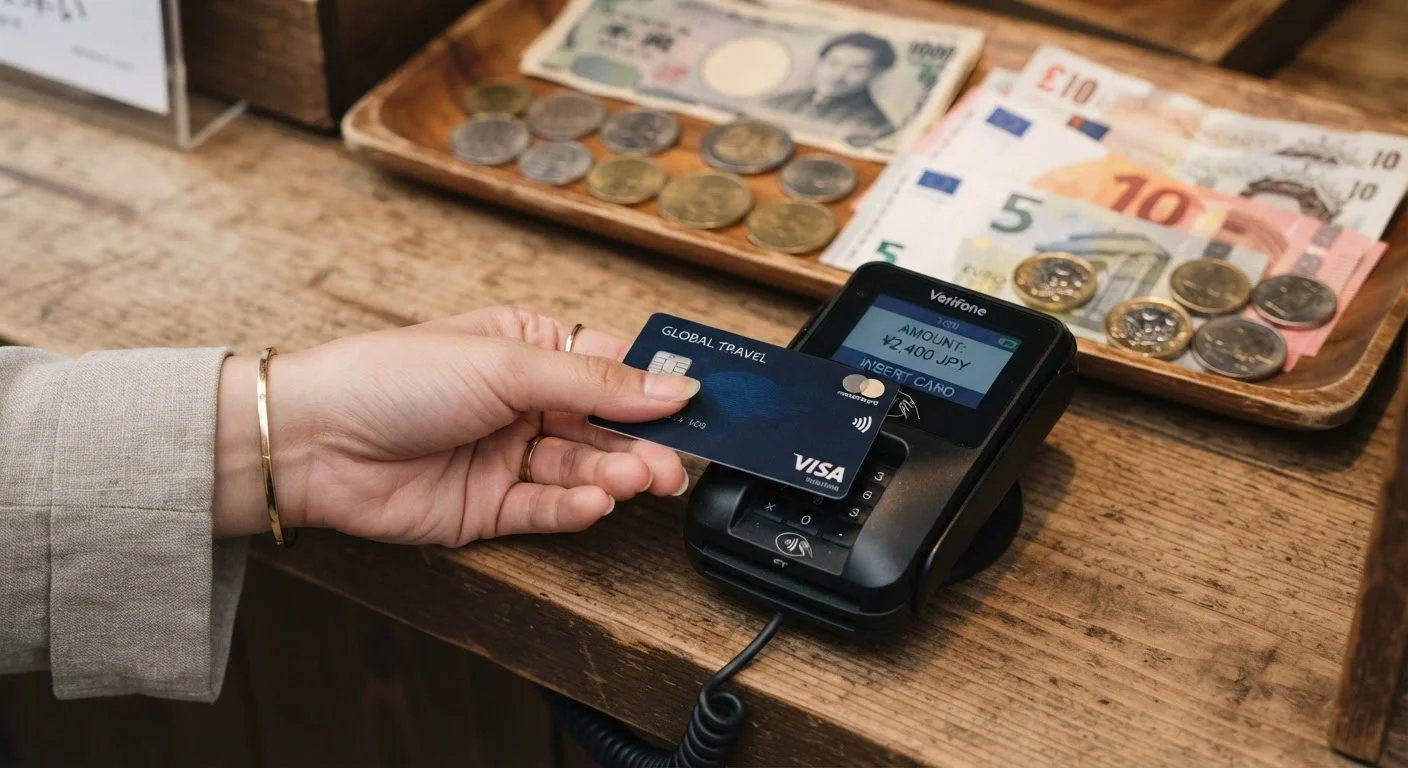
A foreign transaction fee is a charge your card issuer adds whenever you make a purchase in a foreign currency or through an overseas payment network. It typically ranges from 1% to 3% of the transaction amount and is applied automatically - often without any notice at the point of sale. The fee shows up on your statement as a small line item or is quietly rolled into the total charge.
The fee is usually composed of two parts: a network assessment fee (charged by Visa or Mastercard, typically around 1%) and an issuer markup (charged by your bank or credit union, typically 1-2%). Not all cards pass both components to the cardholder.
How Foreign Transaction Fees Actually Work
Every time you swipe, tap, or dip your card at a foreign merchant - or pay a foreign-currency invoice online - your transaction travels through an international payment network before reaching your bank. At each stop, a small percentage may be deducted. The result is a foreign transaction fee that appears on your statement, sometimes as a distinct line item and sometimes folded invisibly into the charge itself.
The fee has two typical components. First, the card network (Visa, Mastercard, or American Express) assesses a cross-border fee, often around 1% of the transaction. Second, your card issuer may add its own markup - commonly another 1% to 2%. Together, these can reach 3% per purchase. On a two-week trip with $3,000 in card spending, that's up to $90 in fees you may not have budgeted for.
It's worth noting that the fee is tied to currency, not geography. If you buy from a UK-based website while sitting at home in Chicago - and that website bills in British pounds - your card issuer may still apply the fee. For a fuller picture of how currency and cards interact abroad, see our plain-language overview of travel money.
1%-3%
Typical foreign transaction fee range per purchase
The Consumer Financial Protection Bureau notes that foreign transaction fees commonly fall in this range, composed of a network assessment and an issuer markup.
~$90
Estimated fees on $3,000 in card spending at 3%
A straightforward calculation illustrating how a 3% fee compounds across a two-week trip with moderate card usage.
2 components
Parts that make up a typical foreign transaction fee
The fee generally consists of a card network cross-border assessment (often ~1%) and an issuer markup (often 1-2%), which may or may not both appear on your statement.
When Foreign Transaction Fees Catch Travelers Off Guard
Most travelers expect fees at international ATMs or currency exchange counters. Fewer realize that a card swipe at a Paris café or a hotel checkout in Tokyo also triggers them. Here are the common scenarios where these fees appear unexpectedly:
- In-person purchases abroad: Any card transaction processed through a foreign payment network - restaurants, shops, transportation - is subject to the fee.
- Online purchases in foreign currencies: Booking a tour through a foreign operator's website, paying for international accommodations, or subscribing to a foreign streaming service can all trigger the charge.
- Dynamic currency conversion: When a merchant offers to charge your card in U.S. dollars rather than the local currency, they apply their own exchange rate - which is often less favorable. If your card also charges a foreign transaction fee on top of this, costs compound quickly. When given the option, paying in local currency and letting your card network convert the amount is usually more cost-effective.
- ATM withdrawals abroad: Some debit cards charge a foreign transaction fee on international withdrawals in addition to the ATM operator's own surcharge.
These fees are a documented part of the broader landscape of charges that quietly erode travel budgets. Our guide on hidden travel costs covers additional expenses worth anticipating before you depart.
Always Choose Local Currency at the Register
When a foreign merchant's payment terminal asks whether you'd like to pay in U.S. dollars or the local currency, select the local currency. Dynamic currency conversion - the process behind the dollar option - typically uses a less favorable exchange rate set by the merchant. Paying in local currency lets your card network apply its own rate, which is generally more competitive.
How to Factor These Fees Into Your Travel Budget
The simplest approach is to treat foreign transaction fees as a percentage tax on your card spending abroad. If your card charges 3% and you plan to put $2,500 on the card during a trip, add $75 to your travel budget as a line item for fees. This prevents sticker shock when the statement arrives.
Before any international trip, review your card's fee disclosure - typically found in the Schumer Box in your cardholder agreement or in your online account's fee schedule. Cards marketed toward travelers frequently waive foreign transaction fees entirely, though they may carry annual fees of their own. Weigh those annual costs against your projected travel spending to understand the real trade-off. Our article on credit cards vs. debit cards for international travel breaks down how each card type performs on fees, protections, and convenience.
If you travel internationally with any regularity, it may be worth modeling your total annual card-related fees - foreign transaction fees, ATM surcharges, and any annual card fees - as part of your overall travel finances. The complete guide to managing travel money walks through that kind of end-to-end financial planning for travelers.
This article is for general informational purposes only and does not constitute personalized financial advice. Fees, card terms, and regulations vary by issuer and are subject to change. Consult your card issuer or a qualified financial professional for guidance specific to your situation.