

Key Takeaways
Option A
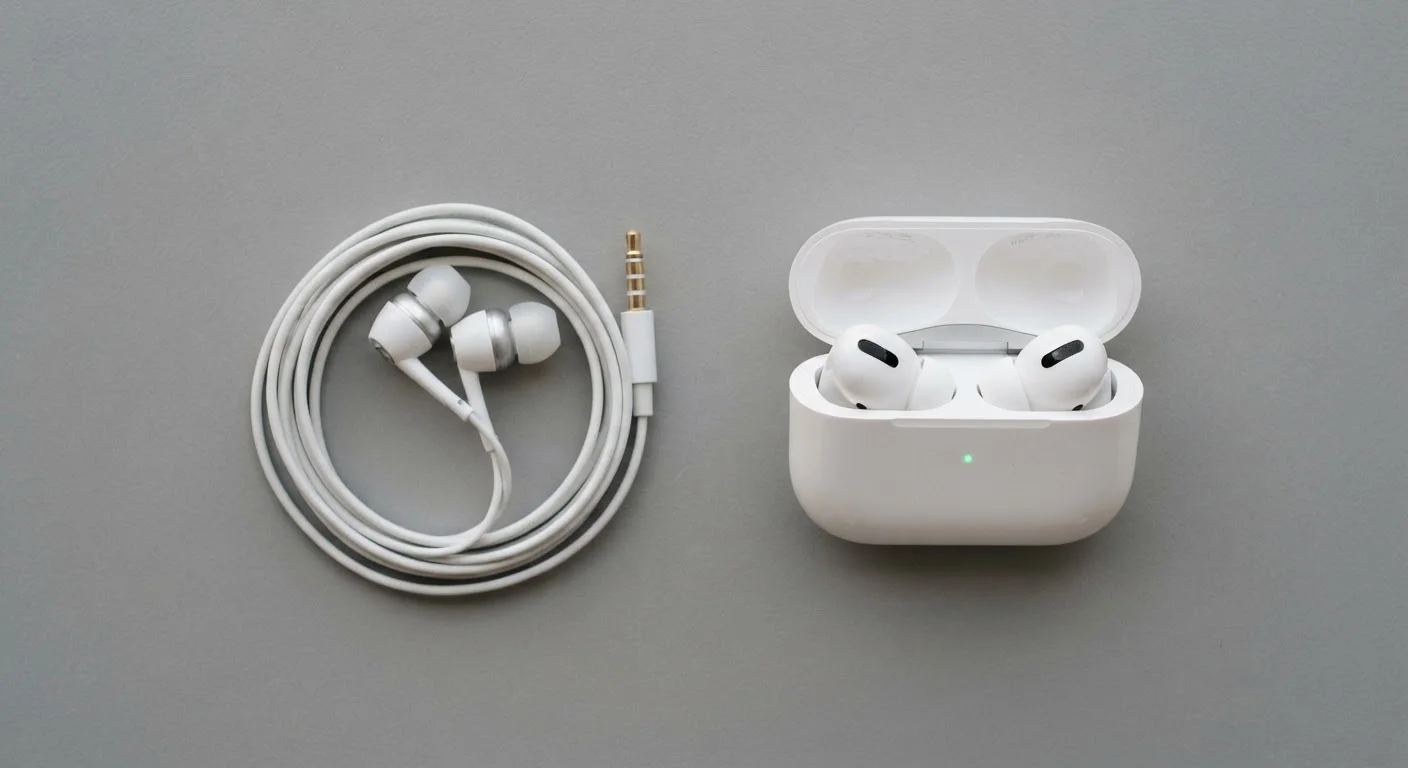
Wired Earbuds
The reliable, uncompromised audio connection.
Best for: Listeners who prioritize audio fidelity, zero latency, and freedom from charging dependencies.
Option B
Wireless Earbuds
The cable-free, feature-rich everyday companion.
Best for: Active users and commuters who value convenience, portability, and smart device features.
If you edit audio, play games, or watch video where sync matters
Wired Earbuds
The near-zero latency of a wired connection prevents audio-visual desync, which is critical for editing work and real-time gaming.
If you commute, work out, or move frequently throughout the day
Wireless Earbuds
No cable to snag or tangle, combined with ANC and a compact charging case, makes wireless earbuds far more practical for high-movement routines.
If audio fidelity is your top priority and you listen at a stationary desk
Wired Earbuds
A wired connection passes an uncompressed audio signal, removing any codec-related quality ceiling that Bluetooth currently imposes.
If you frequently take calls and need smart features like voice assistants
Wireless Earbuds
Wireless earbuds are engineered with multi-microphone arrays, touch controls, and seamless voice assistant integration that wired models rarely match.
How Audio Quality Actually Differs
The common assumption is that wired earbuds always sound better. The reality is more nuanced. A wired connection passes an analog or digital audio signal directly from the source to the driver - no encoding, no decoding, no compression. That directness eliminates one potential point of quality loss.
Wireless earbuds rely on Bluetooth, which requires audio to be compressed for transmission using a codec - essentially a set of rules for encoding and decoding the signal. Standard SBC codec, the Bluetooth baseline, applies lossy compression that can introduce artifacts in complex audio passages. However, higher-quality codecs such as aptX, aptX HD, AAC, and LDAC transmit significantly more audio data, narrowing the quality gap considerably. LDAC, for example, supports up to 990 kbps - far more than SBC's roughly 320 kbps ceiling.
For most casual listeners, the difference between a good wireless codec and a wired connection is genuinely difficult to detect. For critical listening - audiophile-grade music, studio monitoring, or detailed mixing - the absence of any compression ceiling in wired audio remains a meaningful advantage.
| Criterion | Wired Earbuds | Wireless Earbuds |
|---|---|---|
| Audio signal path | Direct, uncompressed | Bluetooth codec, compressed |
| Typical latency | Under 5ms | 20-200ms (varies by codec) |
| Battery required | None | 4-8 hrs per charge |
| Active noise cancellation | Rarely available | Common on modern models |
| Cable management | Cable to manage and untangle | Completely cable-free |
| Device compatibility | Requires 3.5mm jack or adapter | Works with any Bluetooth device |
| Wireless interference | None | Possible in congested RF areas |
Latency: When Milliseconds Actually Matter
Latency - the delay between a sound being triggered and you hearing it - is imperceptible in many everyday contexts. But it becomes consequential in two specific scenarios: video playback and interactive gaming.
Wired earbuds typically measure latency below 5 milliseconds end-to-end - fast enough that human perception cannot detect the delay. Bluetooth audio, depending on the codec and implementation, commonly ranges from 20ms to over 200ms. At the higher end of that range, lip-sync issues become clearly visible during video, and in-game sound effects arrive noticeably after the visual cue they accompany.
Many wireless earbuds now include a dedicated low-latency mode or gaming mode that prioritizes speed over audio quality, bringing effective latency down into the 40-80ms range - acceptable for casual use, though still above the wired baseline.
<5ms
Typical wired earbud latency
Wired connections consistently measure below 5 milliseconds, a threshold imperceptible to human hearing under normal conditions.
990 kbps
LDAC Bluetooth codec maximum bitrate
Sony's LDAC codec, supported on many Android devices, transmits up to 990 kbps - roughly three times the rate of standard SBC compression.
40-80ms
Gaming mode Bluetooth latency
Wireless earbuds with dedicated low-latency modes can reduce Bluetooth delay significantly, though still above the wired baseline.
If your listening is primarily podcasts, music, or calls, Bluetooth latency is unlikely to disrupt your experience. If you sync audio to video in editing software or rely on precise audio cues in gaming, wired remains the more dependable choice.
Daily Practicality: Charging, Durability, and Convenience
Practicality is where the two formats diverge most visibly. Wired earbuds carry no battery - they draw power from the connected device or require none at all. You can use them indefinitely without worrying about charge levels, and there's no case to carry or charging routine to maintain.
Wireless earbuds typically offer between four and eight hours of playback per charge, with a carrying case that provides additional charges on the go. That's sufficient for most daily use patterns, but it introduces a failure mode wired earbuds don't have: you can run out of battery at an inconvenient moment.
Cable management is the inverse concern. Wired cables tangle, snag on clothing or furniture, and can place mechanical stress on connectors over time. Wireless earbuds eliminate cable entirely, which is a genuine quality-of-life improvement for active use - though the small earbud form factor also makes them easier to misplace.
One practical consideration for wired earbuds is device compatibility. The 3.5mm headphone jack has disappeared from many modern smartphones. While USB-C adapters and Lightning adapters exist, they add a step to the connection process that some users find cumbersome. If your device lacks a headphone jack, assess how often you'd need that adapter before defaulting to wired as your primary format. For more on evaluating device and plan compatibility, see questions worth asking before committing to any wireless plan.
Codec Compatibility Depends on Both Devices
A wireless earbud advertised as LDAC- or aptX-compatible will only transmit at that codec's quality if the connected source device also supports the same codec. If your phone supports only SBC, you'll receive SBC quality regardless of what the earbuds are capable of. Check your device's Bluetooth audio settings or specifications to confirm which codecs it supports before assuming you're getting the highest available quality.