

Key Takeaways
Option A
Recessed Lighting
The clean, integrated ceiling solution.
Best for: Rooms where you want an uncluttered ceiling plane, layered lighting zones, or a sleek modern aesthetic.
Option B
Surface-Mount Fixtures
The accessible, versatile ceiling classic.
Best for: Spaces with shallow ceiling depth, limited attic access, or where a single fixture provides adequate coverage.
If you have a shallow ceiling or no attic access above
Surface-Mount Fixtures
Without adequate ceiling depth, recessed cans simply cannot be installed safely. Surface-mount fixtures work on ceilings of any depth with a standard electrical box.
If you want a minimalist, architecturally clean aesthetic
Recessed Lighting
Recessed fixtures sit flush with the ceiling plane, eliminating visual clutter and keeping the eye focused on the room rather than the light source.
If you're working with a modest budget and a single room update
Surface-Mount Fixtures
Installation is typically simpler and less labor-intensive, and you won't need to cut, patch, or re-insulate around multiple openings.
If you want zoned, layered ambient lighting across a larger space
Recessed Lighting
Multiple recessed cans spread across a ceiling allow precise control over illuminated zones and pair well with dimmers for flexible ambiance.
If your ceiling has existing insulation and you're in a cold climate
Surface-Mount Fixtures
Cutting through insulated ceilings for recessed cans can compromise thermal performance unless IC-AT rated fixtures are used and properly sealed - a step many DIYers overlook.
What's Actually Different Between These Two Approaches
Recessed lighting - sometimes called can lights or downlights - is installed inside the ceiling cavity, with only the trim ring and bulb visible from below. Surface-mount fixtures (including flush-mount and semi-flush styles) attach directly to the ceiling surface and hang entirely below it.
That structural difference has downstream effects on installation complexity, cost, energy performance, and design flexibility. Understanding these trade-offs helps you make a choice that matches both your ceiling's physical reality and the way you actually use the room.
| Criterion | Recessed Lighting | Surface-Mount Fixtures |
|---|---|---|
| Required ceiling depth | 6-8+ inches minimum | Standard electrical box only |
| Installation complexity | Higher - cutting, wiring, patching | Lower - mounts to existing box |
| Insulation impact | Can compromise thermal envelope | No ceiling penetration required |
| Aesthetic | Clean, flush, minimal visual presence | Visible fixture; wide style range |
| Lighting coverage | Multiple units for even coverage | Single central fixture typical |
| Dimmer compatibility | Common with LED trims | Varies by fixture and bulb type |
| Retrofit ease | Moderate to difficult in finished ceilings | Easy - replaces any ceiling box |
Installation: What Your Ceiling Can Actually Support
Before choosing a fixture style, examine what's above your ceiling. Recessed lighting requires a cavity depth of at least 6 inches - often closer to 7 or 8 inches when accounting for the housing, insulation clearance, and the floor or roof structure above. If you're working in a room directly below a finished floor above, you may have very little clearance, or the joist bays may already be filled with plumbing or HVAC runs.
Surface-mount fixtures need only a standard electrical box flush with or slightly recessed into the ceiling surface. They work in concrete ceilings, shallow joist bays, and finished basements where recessed cans are impractical.
Recessed lighting also involves cutting multiple holes, which means more opportunities for dust, debris, and the need for drywall patching if plans change. Surface-mount installs are generally a single-box swap - especially useful when replacing an existing ceiling fixture.
IC-AT Rating: What It Means for Recessed Fixtures
IC stands for 'insulation contact' - meaning the housing can be covered by insulation without a fire risk. AT stands for 'air-tight,' meaning the fixture is sealed to limit air movement between the room and ceiling cavity. Both ratings together (IC-AT) are important for energy efficiency and code compliance in insulated ceilings. When shopping for recessed fixtures, verify both ratings are present before purchasing, and confirm local code requirements with your electrician or building department.
Energy and Insulation Considerations
One often-overlooked factor is how each fixture type interacts with your home's thermal envelope. Standard recessed cans - particularly older models - can create significant heat loss pathways through insulated ceilings. If the housing isn't rated for insulation contact and isn't air-tight (look for the IC-AT designation), building codes in many jurisdictions require a minimum clearance from insulation, which means either relocating insulation or accepting reduced energy efficiency.
Modern recessed LED trims and housings have improved substantially, and IC-AT rated fixtures address the insulation contact problem. Still, each penetration you make in an insulated ceiling ceiling is a potential air-sealing challenge. Surface-mount fixtures, by contrast, mount on top of the finished ceiling with no penetration into the cavity, leaving insulation fully intact.
~25-50%
Heat loss through unsealed recessed fixtures
The U.S. Department of Energy notes that air leakage through ceiling penetrations - including unrated recessed lights - can account for a significant portion of home heating and cooling loss.
75%
Energy savings vs. incandescent in LED recessed trims
LED-based recessed trims and surface-mount fixtures use roughly 75% less energy than equivalent incandescent bulbs, according to the U.S. Department of Energy's general LED efficiency guidance.
If your home is in a heating-dominated climate and your lighting project involves an attic-adjacent ceiling, the energy performance of your fixture choice is worth a conversation with an insulation contractor or energy auditor - not just an electrician.
Design and Room Function: Matching the Fixture to the Space
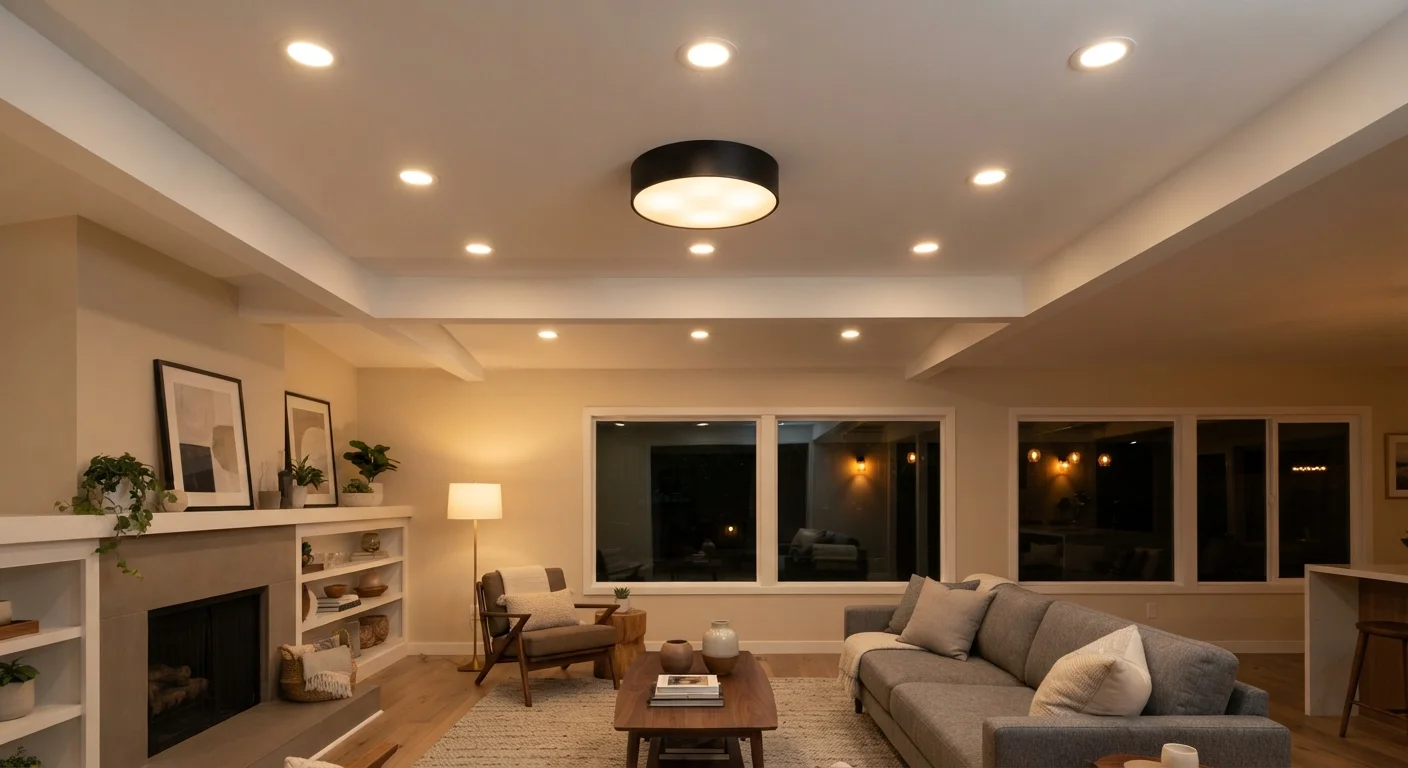
Recessed lighting excels in larger, open rooms where a grid of downlights creates even ambient illumination without any single fixture dominating the visual field. It works particularly well in kitchens, living rooms, and hallways - especially spaces being reimagined with an open layout. If you're reconsidering your floor plan entirely, our guide on open-concept layouts covers how lighting integrates with larger structural decisions.
Surface-mount fixtures come in a wide range of styles - from utilitarian flush-mounts in utility rooms to sculptural semi-flush designs that become focal points in entryways and bedrooms. In rooms with 8-foot or lower ceilings, a pendant-style surface mount can add character without eating into headroom.
Neither approach is inherently superior - the most functional spaces often combine both. Recessed cans provide general ambient coverage while a surface-mount or pendant fixture adds visual warmth and design identity. The goal is light that serves the room's purpose, not a rigid commitment to one system.