

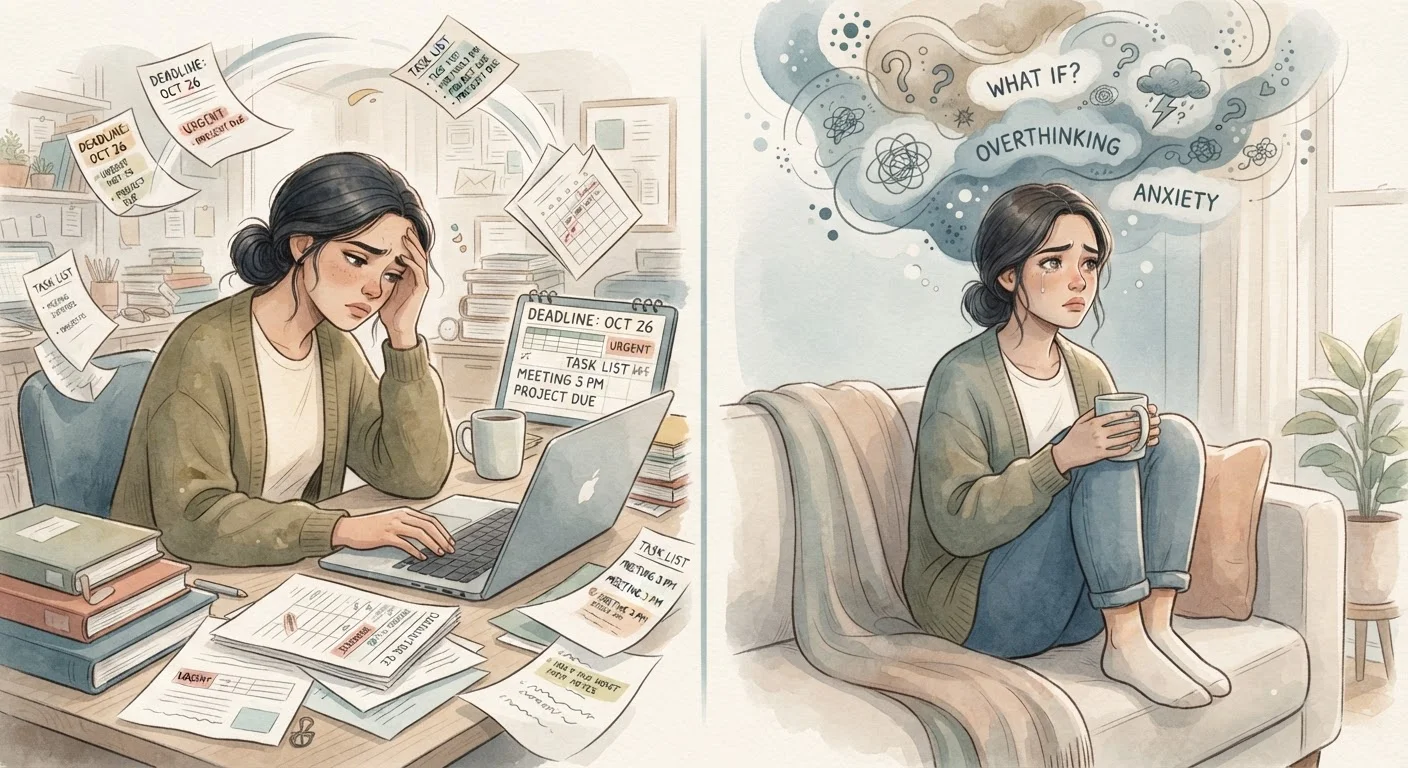
Key Takeaways
Option A
Stress
The body's response to an external pressure or demand.
Best for: Understanding how your body reacts to identifiable, often temporary challenges in your environment.
Option B
Anxiety
A persistent internal state of worry that can outlast its trigger.
Best for: Recognizing when worry feels disproportionate to circumstances and may need professional attention.
If your worry is tied to a specific upcoming event or deadline
Stress
Situational distress that eases once the event passes is most accurately described as stress. Practical coping strategies like time management and rest are often effective.
If worry persists for weeks without a clear cause
Anxiety
Prolonged, free-floating worry that interferes with daily life may indicate an anxiety condition and warrants a conversation with a qualified mental health professional.
If you experience physical symptoms like rapid heartbeat or sleeplessness regularly
Anxiety
When physical symptoms recur independently of specific triggers, anxiety disorders - rather than situational stress - may be contributing. Professional evaluation is the appropriate next step.
If you want to build general emotional resilience
Stress
Understanding how your body handles stress is a practical starting point for building coping skills that support long-term mental wellness.
Why the Distinction Matters
Many Americans use the words stress and anxiety interchangeably, and it's easy to see why - both produce restlessness, tension, and a sense of being overwhelmed. But treating them as identical can lead to misunderstanding your own experience and, more importantly, missing the kind of support that might actually help.
Stress is generally understood as a response to an external pressure: a looming work deadline, a difficult conversation, financial strain, or a health concern for someone you love. It tends to have a clear source. Anxiety, by contrast, is characterized by persistent worry that often continues even when the triggering situation has resolved - or in the absence of any identifiable cause at all.
This distinction isn't just semantic. It shapes how you might respond and, when symptoms are significant or prolonged, whether professional guidance is appropriate. This article is general health information and is not a substitute for advice from a qualified mental health professional.
| Criterion | Stress | Anxiety |
|---|---|---|
| Primary cause | Identifiable external trigger | Internal worry, often without clear cause |
| Duration | Typically resolves with the stressor | Can persist after trigger disappears |
| Physical symptoms | Tension, fatigue, irritability | Similar, plus persistent unease or panic |
| Thought patterns | Focused on current problem | Worry about future, often disproportionate |
| When to seek help | If stress is chronic or overwhelming | If worry interferes with daily functioning |
| Common response strategies | Problem-solving, rest, exercise | Therapy, mindfulness, professional support |
The Biology Behind Both
At the physiological level, stress and anxiety share the same starting mechanism: activation of the body's fight-or-flight response. When your brain perceives a threat - real or anticipated - the hypothalamus signals the adrenal glands to release cortisol and adrenaline. Heart rate increases, muscles tense, and digestion slows.
With stress, this response is generally proportionate and time-limited. Once the external pressure eases, the nervous system typically returns to a calmer baseline. With anxiety, the alarm system can stay switched on even after the immediate threat has passed, or it may fire in response to perceived threats that others might not register at all.
19%
U.S. adults affected by anxiety disorders annually
According to the Anxiety and Depression Association of America, anxiety disorders affect approximately 40 million adults in the United States each year.
~33%
Americans reporting extreme stress levels
The American Psychological Association's ongoing Stress in America surveys have consistently found that a significant portion of adults report stress levels they consider extreme.
Chronic activation of this stress response - whether from repeated stressors or ongoing anxiety - has well-documented health implications, including effects on sleep quality, immune function, and cardiovascular health, according to established research in psychoneuroimmunology. This is one reason mental health experts emphasize addressing both stress and anxiety rather than minimizing either.
When Stress Becomes Anxiety
The boundary between stress and anxiety is not always sharp. Prolonged or intense stress can, over time, contribute to the development of an anxiety disorder. The American Psychological Association notes that anxiety disorders are among the most common mental health conditions in the United States.
Key signs that stress may have shifted into something requiring professional attention include: worry that feels out of proportion to actual circumstances, difficulty controlling anxious thoughts, avoidance of everyday situations, and physical symptoms - like muscle tension or sleep disruption - that persist without a clear stressor present.
If you recognize these patterns in yourself, a licensed mental health professional can provide an accurate assessment. Understanding the difference between stress and anxiety also relates to understanding which therapeutic approaches may be helpful - for instance, our overview of CBT versus traditional talk therapy explains how distinct methods address distinct needs.
Stress, Anxiety, and Financial Pressure
Financial strain is one of the most commonly cited stressors among American adults, and chronic financial stress can contribute to anxiety symptoms over time. If money worries are a source of ongoing distress, understanding the structure of your obligations - such as the difference between secured and unsecured debt - can be a practical first step. Our article on secured vs. unsecured debt provides a clear breakdown. As always, consult a licensed financial professional for advice tailored to your situation.
Practical Ways to Respond to Each
Because stress and anxiety have different roots, the most helpful responses can differ as well.
For situational stress, strategies that directly address the source tend to be effective. These might include breaking a large task into smaller steps, setting boundaries around time commitments, getting adequate sleep, or engaging in regular physical movement - all of which support the nervous system's ability to recover.
For anxiety, particularly when it is persistent or interfering with daily functioning, self-help approaches alone may not be sufficient. Evidence-based therapies, such as cognitive behavioral therapy, have a strong research track record for anxiety disorders. Mindfulness-based practices have also shown benefit in supporting emotional regulation in research settings.
In both cases, social connection, routine, and limiting alcohol and caffeine - which can heighten physiological arousal - are broadly supportive. But if anxiety symptoms are significant, early professional support is generally more effective than waiting. Consult a doctor or licensed mental health professional to discuss what's appropriate for your individual situation.