

Key Takeaways
Our Verdict
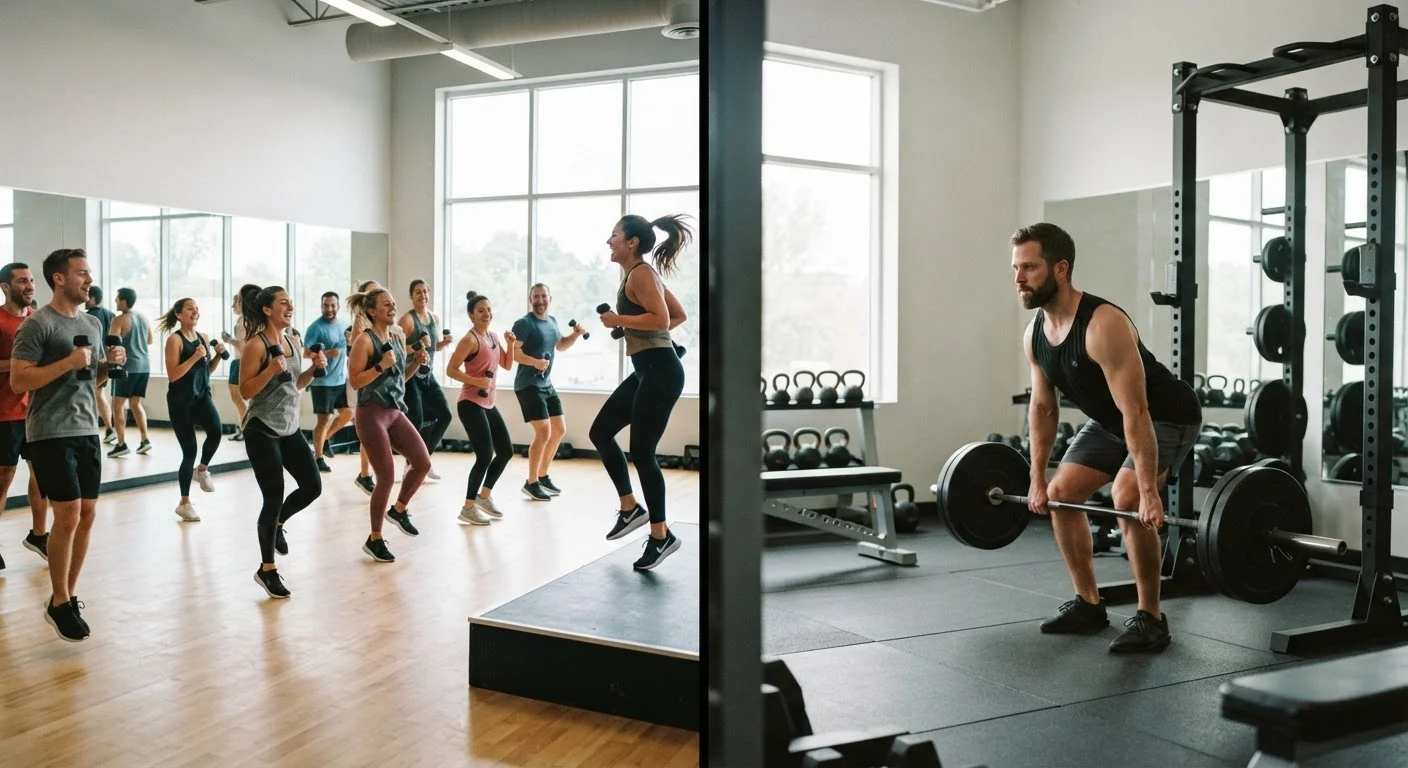
Group exercise classes and solo training each address different needs, and neither is the default right answer. Group formats tend to work best for people who thrive on social energy and external structure, while solo training suits those who value flexibility and self-directed focus. For many people, a thoughtful blend of both produces the most sustainable long-term habit.
| Best for | Recommended |
|---|---|
| Those who struggle with self-motivation or consistency | Group Exercise Classes |
| Those with unpredictable schedules or specific training goals | Solo Training |
| Beginners who want guidance and a welcoming environment | Group Exercise Classes |
| Experienced exercisers managing their own progressive programming | Solo Training |
The Core Difference: Structure vs. Autonomy
At their core, group exercise classes and solo training represent two different relationships with structure. Group classes hand you a pre-designed workout, a qualified instructor, and a room full of people moving alongside you. Solo training puts every decision - what to do, when to do it, how hard to push - entirely in your hands.
Neither arrangement is inherently superior. What matters is which one aligns with how you actually function. If external cues help you show up and push through, a scheduled class removes a layer of daily decision-making. If rigid schedules create friction that eventually leads to skipping, the freedom of solo sessions may keep you more consistent over time. For a structured way to evaluate your readiness before committing to either, see this week-by-week readiness checklist.
| Group Exercise Classes | Solo Training | |
|---|---|---|
| Structure | Pre-designed by instructor | Self-directed, fully customizable |
| Scheduling flexibility | Fixed class times | Anytime, any location |
| Accountability | Social commitment, instructor oversight | Self-reliant; requires internal motivation |
| Personalization | Built for the group average | Tailored to individual goals and limits |
| Beginner-friendliness | Varies by class; can be high or low | Depends entirely on what you choose to do |
| Cost | Gym membership or class fees required | Can be low-cost or free depending on setup |
| Social element | Built-in community and energy | Solitary; minimal to no interaction |
What the Research Suggests About Social Exercise
Studies have consistently found that exercising with others - whether in a formal class or informally with a friend - tends to increase both enjoyment and adherence compared to exercising alone. A frequently cited mechanism is social facilitation: the presence of others can elevate effort and motivation, even when the interaction is minimal.
Group settings also introduce a form of commitment device. When you've signed up for a Tuesday morning yoga class or a spin session, the social expectation of showing up adds friction to the decision to skip. This isn't trivial - habit research suggests that reducing the number of active decisions required to exercise is one of the most reliable ways to sustain a routine.
That said, social exercise isn't universally helpful. For some people, the group environment creates performance anxiety or self-consciousness that undermines enjoyment. Beginners in particular may find certain class formats - fast-paced, high-intensity, or technique-heavy - more stressful than motivating. If you're returning to exercise after a long break, the pace of a group class may need careful consideration.
~26%
Increase in workout output with social exercise
Research published in the journal PLOS ONE found that participants exercising with a partner showed meaningful increases in exercise duration and intensity compared to solo sessions.
~50%
Adults who drop new exercise habits within 6 months
Public health research consistently shows that roughly half of people who start a new exercise program discontinue it within six months, underscoring the importance of format fit.
Where Solo Training Has the Edge
Solo training's primary advantage is control. You can adjust intensity on the fly, extend a warmup, cut a session short when life intervenes, or rearrange your week without coordinating with anyone. For people managing demanding or unpredictable schedules, this flexibility often makes the difference between exercising and not exercising at all.
Solo sessions also allow for more precise progressive overload - the principle of gradually increasing training stress to drive adaptation. If you're following a structured strength program, for instance, you need the ability to track your own loads, rest periods, and rep ranges session to session. Group classes, by design, are built around the average participant rather than your specific starting point or history. If you're curious how strength and endurance work differently, understanding what each training type does can help clarify your priorities.
Solo training also suits people who use exercise as genuine decompression time - a mental reset that requires solitude rather than social energy. Respecting that psychological need is a legitimate part of building a sustainable practice.
Finding What Actually Works for You
The most honest answer to this comparison is: try both before deciding. Many people discover that a hybrid approach - say, two group classes and one or two solo sessions per week - captures the accountability benefits of a class format alongside the flexibility of independent training.
When evaluating group classes, consider the instructor's cueing style, the pace of the class, and whether modifications are offered. A well-run class should feel accessible regardless of your current fitness level. If high-intensity formats appeal to you, read up on what HIIT demands before jumping in, especially if you're newer to structured exercise.
For solo training, the barrier is often knowing what to do. If programming feels overwhelming, starting simple - a consistent walking habit, a few foundational movement patterns, or low-intensity zone 2 cardio - is far more valuable than an elaborate plan you abandon after two weeks.
This article is for general informational and educational purposes only and is not a substitute for personalized advice from a qualified fitness or healthcare professional. Consult a professional before beginning any new exercise program, especially if you have existing health conditions or injuries.