

Key Takeaways
Option A
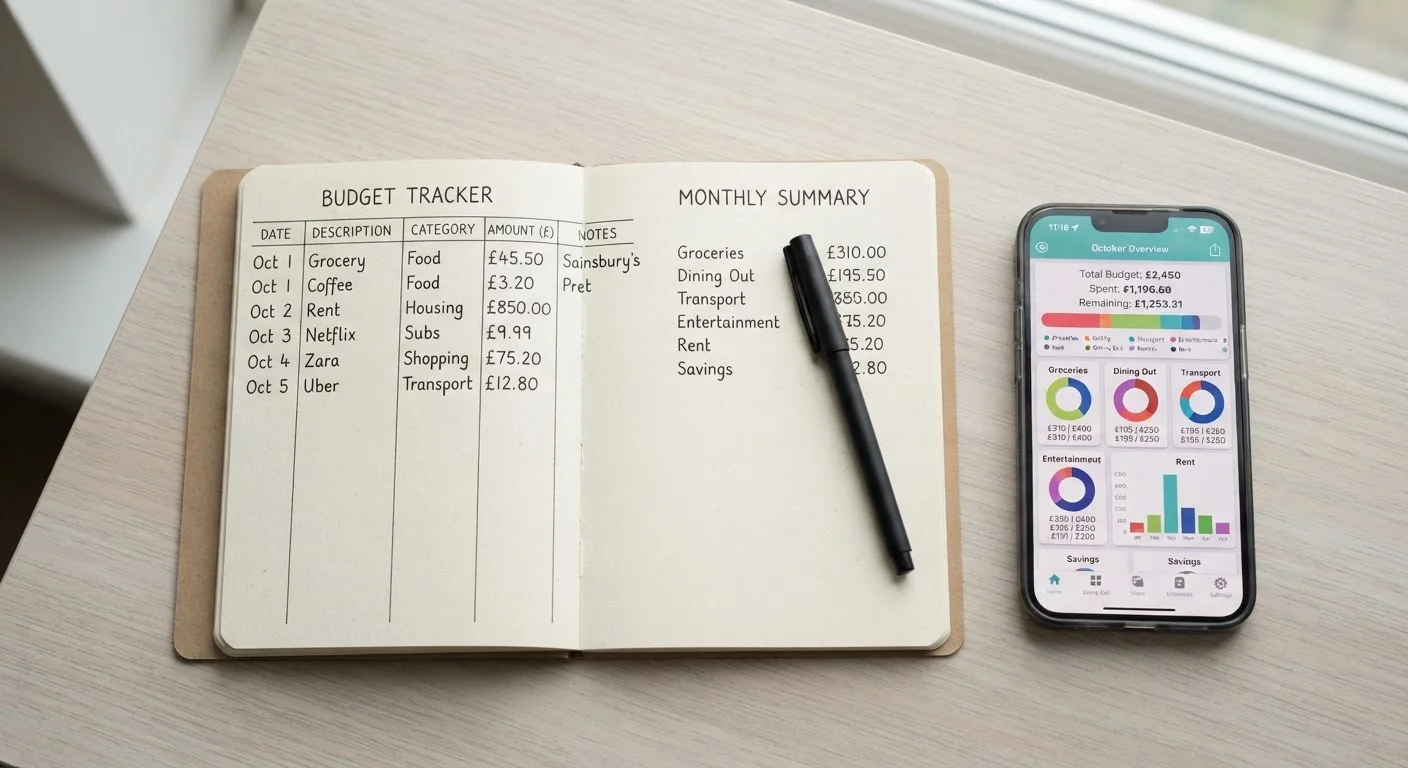
Manual Tracking
The deliberate, hands-on approach to expense awareness.
Best for: People who learn through writing, want full control, or are just starting to build budgeting habits.
Option B
Budgeting Apps
The automated, data-driven alternative for on-the-go visibility.
Best for: People who want real-time transaction alerts, visual breakdowns, and less administrative friction.
If you're building a budget for the first time
Manual Tracking
Writing down expenses forces active engagement with your money, which research consistently links to stronger habit formation in the early stages of budgeting.
If you have multiple accounts and want a consolidated view
Budgeting Apps
Apps can aggregate checking, savings, and credit card activity in one dashboard, reducing the effort of reconciling accounts manually.
If data privacy is a top concern for you
Manual Tracking
Pen-and-paper or offline spreadsheets keep your financial data entirely off third-party servers, eliminating app-related privacy exposure.
If you tend to lose momentum and abandon budgets
Budgeting Apps
Automated transaction imports and push notifications reduce the effort required to stay current, making it easier to maintain consistency over time.
If you want to understand your spending patterns at a deeper level
Manual Tracking
The act of recording each transaction by hand reinforces memory and pattern recognition in ways that passive automation does not replicate.
What Each Approach Actually Involves
Manual tracking means recording every expense yourself - in a notebook, a printed worksheet, or a spreadsheet you maintain. You log each transaction as it happens or in a daily review session, then categorize and tally totals at the end of the week or month. It requires discipline but demands nothing more than a pen or a basic spreadsheet program.
Budgeting apps connect to your bank accounts and credit cards through secure data-sharing integrations and import transactions automatically. Most apps categorize spending, generate charts, and let you set category limits with alert notifications. Some apps also offer goal-tracking features, net-worth summaries, and subscription monitoring. To get started with solid foundational concepts before choosing either method, see our guide to personal budgeting from the ground up.
| Criterion | Manual Tracking | Budgeting Apps |
|---|---|---|
| Setup effort | Low - pen or basic spreadsheet | Moderate - account linking required |
| Ongoing time cost | High - daily entry required | Low - mostly automated |
| Data privacy | Full control, no third parties | Data shared with app provider |
| Spending awareness | High - active, deliberate process | Variable - depends on engagement |
| Error risk | Missed entries from forgetting | Miscategorized auto-imports |
| Best for multiple accounts | Cumbersome to consolidate | Handles aggregation well |
| Cost | Free | Free to paid tiers available |
The Case for Tracking by Hand
The strongest argument for manual tracking is psychological engagement. Studies in behavioral finance consistently suggest that friction - the small effort required to write something down - creates mindfulness around spending decisions. When you physically record a $14 lunch, it registers differently than a transaction silently imported into an app.
Manual tracking also eliminates third-party data exposure. Your financial information never leaves a notebook or a locally stored spreadsheet. For people with legitimate privacy concerns about linking bank credentials to external platforms, this is a meaningful advantage.
The obvious limitation is time. Tracking every transaction by hand across a busy month is genuinely laborious. Missed entries corrupt the record, and catching up after a lapse feels discouraging. Manual tracking tends to reward people who already have structured daily routines.
~1 in 3
Americans who follow a formal budget
Gallup polling has repeatedly found that fewer than one-third of U.S. adults report maintaining a detailed household budget.
73%
App users who report improved spending awareness
A National Foundation for Credit Counseling survey found a majority of budgeting-app users said the tools helped them better understand their spending habits.
21 days
Average before a new habit solidifies
Behavioral research suggests it typically takes several weeks of consistent practice before a new financial routine becomes automatic.
The Case for Using a Budgeting App
Apps reduce the administrative burden of budgeting dramatically. Automatic transaction imports mean you're less likely to miss an expense, and visual category breakdowns make it faster to spot problem areas - a chronically overspent dining category, for example, becomes obvious in a bar chart in a way it might not in handwritten columns.
For people managing complex financial lives - multiple income streams, several accounts, irregular expenses - an app provides a consolidated overview that would take significant manual effort to replicate. Many apps also surface patterns over months or years, helping users identify seasonal spending trends.
The trade-offs are real, however. Apps require linking sensitive account credentials to third-party platforms, which carries inherent security considerations. Miscategorized transactions (a common occurrence) can distort your picture if not corrected. And some people find that passive automation reduces the intentionality that makes budgeting effective in the first place. Our article on the pros and cons of strict spending categories explores a related tension between structure and flexibility.
Making Your Choice - and Sticking With It
The most important factor is consistency. A budgeting method you'll actually use for six months outperforms the theoretically optimal method you abandon after three weeks. Consider your existing habits: if you already journal or keep written lists, manual tracking may slot naturally into your routine. If you rely on your phone for daily task management, an app may feel more sustainable.
A hybrid approach - using an app for passive transaction capture while doing a brief manual review weekly - captures advantages from both methods. This is particularly effective when combined with a regular check-in habit. Our monthly budget review framework walks through exactly this kind of structured check-in.
This article provides general financial education and is not personalized financial advice. For guidance specific to your financial situation, consider consulting a qualified financial professional.